Showing posts with label Black Filmmakers. Show all posts

Wednesday, February 26, 2014

SCREENING: Through a Lens Darkly: Black Photographers and the Emergence of a People


NEW YORK PREMIERE!
Friday, February 28, 2014, 8:00 p.m.

Discussion with director Thomas Allen Harris and photo historian Deborah Willis immediately after screening

Theater 1 (The Roy and Niuta Titus Theater 1), T1
11 West 53rd Street
New York, NY

Summary: 
Inspired by photographer and curator Deborah Willis's groundbreaking book Reflections in Black, this visual narrative reveals how, since the 1840s, photography by African Americans has played a major role in shaping the identity, aspirations, and social emergence of African Americans from slavery to the present. Directed by Thomas Allen Harris. 87 min.


Wednesday, October 16, 2013

IN PRINT: Steve McQueen / Interview / October 2013


Interview | Elvis Mitchell
Photograph | Sebastian Kim

The director Steve McQueen has found a way to constantly include the element of surprise in his work, both as an artist and as a filmmaker. It would be dismissive and reductive to say that he operates on pure instinct, but what he has done with his installations—such as his video pieces Bear (1993) and Five Easy Pieces (1995)—comments on the way that we inhabit space, and how subtly and insidiously shocking it is when our intimate spaces have been violated. He often seems surprised himself when he's asked about the unrelenting power in his work. The three feature films he's responsible for as director—Hunger (2008), Shame (2011), and his latest, an adaptation of Solomon Northup's 1853 narrative Twelve Years a Slave, which is out this month—all explore the notion of having someone's personal space invaded, and how the protagonists in each film deal with that issue.

Given how unflinching his productions have been, the 44-year-old McQueen is remarkably gentle and thoughtful—so much so that he will request a moment to consider a question, and turn it around in his head to get the shape and weight of it, before answering, occasionally with an excited rush of words in response. (And I'm hard-pressed to remember a conversation with him, be it an interview or a chat over tea, that hasn't included a chuckling, "I hope that won't stir up too much trouble ...") That has been my experience with him since we became acquainted a few years back, after the American release of Hunger. He has an insatiable desire to understand and to be understood; if his work stimulates conversation—demands it, really—then so much the better.


Excerpt:

MITCHELL: One image in the film that really sticks with me is when Solomon shatters the violin.

McQUEEN: The violin, to me, is his last remaining hope. It's like the sex scene with the slave that we were talking about—that object was his sense of being human. That was his instrument, that's what he wanted to engage in. And he gives up his hope, in a way, by smashing it.

Well, the violin is also kind of his last link to his old world. There's also that pride that he has in his art—as far as he's concerned, he's an artist—and the idea of an artist giving up his means of achieving that art is heartbreaking.
It's like destroying a piece of yourself in order to feel, I suppose. To feel what? I don't know.

We see Solomon throughout the film as someone who always sees possibilities, and just destroying that violin means that he realizes he can't live for possibilities anymore—that he's just got to be thinking about existing day to day.

Destroying your violin ... I mean, it's just about the worst thing you could do in that situation short of cutting off your hands. The worst thing you could do as an artist is to destroy your art.


Pick up a copy of the October 2013 issue of Interview magazine on newsstands now or read complete interview here.


Friday, September 27, 2013

COVER: 12 Years a Slave / Film Comment / September - October 2013

12 Years a Slave movie still by Franҫcois Duhamel.
British gallery artist/filmmaker Steve McQueen’s 12 Years a Slave unsparingly portrays a crime of historical magnitude

Interview by Graham Fuller

Excerpt:

Was anger a personal motivation for your making the film?

What motivated me more than anything was a sense of love, strange though that sounds. It’s a word that doesn’t get used often in this context. It was a sense of wanting to embrace the sin of slavery and make myself comfortable with it – and not just myself, of course. It’s like fire. It’s dangerous, but I wanted to embrace it.
Why love and not rage?
To tame it, to master it. It sounds odd, but it’s the truth.
In you filmed artworks, such as Bear (1993), Just Above My Head (1996), and Exodus (1997), there’s an enigmatic quality about your presentation of black men – their status, their interrelatedness, their effect on the spectator. With 12 Years a Slave, were you conscious of wanting to make a more explicit statement about the subjugation of blacks?
No. It is a fact, so I didn’t have to do anything. My job was to visualize a historical moment that for me hadn’t been visualized, that hadn’t been reconciled with. When people talk about slavery, they don’t change anything. When you visualize something, it does something extra to it. That for me was the sole purpose of making the movie.

12 Years a Slave in theaters October 18th.

To read complete interview pick up a copy of the September-October issue of Film Comment on newsstands now on order online here.


Monday, June 17, 2013

SCREENING: 110 Morningside


Friday, June 28, 2013, 6:30pm

THE FREDERICK DOUGLASS RESOURCE CENTER
36 King Street
Rochester, NY
(585) 497-6139

The Frederick Douglass Resource Center will screen the Nicholle La Vann documentary “110 Morningside” from 6:30 p.m. to 9:30p.m. The documentary is based on the life of poet, teacher, author and founding member of The Last Poets, Abiodun Oyewole.

This two-day program is an extension of the center’s exhibit entitled The Price of Freedom Is Death: Black Aesthetic Art Show 2013, which opened on May 18, 2013, and focused on the critical aspects of and personalities in the Black Arts Movement of the 60s and 70s.

Abiodun Oyewole is scheduled to attend the film screening and will also participate in the Rochester Black Arts Council’s (RBAC) closing program scheduled for the 29th, from 6 p.m. to 9 p.m., The Black Aesthetic: The Search for Self in the 21st Century.

This is an extraordinary opportunity to meet and greet one of the pioneers/icons of the Spoken Work/Hip-Hop genre, and glean from his over 40 years of experience in the arts arena.

Admission is $15 for both days, or $10 each if purchased separately.


The Frederick Douglass Resource Center is committed to articulating the life and legacy of Frederick Douglass and African American heritage and culture. Through culturally conscious, educational programming, we will effect positive change as it relates to self-image and esteem, community, economic viability and true social justice. With Frederick Douglass serving as our guide, we endeavor to continue the legacy of promoting excellence in education and service to the commUNITY.


Monday, November 19, 2012

CAPTURED: Tom Burrell and Deborah Riley Draper

Photo © 2012 BlackArtistNews. All rights reserved. 
Advertising executive and author Tom Burrell was among the VIP attendees for a screening of Deborah Riley Draper’s documentary "Versailles '73: American Runway Revolution" held November 13, 2012 at Columbia College Chicago. 

The film chronicles the events surrounding a 1973 benefit fashion show that featured American and European designers. The production was organized in order to raise money for the restoration of the Palace of Versailles in France but -- more importantly -- resulted in the international acceptance of American ready-to-wear clothing. The designers and historians unanimously cite the role of the models (the majority of whom were black) for "putting American fashion on the map."

After the screening, Draper introduced members of the cast and crew: Caraline Robinson, Executive Producer; Tamara Houston, Co-Producer; Mikki Taylor, Beauty and Style expert and Editor-at-Large for ESSENCE magazine; and Charlene Dash, Norma Jean Darden and Pat Cleveland three of the models who worked the runway at Versailles.


View more BlackArtistNews photos of the Chicago screening of "Versailles '73" here.


Versailles '73: American Runway Revolution available on DVD February 5, 2013.


Monday, October 15, 2012

HOT LINKS: October 15, 2012


Rashid Johnson, 6th of August, 2012, branded red oak flooring, black soap, wax, 96.5 x 132.5 x 3 inches. (Fredrik Nilsen / David Kordansky Gallery) Image via LATimes.com


Over the past few days, the following news items caught the attention of BlackArtistNews:

(L.A. Times)


(PBS.org)

(ChicagoReader.com)

(CarolinaAlive.com)

(TheCincinnatiHerald.com)

(HuffingtonPost.com)

(Richmond Times-Dispatch)

(Oregonlive.com)

(Evansville Courier & Press)

(JacksonFreePress.com)


Tuesday, March 20, 2012

GENESIS: Shelton Jackson Lee / March 20, 1957

Jessica Rycheal, A Spike Lee Joint, Vector illustration, 2012 via JessicaRycheal.com

PORTRAIT BY JESSICA RYCHEAL
Everybody knows that Spike Lee is an important filmmaker, but do they realize how good he is with actors, and how innovative he is with style? We live in a period when many filmmakers use either a straightforward meat-and-potatoes style, or draw attention with meaningless over-editing, queasy-cams and showboat shots. With Lee, as with any classical director, the emphasis is on the story and the people. But he's always there, nudging us, being sure what we notice, moving his camera not merely with efficiency but with grace and innovation. Because he doesn't go out of his way to call attention, how many realize what a master stylist he is?

~Roger Ebert


Friday, December 2, 2011

VIDEO: The Confessions of Steve McQueen by Alison Chernick


The Artist and Filmmaker’s Dark Parable On the Shame of Sex Addiction

Cornered in his hotel room during the Toronto Film Festival, the ever-provocative
Steve McQueen ruminates on free will, desire and his film "Shame" in Alison Chernick’s latest short. Recipient of the Camera d’Or and Fipresco prize for debut feature "Hunger," McQueen has earned a reputation as one of our most prolific and challenging visual artists, winning The Turner Prize in 1999 for his short black and white film "Deadpan," and representing Britain at the 2009 Venice Biennale. Co-written with Abi Morgan (Brick Lane), the director’s sophomore feature takes an unflinching look at the destructive nature of sex addiction, following Michael Fassbender’s corporate drone Brandon through a solitary routine of meaningless sexual encounters and the fallout that occurs when his equally damaged, self-harming sister Sissy (Carey Mulligan) comes to stay. “I wanted to discuss the theme of imprisonment in his films—in this case psychological," reveals Chernick. "But after seeing 'Shame' I was more focused on the collide between morality and addiction, where one ends and the other begins.”


"Shame" in select theaters December 2

Source


Monday, October 31, 2011

POST: The Struggle for the "Most Dangerous Film Festival in the World" / Chicago Sun-Times / October 31, 2011


Filmmaker struggled to put on 'dangerous' Englewood film fest
by Mark Konkol Staff Reporter for the Chicago Sun-Times
October 31, 2011

Filmmaker Mark Harris knows outsiders fear his neighborhood.

“The reputation Englewood has — it’s one of … it’s the worst community in Chicago,” he said. “And people who aren’t from Englewood don’t want to come here because they fear for their lives, which we can all understand. Englewood is dangerous. We all know that.”

But the thing is, folks still live there. They’re not all criminals. They even have fun sometimes. And get this, Harris said: They like movies, too. 

Harris, who lives in Englewood just a few blocks from where he grew up, says his neighbors need — heck, deserve — reminders that there’s hope amid all the hopelessness and despair.

More than anything, that’s what inspired the 39-year-old to organize the inaugural Englewood Film Festival, two days of movies and seminars that ended Saturday with a screening of “The Interrupters,” a documentary about Chicago’s urban “violence interrupters” that was filmed in the neighborhood.

“If you want to be an example, because really this is about the children of Englewood, you have to show people something different, a different attitude that they haven’t seen,” Harris said. “If we can change collectively that condition of people in Englewood, how can that change Chicago as a whole?”

But change doesn’t come easy, not in such a hardscrabble place.

Harris, a Tilden High School graduate who has produced, written or directed more than 10 movies including “Show Stoppers” and “I Used to Love Her,” sent letters to all 50 aldermen, passed out fliers, solicited businesses and non-profits and even asked certain celebrities who came from Chicago’s toughest neighborhoods for support. He asked friends and business associates to donate their time or cash or at least buy tickets in advance. The festival needed financial backing, of course, but what Harris wanted most was for city and community leaders to be either festival partners or pledge to show up.

Harris got nice letters from Mayor Rahm Emanuel and Gov. Pat Quinn. And that’s it.

It was like he was trying to create “The Most Dangerous Film Festival in the World.”

“I got more encouragement from brothers on the corners with sagging pants and white T-shirts than anyone in the political community,” Harris said. “They seemed excited. They said, ‘Continue to do your thing.’ ”

So he did.

The only two organizations that had agreed to be festival sponsors backed out.

Advance ticket sales were slow and Harris couldn’t convince folks at the original location, Kennedy-King College, to reduce rental fees. “They would not give us one free seat. Nothing at all,” Harris said.

Harris considered canceling the festival, but his partner on the project, Khadeejah Tasheen, insisted he didn’t give up.

“There were no sponsors,” Harris said. “Well, Reggio’s gave us three pizzas. I had to beg for that because I’m broke. My staff needed to eat.”

Harris says the lack of response, even from people he considers friends, sends an alarming message: “They don’t think there’s any hope for Englewood.

“Sponsors look at a film festival and don’t think the people of Englewood will support something like this. They don’t think people on the outside will either. They don’t want to attach their brand to an event like this if they think something, something violent, may happen,” he said. “That was my struggle.”

And for Harris that led to moments of doubt.

“I started asking myself, ‘Why are you doing this?’ ” he said. “And the truth is I don’t know why sometimes.”

With two weeks to go, Harris relocated the festival to Lindblom Math and Science Academy at 62nd and Wolcott. After hearing about the festival’s troubles from a parent, Lindblom Principal Alan Mather agreed to rent the auditorium to Harris at cost.

“We have the most beautiful auditorium in the city. It’s a gorgeous space and should be used, and sadly, it’s underutilized,” Mather said. “If [newspapers] only produce statistics of violence then that’s all people will think Englewood is going to be. There are wonderful things and wonderful people in Englewood.”

The festival had a new, affordable home. Harris made the right choice. If you don’t give up, you don’t have regrets.

“What took place leading up to the festival, I wouldn’t change a thing,” he said. “It taught me about myself. Yeah, I wanted to strike back when I didn’t get support … but you know there has to be something greater than our ego and something greater than our anger. It taught me a lot of patience and a lot of discipline to do what’s best … and not just what’s best for my own emotions.”

The Englewood Film Festival opened on Friday night.

There were no banners hung outside the entranceway to Lindblom — a Classical Revival-style building built in 1919 with city landmark status that is across the street from four boarded-up houses.

The festival programs were printed on plain, white paper. And there was no red carpet to walk. Instead, those in attendance, more than 200 people, walked past disconnected metal detectors to the auditorium screening room.

It wasn’t fancy. It wasn’t a sellout. But Harris says he could see the weekend for what it was: a success.

Think about it. Englewood — the place better known as a murderous, drug-dealing, gangbanging hellhole on the South Side — was home to its own artsy, independent film festival.

No one was shot — and people had fun.


Harris says he’s ready to do it again next year. He doesn’t think it will be such a struggle.
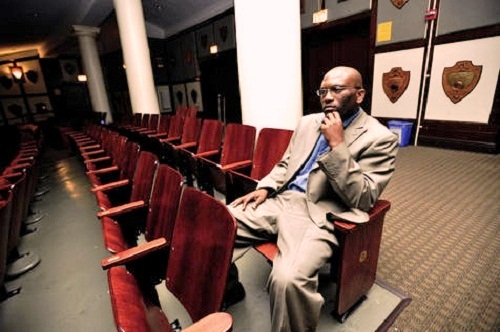
Filmmaker Mark Harris, founder of the Englewood Film Festival. Photo by Brian Jackson/Chicago Sun-Times.


Thursday, September 8, 2011

EVENT: Kevin Jerome Everson / Artist Talk and Screening / Whitney Museum / September 8, 2011

Kevin Jerome Everson, production still from The Equestrians, 2011. Super 8 film, color and black-and-white, silent; 12 minutes. Image courtesy of the artist and Picture Palace Pictures.


THURSDAY, SEPTEMBER 8, 2011  7 PM


Artist Kevin Jerome Everson works in a variety of media, including film, painting, sculpture, and photography, exploring aspects of everyday life. Some of his films are constructed from appropriated news and film footage, bringing to light forgotten details of the experiences of African-Americans from the Great Migration to life in the 1960s and '70s. Everson, whose work was included in the 2008 Whitney Biennial, approaches the topics of race, sexuality, and economic conditions in observant and insightful ways. his latest exhibition at the Whitney Museum, More Than That: Films by Kevin Jerome Everson, explores his interest in labor and its relationship to class, identity, and the human body. Join the Whitney Museum for a conversation with the artist and curator Chrissie Iles. A screening of Everson's latest project will follow the talk.

This program is free; registration is recommended.


Saturday, September 3, 2011

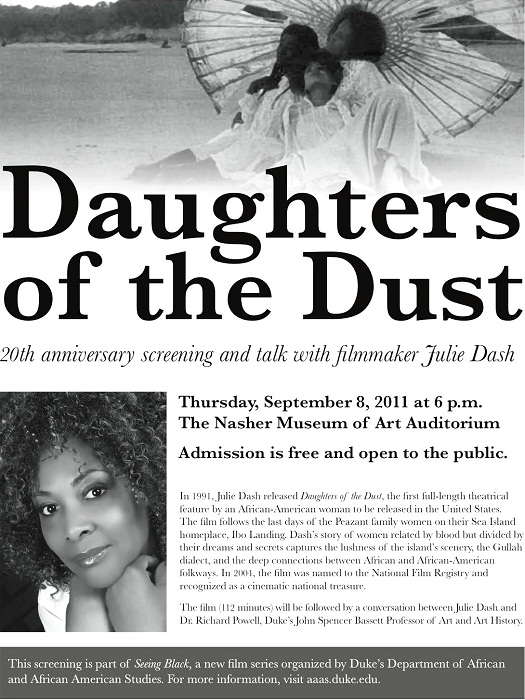
EVENT: Daughters of the Dust / Screening & Talk with filmmaker Julie Dash / Nasher Museum of Art / September 8, 2011

Los Angeles-based filmmaker Julie Dash will discuss her film "Daughters of the Dust" on the 20th anniversary of its release during the film's screening on Thursday, September 8, 2011.

The film, which kicks off the Duke African & African American Studies (AAAS) department's "Seeing Black" film series, will be shown at 6 p.m. at the Nasher Museum of Art. A discussion with Dash and art history/AAAS professor Dr. Richard Powell will follow the screening. The event is free and open to the public.

"With the spirited public conversations about films like 'Precious,' 'For Colored Girls,' and most recently 'The Help,' it's clear that the moving image continues to be one of the critical sites of interest about the preservation and dissemination of images of black humanity," said Dr. Mark Anthony Neal, black popular culture professor and event co-organizer.

"Daughters of the Dust," released in 1991, was the first full-length feature by an African-American woman to gain national theatrical release and was named to the National Film Registry, a collection of films deemed by the Library of Congress to be national treasures.

The film draws on Dash's South Carolina heritage and focuses on three generations of women with roots in the Sea Islands and Gullah culture. Set in 1902, "Daughters of the Dust" grapples with slavery's legacy, migration, sexual abuse and sexual freedom, and maintaining tradition amid modern pressures. The film was critically acclaimed for its lush visuals of the Sea Islands, its use of language and unique narrative voice.

Dash's visit will also include classroom and other student-centered screening of her short film, "Praise House," a collaboration with the founder and choreographer of Urban Bush Women.

"Daughters of the Dust" is the first film of the 2011-12 African American Studies film series, curated by Dr. Mark Anthony Neal and graduate student Cynthia Greenlee-Donnell. In October, the series will show "Handsworth Songs" (1986), an experimental film documenting the 1985 racial unrest in Britain.

Sunday, August 21, 2011

GENESIS: Melvin Van Peebles / August 21, 1932

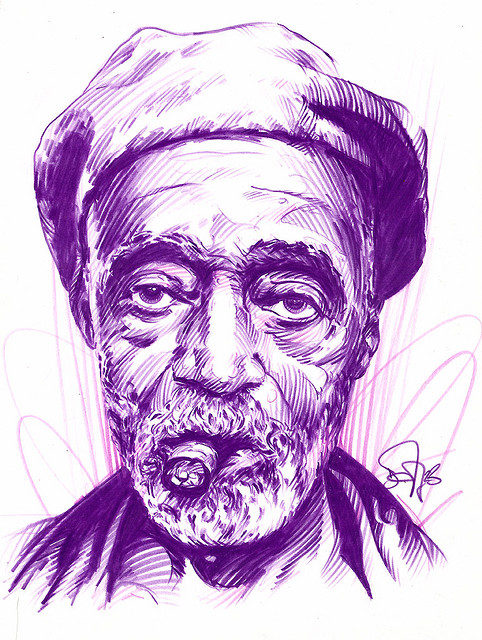
Melvin Van Peebles by Dan23. © 2009 All rights reserved.
"I started this so called life as a painter and a sculptor. What I discovered as time went on was that I didn't feel that painting allowed me to talk to the people I wanted to talk to. So I said, 'Shit, I'll go into movies.'" -- Melvin Van Peebles

Wednesday, August 10, 2011

EVENT: "Bearden Plays Bearden" Film Screening / Studio Museum in Harlem / August 11, 2011

Thursday August 11th 7:00pm
Summer of Music: Harlem Outdoor Music and Screening Series
  

The Maysles Cinema Presents


In Honor of the Centennial of Romare Bearden's birth, September 2, 1911.
The Studio Museum in Harlem In Collaboration with the Maysles
Cinema Presents:
 @ The Courtyard at the Studio Museum 
144 West 125th Street

7:00pm Music:
DJ Ski Hi
(100 years of music)

8:30pm Screening:
Bearden Plays Bearden
Billie Allen and Nelson E Breen, 1981, 60 min.
Features conversations with Ntozake Shange and Joseph Campbell,among others, about Romare Bearden and his legacy as well as Bearden's own observations and time with him in his studio. A painter, collagist, muralist, and set designer whose influence reverberates still, Romare Bearden, one of the founders of the Studio Museum and a featured artist in the current exhibition Spiral: Perspectives on an African-American Art Collective, is widely recognized as one of the most important artists of the twentieth century.


Food and drink will be available for purchase in the Atrium Cafe.


Maysles Cinema | 343 Lenox Ave/ Malcolm X Blvd. | New York | NY | 12345
The Maysles Cinema was founded by documentary filmmaker Albert Maysles 
and is co-directed by Jessica Green and Philip Maysles.

Links:


Monday, July 11, 2011

PROPS: CLAM magazine

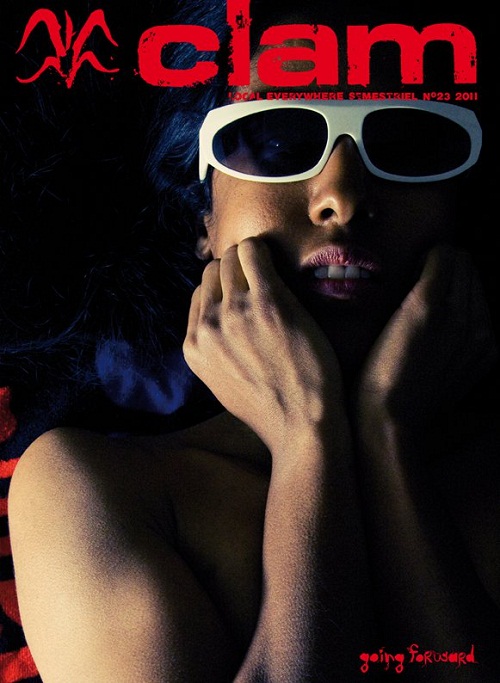
The Spring/Summer 2011 issue of CLAM magazine. Photograph by Andrew Dosunmu. 

CLAM magazine founder and publisher Andy Amadi Okoroafor truly understands the meaning of "globalism.” Each issue introduces readers to individuals from various parts of the world who are dedicated to their personal mode of expression – artists, models, photographers, musicians, writers and activists are the norm but a Q&A with an Asian immigration detainee in Australia (in the Spring/Summer 2011 issue, pictured above) is a prime example of the magazine’s real sense of inclusion. There is usually one advertisement per issue, no table of contents, no mass head, no contributor’s page, but each issue has a theme and all the interviews are conducted with that theme in mind. Arguably, when reading CLAM it could be to your advantage to be bi- or multi- lingual: the magazine prints the interview subject's response in their native tongue. But don’t let that stop you from purchasing a copy of this excellent magazine because the photographic and artistic imagery  – of which photographers Andrew Dosunmu and Marc Baptiste regularly contribute – translates successfully in any language.


The CLAM magazine concept:
CLAM is a unisex magazine whose goal is to promote creativity, concepts and ideas in fashion, architecture, music, design, the arts, free-time, travels and African design. These different themes are approached in two main areas: Lifestyle and Trends. Each subject is part of an original and conceptual artistic direction. The concepts are presented through the expression of the artists and creators coming from very different horizons.The place accorded to the image is central: to be unusual, so as to create constant surprise for the viewer. Experimentation is one of the characteristics of CLAM which explains its layout: always changing, never fixed. CLAM wants to encourage creative reflection. The presentation is based on ideas and not seasons. This concept confers to the magazine as a collector's item. 

Publisher Andy Okoroafor on the CLAM concept:
"The fashion and visual creative worlds are very closed, our vision was to make them open and bring more interesting views out to the fore… Also we wanted to create a global platform for creative people to discover each other...then finally we wanted the create a place for information on creativity in an honest non elitist fashion ..while using the same elitist tool, very tricky!!" 

LINKS:

Thursday, June 9, 2011

VIDEO: Nelson George's "Migrations" Trailer


This is the trailer for filmmaker Nelson George's work-in-progress feature "Migrations". So far, prinicple shooting has been completed in Berlin, Paris, London and New York with plans to shoot in Brooklyn, Los Angeles and Ethiopia before the end of 2011. George describes it as "a film about the African diaspora in all its complexity." It stars Tigist Selam, Saul Williams, Osas Ighoduro, Epee Dingong and Ariane Plubel.

Tuesday, June 7, 2011

COVER: Ava DuVernay / CINEMATIQ / Spring 2011


CINEMATIQ MAGAZINE SECOND ISSUE FEATURING AVA DUVERNAY
CHANGING THE GAME WITH AFFRM!
CINEMATIQ, a new quarterly resource magazine with a distinct perspective in Black Cinema presents their 2nd issue honoring Forty Fascinating Women in Film and Television. Four decades of women behind and in front of the lens compiles the list: 1970’s Soul Cinema, 1980’s Primetime Players, 1990’s Black Are Beautiful and Millennium Women. Ava DuVernay graces the spring issue of CINEMATIQ magazine. She is the founder of the newly formed African-American Film Festival Releasing Movement (AFFRM) and director of “I Will Follow” featuring Salli Richardson-Whitfield, Michole White, and Beverly Todd.  The magazine is available in print only and  is available exclusively at www.cinematiqmag.com.
“This issue is very special to me. It highlights many of my favorite childhood to adulthood Black Women in Film & Television,” explained Angel L. Brown-Ross, Editor-In-Chief of CINEMATIQ. “I also had an amazing time and learned a lot, interviewing Leslie Harris who wrote, produced and got her film, “Just Another Girl On The I.R.T.” distributed in the 90’s.” “ I am super excited about REEL READY, guest columnist, Leyla T. Rosario, cinematographer of the new series, “The Bridge.” It is particularly essential for this magazine to highlight as many women cinematographers, producers, writers, women in general ‘behind’ the lens, showing one range/ depth and knowledge of the art; something I plan to cover in every issue.”
About CINEMATIQ Magazine (http://www.cinematiqmag.com/subscribe.php) Founded and created by Angel L. Brown-Ross, CINEMATIQ is a quarterly resource magazine with a distinct perspective in Black Cinema.  CINEMATIQ will cover the vast selection of films from independent films to mainstream.  In each issue, readers will find; interviews, film and equipment reviews, reviews focusing on topics ranging from development to distribution, resources and support for independent producers seeking funding for their projects.  The magazine is currently in print exclusively at http://www.cinematiqmag.com/ and will soon be available in stores.