Showing posts with label Romare Bearden. Show all posts

Wednesday, March 19, 2014

NEW YORK: Romare Bearden

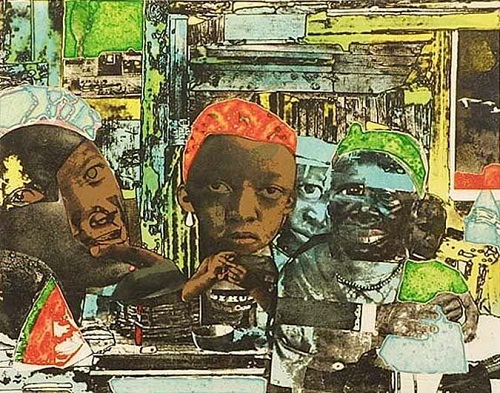
Romare Bearden, Artist with Painting and Model, 1981, Collage with mixed media, 44 x 56 inches. Image via dcmooregallery.com. 
Insight and Innovation
March 20 – April 19, 2014

Opening reception: Thursday, March 20, 2014, 6:00 – 8:00pm

535 West 22nd Street
New York, NY

From the DC Moore Gallery web site:

DC Moore Gallery is pleased to present Romare Bearden: Insight and Innovation, an exhibition that presents some of the finest examples of Bearden’s work in collage, watercolor, and oil, highlighting his mastery of multiple artistic techniques and mediums. While probably best known for his powerful collages, Bearden also created modernist tempera paintings, lyrical abstractions, photographic enlargements that he called Projections, lush watercolors, and jazz and blues monotypes. 

In 1981, Bearden (1911-1988) completed a unique, large-scale collage titled Artist with Paintings and Model that is both a visual autobiography and his only known self-portrait. Depicting himself holding a brush with his arm draped over a painting, he identified the collage as a view of his studio around 1941. Motifs that allude to his artistic training and art historical sources appear throughout, in an evocative narrative of personal history.

The painting on the easel in the collage is a depiction of The Visitation of 1941, a strongly modernist tempera on paper that, along with a group of about twenty others, was the first time that Bearden focused on Southern themes and childhood memories, which became the foundation of much of his later work in collage. Through the interplay of abstraction and representation, the painting presents the biblical story of the visit of the Virgin Mary to her cousin Elizabeth as an everyday encounter between neighbors, set in the hills of North Carolina.

Seen together in this exhibition, The Visitation and Artist with Painting and Model are major artistic statements that offer a rare opportunity to view key works created by Bearden at the beginning of his career and when he was a mature artist. 

After working in varying degrees of abstraction in the 1940s and 1950s, Bearden entered a decisive new phase during the turbulent decade of the 1960s. Inspired by the momentous social and political developments at the time, and the formation of Spiral, an African American artist’s group, he launched wholeheartedly into collage and photomontage, which he soon developed into a series of large-scale photostats that he called Projections. 

His earliest collages are relatively small in size and composed almost entirely of images cut from magazines and newspapers. Rooted in Cubism and Dada collage, they are characterized by bold fragmentation and fractured forms, irregular scale and proportion, and complex layering of motifs. When blown up as photostat Projections, they became powerful black and white photographic images that resonate with an immediacy that reflects the churning and often clashing cultural currents of the decade. 

By the late 1960s, Bearden was generally working on a larger scale and constructing spaces that were more suggestive of actual places. In Big Sister of 1968, he evokes a moment shared by two sisters, probably inspired by memories of his youth in Mecklenburg County, North Carolina, in which the girls are the central focus of a room of fractured forms, flattened space, and tilted tabletops.

Bearden’s collages brought him national recognition and established his reputation as a leading contemporary artist. At the same time, he added a new dimension to his art in the 1970s by painting lush watercolors on tropical themes inspired by visits to the Caribbean island of St. Martin, the ancestral home of his wife, Nanette. 

From about 1974 to 1983, Bearden also created freely worked, broadly painted, and highly expressive monotypes. Jazz and blues themes predominate, as in Kansas City Walking Bass, which captures the essence of a performance through the fluid application of paint.

Bearden’s more painterly approach is also seen in many of his collages from the 1980s. Two landscapes from 1983, September – Sky and Meadow and October – Towards Paw’s Creek are excellent examples, bold, richly textured works rendered in the fall palette of North Carolina, with a density that heightens their seasonal intensity. 

Recognized as one of the most original visual artists of the twentieth century, Romare Bearden has work in public collections across the country, and has had a number of major retrospectives, including a comprehensive traveling exhibition organized by the National Gallery of Art in 2003. Most recently, the Mint Museum of Art in Charlotte, North Carolina organized a traveling exhibition in 2011, in honor of the centennial of the artist’s birth.

DC Moore Gallery is the exclusive representative of the Romare Bearden Estate and Romare Bearden Foundation.


Saturday, March 15, 2014

NEW YORK: Rising Up/Uprising

Charles Alston, Magic in Medicine: Study for Harlem Hospital Mural, NYC, 1936,graphite on paper, 16 3/4 x 13 1/2 inches (sheet size), 14 3/4 x 12 1/8 inches (sight size), signed. Image via michaelrosenfeldart.com.
Twentieth Century African American Art
March 15 – May 3, 2014

Opening Reception:  Saturday, March 15, 2014, 5:00-7:00pm

100 Eleventh Avenue at 19th Street
New York, NY

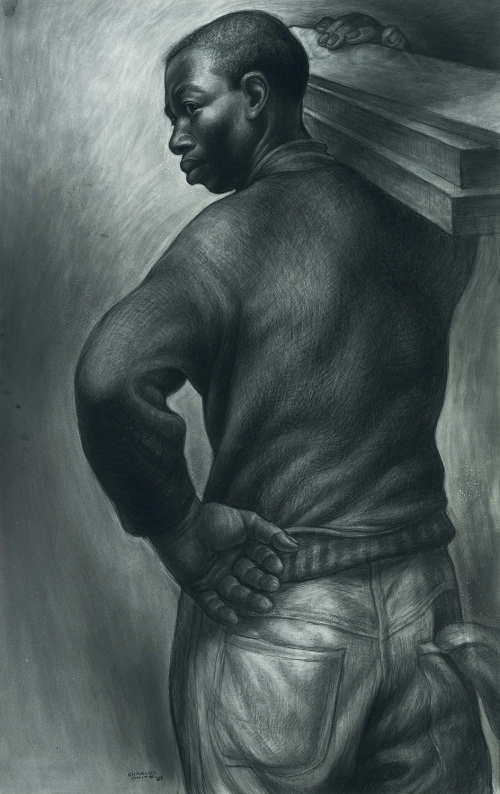
Featuring works by Charles Alston, Benny Andrews, Romare Bearden, John Biggers, Selma Burke, Elizabeth Catlett, Robert Colescott, Eldzier Cortor, Ernest Crichlow, Beauford Delaney, Aaron Douglas, William H. Johnson, Jacob Lawrence, Norman Lewis, James A. Porter, Betye Saar, William E. Scott, Alma Thomas, Bob Thompson, Charles White and Hale Woodruff.

Rising Up/Uprising is the second exhibition in a two part series commemorating the fiftieth anniversary of the Civil Rights Act of 1964.

Beyond the Spectrum: Abstraction in African American Art, 1950-1975 was on view January 9 to March 8, 2014. 


Wednesday, July 11, 2012

ALLIANCE CONFERENCE 2012: The Saint Louis Art Museum / July 12-15


Broad range of art experts and connoisseurs brought together for the 12th National Alliance of African and African American Art Support Groups 

The Saint Louis Art Museum will play host to “Navigating the Mainstream: Learning from the Past, Looking to the Future,” the 2012 convention of the National Alliance of African and African American Art Support Groups, on July 12-15.  

Over three days, more than 25 prominent artists and scholars will discuss the rich history and development of African and African American arts. Conference panels and presentations will also address the best practices regarding the collection and preservation of these works as well as their presentation and interpretation, especially in mainstream museums. 

In one such panel, distinguished scholar Dr. David Driskell, professor emeritus of the University of Maryland, will discuss his role in assisting many organizations and individuals in assembling art collections, most notably the Camille and Bill Cosby Collection and the Driskell collection. In 1995, Dr. Driskell supervised the White House’s first purchase of a work of art by an African American artist. 

In addition to engaging in critical discussion and reflection, conference participants will explore surrounding arts organizations such as Theaster Gates’s Rebuild Foundation, located and active in the Hyde Park neighborhood. Rebuild Foundation brings together artists, architects, developers, educators, and community activists throughout the Midwest to affect creative community change. 

The conference will also celebrate the 20th anniversary of the Saint Louis Art Museum’s Romare Bearden Graduate Minority Museum Fellowship. The fellowship was named for African American artist Romare Bearden, who supported young and emergent artists throughout his life, with the goal of preparing minority graduate students for careers in arts and cultural institutions.   

The National Alliance Conference coincides with the summer exhibition of renowned print artist Kara Walker’s Harper’s Pictorial History of the Civil War (Annotated) by KaraWalker. Featured in Gallery 321 until August 26, 2012, Walker’s prints explore historical and contemporary views of the Civil War through parataxis.  This exhibition was co-curated by the 2011-2012 Romare Bearden Graduate Minority Fellow.  

For more information on the conference, including schedules, guest speakers and registration, visit slam.org/bearden2012. Follow the conference on Twitter at @Bearden2012


The Saint Louis Art Museum is one of the nation’s leading comprehensive art museums with collections that include works of art of exceptional quality from virtually every culture and time period. Areas of notable depth include Oceanic art, pre-Columbian art, ancient Chinese bronzes and European and American art of the late 19th and 20th centuries, with particular strength in 20th-century German art. The Museum offers a full range of exhibitions and educational programming generated independently and in collaboration with local, national and international partners.  Admission to the Saint Louis Art Museum is free to all every day. For more information about the Saint Louis Art Museum, call 314.721.0072 or visit  slam.org.


Thursday, October 6, 2011

AUCTION: Romare Bearden / Train Whistle Blues / Swann Galleries / October 6, 2011

Romare Bearden, Train Whistle Blues, watercolor, pen, pencil and collage on wove paper, circa 1979.
On October 6, 2011 Swann Galleries will feature Romare Bearden's Train Whistle Blues in the African-American Fine Art sale, a lot valued at $20,000 to $30,000.

Tuesday, September 27, 2011

BEARDEN GOES POSTAL: US Post Office To Issue Romare Bearden Commemorative Stamps on September 28, 2011

Ordering First-Day-of-Issue Postmarks
 
Customers have 60 days to obtain the first-day-of-issue postmark by mail. They may purchase new stamps at their local Post Office™ facility, at The Postal Store® website at www.usps.com/shop, or by calling 800-STAMP-24.  

Thursday, September 22, 2011

VIDEO: Charlie Rose - An Appreciation of Romare Bearden / January 24, 2004


This 2004 broadcast of The Charlie Rose Show focuses on the work of artist Romare Bearden and the exhibit The Art of Romare Bearden with exhibition curator Ruth Fine, photographer Frank Stewart, and musician Branford Marsalis.


Friday, September 16, 2011

FIVE: Elizabeth Alexander

“FIVE” is a special feature at BlackArtistNews where five questions are posed to an individual artist, curator, gallerist, collector or art lover. Why five questions? Well, there are five fingers on each hand and artists create with their hands hence one, two, three, four, FIVE. 

Elizabeth Alexander. BlackArtistNews photo. All rights reserved.
Elizabeth Alexander is a builder of words. She frames them into poetic structures that house memory and metaphor. Few Americans were aware of this before January 20, 2009 the day when the award-winning poet and Yale University professor recited "Praise Song for the Day" at the presidential inauguration for Barack Obama. Alexander is also a devoted art lover; her books are cloaked in works by Henry Ossawa Tanner, Elizabeth Catlett and Romare Bearden, an artist she has applauded in poem and prose. While attending yet another inauguration (the Poetry Foundation's new building dedication event in Chicago) Elizabeth Alexander spoke with BlackArtistNews about the "modernist master" who definitely deserves a high "FIVE":

What was the specific circumstance that lead to your initial writings about Romare Bearden’s work?

I lived with Bearden’s work my whole life. He is a cousin by marriage. My great uncle is the painter Charles Alston, who’s a cousin by marriage to Bearden. And so we had an early Bearden watercolor in the house – a painting in the house –one of the bullfighters. And he was always someone who was in my mother’s stories from her childhood. So that is just to say that I knew there were artists who happened to be African American who were really towering giants to me even if the art historical world and the museum world wasn’t paying the kind of attention to them that they subsequently have come to. 

Then when I was in college I started thinking more analytically and learning more about Bearden’s work. [After] the exhibit that was Memory and Metaphor [in 1991] I started really looking at the collages more. And then studying his work pretty much on my own because again Mary Schmidt Campbell had written her dissertation but there wasn’t a lot of material that was available on Bearden in the early and middle 1980’s. And so his work ended up being the generative source for a theory of collage that I wrote about in my dissertation as a way of thinking about hybrid text by African American women in particular and the process of collage as an African American process of self-making and artistic self-making. 

At that point – again college into graduate school – I corresponded with him a little bit. He was a very generous correspondent; I never met him. But he was open. I just sort of found him I think by calling information and calling him in the studio on Canal Street and he talked to me on the telephone! I told him who I was relative to family but it wasn’t like a family connection: It was an artist responding to a young person who cared about making art and who cared about black culture. 

And so in that period he just became not only my favorite artist but more importantly the artist who taught me the most about making other forms of art. And also someone who I just thought was a dazzling and undervalued genius. So it’s been really gratifying over the last – let’s say twenty years in particular – to see the ways that through the Bearden Foundation and through the museum at the National Gallery and though just the changing times, his work has finally started to get the attention that it should have gotten all along.

Do you think that the general public will ever truly understand why Bearden is an important figure in art history?

Well, you know with the show that was just at Michael Rosenfeld [Romare Bearden (1911-1988): COLLAGE, a Centennial Celebration which ran March 26 - May 21, 2011] that closed about a month ago, the review in the [New York Times] sort of said “finally we see that Bearden was a modernist master” and I had a kind of wry response to that because I thought “well, finally you see.” And I hope that other people will take heed of this: this idea that someone – again, at his centennial – is being discovered as the modernist master that he was is…it’s bittersweet. It’s bittersweet. But you know the art world and its exclusions; it’s a pretty powerfully exclusionary world maybe even more so than the poetry world. So I think things have changed but they need to change more.

You wrote this beautiful, beautiful essay on Romare Bearden for the book Something All Our Own: The Grant Hill Collection of African American Art. How did that come about?

Well again, I had been living with this work and thinking about this work for years and years and years and years and years. And so some of the focused hard thinking in my dissertation came to that essay but I was pleased to be able to write about Bearden in the context of family collecting. And of a young person doing this art collecting and just on a level of responding to the sheer beauty and power of the work; you don’t need to know anything fancy to have that kind of visceral response to it. And that this young man – Grant Hill – who’s someone who I’ve known since he was a child, and to see him taking this kind of really serious interest in art is a wonderful thing.

Was he the individual who asked you the write the essay?

Yes.

Is there a living artist whose work and career interests you?

So many; I follow a lot of artists. One of them would be my husband who’s a painter named Ficre Ghebreyesus. I follow very intimately, I’m sure you know Kerry James Marshall’s work…

Un-huh, [a] local guy. That’s right, you lived in Chicago…

I lived in Chicago, yeah. [Kerry was] a friend from before my Chicago days [and] I think a tremendous modern master. A really, really amazing painter and both my husband and Kerry are really painter’s painters. And they are painters devoted to the art of painting and not to say that both of them…I mean that in Kerry’s work he’s doing with the serials, the comic books and you know he has those installations – I like that stuff – but I feel like he is a painter. And in the same way I think Bearden in the collage form was a painter. That virtuosity I think is really extraordinary. And also I think in all of those artists understanding viscerally and kind of brilliantly the sheer power of color. Understanding it as a life force onto itself – many great artists don’t understand that. And so that’s something that I see in common with a lot of that work. And then – I mean again – there are so many others but I would say that Lorna Simpson is someone else who’s work I have felt in conversation with and engaged with for – she’s my contemporary – she started a little bit before me but not much – and so I feel that all of the intellectual concerns that have gone on in African American literary and cultural studies, she’s been working many of those through in her visual artwork. I think also that her aesthetic is very Zen. Everything is there, they’re lush and generous pictures but they’re also very, very elemental and paired down.  And I think of that in contrast to a Kerry James Marshall aesthetic were there are so many things to look at. There are so many codes to read; there’s so much language. And so to in my husband’s painting there is so much language in them. So part of me loves that, but I feel like in Lorna there’s something very cool water.

What’s your take on her video work?

Fantastic! I mean wonderful! And I think of those kind of in a way separate – I mean I know that they come from one artist but I think of them separate from the still images. And I guess maybe the transitional work would be  – a work I love quite a bit – what’s it called? It’s where all the mouths are singing the [same] song…

I know which one you’re talking about but I don't know the title of it.

"Someone to Love?" It’s a [John] Coltrane song… I really love that because I feel that it as a sort of a piece right in front of you that has its interest but then also as a moving image and something also with sound it’s got another set of interests as well. So I particularly love that piece. (Note: The video's title is “Easy to Remember”. View it here. Listen to John Coltrane's recording of "It's Easy to Remember" here.)

What can creative individuals learn by engaging in dialogue (real or imagined) with artists outside their chosen discipline?

Oh, gosh. Well, I think there always comes a point if you’re a very devoted artist of whatever kind that you bump up against the edges of your material. So in the case of a poet that’s words and that doesn’t mean that they’re not always ways to turn over and approach writing the poem, but I feel that when I’m bumping up against the edges to look across to what a dancer is doing or to what a visual artist is doing or what a musician is doing is just… it sort of torques or turns me toward a different way to approach my own work. And sometimes it’s not even explicit. You know, I can’t trace those steps. But I know that it’s looking outside to people doing things that I don’t know how to do. That can bring me back in with new eyes to the work that I do. Also I think that collaboration is a really exciting possibility too. Again, doing everything that in my case I can do with words and then giving it to the painter, giving it to the musician, giving it to the dancer, giving it to the theater artist and say “Okay, now what do you do?” that’s just cool. [Laughs]

Does art matter?

Oh, my goodness we’re dead without it! Really, our souls are. And does that mean the same thing as saying do paintings matter? No, but without the will to beauty something is dead. In the human soul. Can’t kill the will to beauty.


Elizabeth Alexander's latest publication Crave Radiance: New and Selected Poems 1990-2010  (Graywolf Press) features cover art by Alma Thomas.

Saturday, September 10, 2011

VIDEO: Inside New York's Art World: Romare Bearden (1979)

BlackArtistNews proudly celebrates the art, life and legacy of Romare Bearden

This 1979 interview with Romare Bearden was conducted just prior to his 1980 exhibition at The Mint Museum. Bearden's 1980 retrospective at the Mint was a landmark exhibition for the museum.

Sunday, September 4, 2011

POST: Charlotte Celebrates Romare Bearden / CharlotteObserver.com / August 30, 2011


BlackArtistNews proudly celebrates the art, life and legacy of Romare Bearden
Key events in the Charlotte, North Carolina's Bearden 100 celebration. Call venues to confirm details.

Before Bearden: In-school artist residencies in conjunction with Bearden 100 Celebration, at several CMS middle schools. Bechtler Museum of Modern Art looks at artists in the collection that influenced Bearden. Thursday-Dec. 31. 704-353-9200.


"Back Porch Serenade": The collage being given to the Mint by the Romare Bearden Society will be unveiled as part of the Mint's First Fridays event to open its exhibition, 6:30 p.m. Friday. At 8 p.m. a premiere screening of WTVI's "Charlotte's Bearden 100," presented by Steve Crump. Members from the Bearden Foundation and Nannette Bearden's family plan to attend.

Conversations at Gantt Public Lecture: Bearden's Role in the Canon of American Art, with Pamela Ford, 6 p.m., Sept. 3, 
Gantt Center. RSVP required; 704-547-3700.

Romare Bearden's Jazz Compositions in Performance: 3 p.m., Sept. 4. Mint Museum Uptown.

Romare Bearden: A Centennial Exhibition: An Artist Remembers His Birthplace, Jerald Melberg Gallery, Sept. 9-Nov. 12. 704-365-3000.

Color Struck: Evidence and Essence (Decoding and Living the Legacy of Romare Bearden), discussion with Hasaan Kirkland, associate professor of fine art, Johnson C. Smith University, 11 a.m. Sept. 10:, Mint Museum Uptown.

Point/Counterpoint Dialogue: Bearden's Charlotte Recollections, Dr. Glenda Gilmore, historian, Yale University, and Dr. Richard Powell, art historian, Duke University, 3 p.m. Sept. 11, Mint Museum Uptown.

"Li'l Dan, The Drummer Boy": An interactive family exhibition on a book written and illustrated by Bearden, ImaginOn, Sept. 15-Oct. 15, 704-973-2780.

Romare Bearden's Charlotte, 1911: Public debut of the interactive site Bearden1911.org with historian Tom Hanchett at the Duke Mansion, 400 Hermitage Road in Myers Park, 3 p.m. Sept 18. Part of the ongoing series Explore History! sponsored by Levine Museum of the New South and the Duke Mansion. Free, reservations required: email pmartin@tlwf.org or 704-714-4448.

Curator's Tours with Carla Hanzal: Exploring Romare Bearden, 2 p.m. Sept. 21, Oct. 16 and Nov. 9. Mint Museum Uptown.

Conversation on the Art of Romare Bearden: With Ruth Fine, curator of special projects in modern art, National Gallery of Art, and Herb Jackson, painter and professor emeritus, Davidson College, 7 p.m. Oct. 14, Mint Museum Uptown.

Sunday Fun Day: Drop-in family friendly activities, Mint Museum Uptown, Oct. 16.

Lecture: Kyle Coleman, Columbia Museum of Art, on parallels between Africobra and the Spiral Groups, 7 p.m. Oct. 18, Mint Museum Uptown.

Bearden 100: Celebrating the Man Through Music, Charlotte Symphony Orchestra, Jacomo Rafael Bairos, conducting, 7:30 p.m. Oct. 21, Knight Theater, 704-972-2000.

Carolina Jazz of Coltrane, Monk and Gillespie: UNCC student ensemble, 3 p.m. Oct. 30, Mint Museum Uptown.

Bearden's Gospel Train: With Charlotte vocalists and musicians, 6 p.m. Nov. 15, Mint Museum Uptown.

Dramatic Vision of Romare Bearden and August Wilson: Celebrating Art, Drama and Jazz, 3 p.m. Nov. 20, Mint Museum Uptown.

Carolina Shout: UNC Charlotte Jazz Ensemble celebrates Bearden, 8 p.m. Dec. 1, Anne R. Belk Theater at UNCC; 704-687-2599.

Virginia Paper Co. Building, Third Ward: 22 computer-generated panels inspired by Bearden, through December 2012.

Source
Charlotte Celebrates Bearden

Friday, September 2, 2011

GENESIS: Romare Bearden / September 2, 1911

BlackArtistNews proudly celebrates the art, life and legacy of Romare Bearden
Frederick J. Brown, Romare Bearden, 2001-02. Oil on linen. 80 in. x 80 in.
"Bearden's art is not only an affirmation of his own freedom and responsibility as an individual and artist, it is an affirmation of the irrelevance of the notion of race as a limiting force in the arts. These are works of a man possessing a rare lucidity of vision." -- Ralph Ellison

Wednesday, August 31, 2011

RECAP: (Re) Discovering Romare Bearden

Romare Bearden, Profile Part II, The Thirties: Artist with Painting and Model, 1981
collage of various papers with fabric, foil, tape, paint, and graphite on fiberboard
Glen and Lynn Tobias
© Romare Bearden Foundation/Licensed by VAGA, New York, N.Y.

As much as I love and admire Romare Bearden's work I'm ashamed to admit that I've never really explored the depths of his artistry. To my friends it appears just the opposite: I own two Bearden monographs, an exhibit catalog, the Wynton Marsalis recording "J Mood" (which the famed jazz musician commissioned Bearden to illustrate) AND -- probably the most difficult Bearden item to obtain -- a copy of his book The Painter's Mind. That's a pretty good collection of source materials yet my knowledge of this great artist is fragmented and superficial. To be honest, I've only just come to a point in my life where I understand the principles by which he created art. Before it just seemed too heady to process. Now -- on the eve of September 2, 2011 the day that marks what would have been Bearden's 100th birthday --  I have the mental muscle and stamina for the intellectual workout required to lift and examine his work. (Which is a relief because I was beginning to think that only a "Moe Howard" smack on the forehead would bring me to my senses.) Celebrations are planned nationwide in honor of Bearden's centennial making it the perfect time for me to achieve greater knowledge and understanding of his art, life and legacy. BlackArtistNews will try to post and/or tweet as much relevant information as possible but for those of you who follow this blog, you know that I like to fish for unique and interesting items that slip through the mainstream. The Bearden blogs posted here will be in alignment with that practice. At some point within the next twelve months take time out to read about Romare Bearden or rent the documentary The Art of Romare Bearden from Netflix or visit one of the many exhibits planned. I surely will. 

Romare Bearden Centennial Tribute


BlackArtistNews extends appreciation to the following individuals for their encouragement, support and trust during the month of August 2011: Sean Qualls, AndrĂ© Douglas, Andre RawSun, Lorrie Davis and Kendrick Daye. 

Wednesday, August 10, 2011

EVENT: "Bearden Plays Bearden" Film Screening / Studio Museum in Harlem / August 11, 2011

Thursday August 11th 7:00pm
Summer of Music: Harlem Outdoor Music and Screening Series
  

The Maysles Cinema Presents


In Honor of the Centennial of Romare Bearden's birth, September 2, 1911.
The Studio Museum in Harlem In Collaboration with the Maysles
Cinema Presents:
 @ The Courtyard at the Studio Museum 
144 West 125th Street

7:00pm Music:
DJ Ski Hi
(100 years of music)

8:30pm Screening:
Bearden Plays Bearden
Billie Allen and Nelson E Breen, 1981, 60 min.
Features conversations with Ntozake Shange and Joseph Campbell,among others, about Romare Bearden and his legacy as well as Bearden's own observations and time with him in his studio. A painter, collagist, muralist, and set designer whose influence reverberates still, Romare Bearden, one of the founders of the Studio Museum and a featured artist in the current exhibition Spiral: Perspectives on an African-American Art Collective, is widely recognized as one of the most important artists of the twentieth century.


Food and drink will be available for purchase in the Atrium Cafe.


Maysles Cinema | 343 Lenox Ave/ Malcolm X Blvd. | New York | NY | 12345
The Maysles Cinema was founded by documentary filmmaker Albert Maysles 
and is co-directed by Jessica Green and Philip Maysles.

Links: