Showing posts with label Public Art. Show all posts

Friday, September 19, 2014

GOOD FELLOW: Houston artist Rick Lowe wins MacArthur Fellowship

2006 photo of Rick Lowe, founder of Project Row Houses, in front of duplexes designed by Rice University students to provide low-income rental homes as part of the project. Photo by Michael Stravato for The New York Times.
Founder of Project Row Houses given prestigious award to pursue his dreams

Text | Claudia Feldman for the Houston Chronicle
Published | September 16, 2014, updated September 17, 2014

Rick Lowe, Rick Lowe's cellphone wouldn't stop ringing. He ignored the calls from area code 312 and a number he did not recognize.

But finally, the artist stepped outside the Epicure Cafe on West Gray, put his cellphone to his ear and received the call of his life

Lowe, the founder of Project Row Houses in Houston's Third Ward, has been named a 2014 MacArthur Fellow. The prestigious award for creativity comes with a $625,000 grant to be paid during five years and little else - no ceremonial dinners, no speeches, no plaques. Instead, the MacArthur Foundation says, the fellowship provides recipients with flexibility to pursue artistic, intellectual and professional activities without any strings attached.

John Henneberger of Austin, an affordable-housing advocate, also won one of the 21 awards, commonly known as "genius grants."

A model project

Lowe's Project Row Houses, which now spans six blocks and includes 71 structures, was a collection of dilapidated shotgun houses when Lowe envisioned something entirely different: the revitalization of a historical piece of the Third Ward and a place where artists, young single mothers, kids needing a safe haven after school - anybody and everybody - could meet and learn from one another. Twenty years later, it has served as a model for similar redevelopment projects in Dallas, New Orleans, Philadelphia, Los Angeles - even South Korea.

"Rick pioneered a form of art that had no name," executive director Linda Shearer said. "Now his concept is taught in undergraduate and graduate art programs. It's called 'creative place making' and 'social practice.' What's remarkable is that Rick was on this track of socially engaged art and developing community long before anybody thought about it. He imbued those shotgun houses with value that people respect and treasure today."

When President Barack Obama learned about Lowe, Shearer said, he appointed him to the National Council on the Arts.

"Rick doesn't call attention to himself," Shearer said, "and he's not an egomaniac. He's all about being a catalyst and asking, 'How can we transform our communities through art?' "

A change of plan

Lowe, 53, was born in rural Russell County in Alabama. He was the eighth of 12 children, and all of them worked in cotton and peanut fields when they weren't in school.

"We felt like we were the last sharecroppers in the world," Lowe said. "That was my upbringing. I grew up mainly with my mother. My dad wasn't around consistently."

Lowe sums up the life lessons he learned in two words. "Everybody works."

In high school Lowe played enough basketball to earn an athletic scholarship to Alabama State University. But he realized early he wasn't an elite player and transferred to what was then Columbus College in Columbus, Ga.

He paid tuition and other bills by working as a bus boy, dishwasher and waiter. It was a time, Lowe said, "to piece things together and find out how the world worked."

Lowe took his first drawing class as a freshman. Teachers praised his work and encouraged him to become an art major. Nobody, including his mother, asked how he would earn a living with such an impractical degree.

"What my mom taught me was to work hard, have a strong ethical component to my work and live my life right."

Though Lowe teaches classes at Southern Methodist University in Dallas now, he did not graduate from college. He was still in school but struggling when a professor told him, "You're a doer. You should go out into the world and do it."

Lowe moved to the Mississippi Gulf Coast to spend time with one of his brothers. He worked in an ice cream storage plant and as a hair dresser.

In 1984, he moved to Houston "for no particular reason, except that I wanted to be in large city," he said. "I didn't think I'd last very long, but here I am 30 years later."

Lowe remembers it took several years for him to find his niche and artist friends with whom he felt comfortable. He hop-scotched from Spring Branch to an artists' warehouse on Commerce Street to still other artists' studios on Feagan Street near downtown.

By the late 1980s, Lowe realized he had lost touch with his African-American roots, and he spent considerable time trying to connect with Houston's black communities. He took art classes at Texas Southern University. He met black artists including Bert Long, Bert Samples, Jesse Lott, Floyd Newsum, George Smith and James Bettison. He also spent many hours visiting with the executive director of S.H.A.P.E. Community Center, Deloyd Parker.

That, Lowe said, is when he starting thinking about the intersection of art and community, art and social justice, art and social services, art and basic human needs.

"All of us were looking for something," Lowe said, "when I came up with the idea of reclaiming these little shotgun houses on Holman."

The 22 homes built in the 1930s were practically falling down, and some were occupied by drug dealers and addicts. If entrepreneurial Houstonians looked at the shacks and saw town houses, Lowe says his friends gave him the confidence to move forward with his vision.

A focus in Houston

Henneberger, 59, said he intends to use his grant to help low-income neighborhood advocates gain more leverage in their struggles for better housing, more equitable public services and relief from environmental racism. Houston will be a particular focus, he said.

"Houston is of special interest because it is the place where we have seen more effective, democratic community engagement on issues than anyplace else in the state," he said. In addition, "conditions in the neighborhoods are among the most unequal of any place in the state that I've ever encountered."

'Have to be thoughtful'

Lowe hasn't decided what to do with his infusion of cash. "I have to be thoughtful about the best way to use the money," he said. "This is not something I'll play around with and throw away. I do want to have a big impact. And a lot of the money will go to the Third Ward."

When Lowe is not working or traveling for work, he shoots basketball at his gym, the 24 Hour Fitness in Midtown.

"Sometimes it's in the middle of the night, when I can't sleep," Lowe said. "I'm one of those people."

Lowe also plays dominoes with the regulars at Project Row Houses. "We have what we call the humility table, which is a reminder that sometimes you win and sometimes you lose. Sometimes it's about skill and talent, and sometimes it's about luck. But whatever happens, you know to check your ego at the table."

Jazz musician Jason Moran, a native Houstonian who moved to New York, won a MacArthur grant in 2010. Poet Edward Hirsch, who taught literature and creative writing at the University of Houston, earned his MacArthur grant in 1998.

"He left town after he got his," Lowe said of Hirsch. "I'm not going anywhere."


Houston Chronicle Staff writer Mike Snyder contributed to this report.


Monday, September 1, 2014

CHICAGO: Hank Willis Thomas


BENCH MARKS
September 1 – November 30, 2014

Presented by Monique Meloche Gallery at various public locations in Chicago.

From moniquemeloche.com:

Monique Meloche Gallery is pleased to present Hank Willis Thomas: Bench Marks as our debut “off the wall” project. During the fall of 2014, Bench Marks will be installed onto various public bus benches throughout Chicago’s Wicker Park Bucktown neighborhood. This project is concerned with the language of advertising and the visual methods it uses to construct the idea of “Blackness” as a marketing strategy. The installation includes a selection of images from three different bodies of the artist’s work, namely: Branded, Fair Warning and Strange Fruit. Within each of the aforementioned projects, Thomas explores how Black identity functions as commerce, and the similarities between the exploit of the Black male body through the practice of sharecropping during the Jim Crow era and that of the Black male athlete in sports today.

Hank Willis Thomas (b. 1976 lives and works in New York) is a photo conceptual artist working primarily with themes related to identity, history and popular culture. He received a BFA in Photography and Africana studies from New York University and his MFA/MA in Photography and Visual Criticism from the California College of Arts. Thomas’ monograph, Pitch Blackness, was published by Aperture in 2008. He has exhibited throughout the U.S. and abroad including, Galerie Anne De Villepoix in Paris, Annarumma 404 in Milan, the Studio Museum in Harlem, and Galerie Henrik Springmann in Berlin, among others. Thomas’ work is in numerous public collections including The Museum of Modern Art New York, The Guggenheim Museum, The Whitney Museum of American Art, The Brooklyn Museum, The High Museum of Art and the Museum of Fine Arts Houston. His collaborative projects have been featured at the Sundance Film Festival and installed publicly at the Oakland International Airport, The Birmingham International Airport, The Oakland Museum of California and the University of California, San Francisco. Recent notable exhibitions include Hank Willis Thomas at the Cleveland Museum of Art, Strange Fruit at the Corcoran Gallery of Art, Picture Windows: Hank Willis Thomas in collaboration with Sanford Biggers at the International Center for Photography, and the Istanbul Biennial. Thomas is represented by Jack Shainman Gallery in New York City and Goodman Gallery in South Africa.

Off the wall is a public art initiative that invites artists to produce site specific installations throughout the Wicker Park/Bucktown neighborhood. The impetus for this project is to provide a more open platform for contemporary art that engages with the public at large on a daily basis. The series reaches a demographic much larger than the standard gallery-goers and provides an open-armed invitation to discover the arts and the potential they have to influence everyday life. The project is inspired by the success of the gallery’s “on the wall” project, which has been produced in the storefront windows of moniquemeloche since 2010. Both projects are generously supported by a grant from the Wicker Park/Bucktown SSA #33.


Click here to download the Bench Marks location map.


Sunday, July 13, 2014

TOTAL RECALL: Remembering the Workers of the Domino Sugar Factory

BlackArtistNews photo. © 2014, All rights reserved.
For 20 years, Robert Shelton punched the clock at Brooklyn's cavernous sugar refinery. He served as a docent at Kara Walker's art exhibit there, sharing with visitors the story of his life.

Text | Leigh Raiford and Robin J. Hayes for theatlantic.com
Published | July 3, 2014

2737-42.  That was the number Robert Shelton punched into a clock at the Domino Sugar factory for 20 years. “As long as you live. You never forget. That’s my number,” Shelton says. And when he returned to the refinery in Williamsburg, Brooklyn, for only the second time since the factory closed in 2004, this time as a volunteer for Creative Time’s installation of Kara Walker’s “A Subtlety, Or the Marvelous Sugar Baby,” “I had tears in my eyes because it brings back the memories.”

Memories of working the dangerous kiln on a shop floor that regularly reached 140 degrees. Of a hazardous but well-paid union job that enabled Shelton to stop working three jobs, buy his first car, and move his family out of the Roosevelt Housing Projects and into a Bedford-Stuyvesant brownstone.  Of friendships made with the diverse group of Polish, Italian, Caribbean immigrants and other African Americans who also worked at the refinery. Of ongoing labor conflict with Domino Sugar Corporation that resulted in the longest strike in the history of New York City.

Today, with its original brickwork, soaring ceilings, stunning sunlight, and East River views it's not surprising that the site will soon be a 35-story residential and commercial “megaproject” in the now very desirable Williamsburg neighborhood. The only other time Shelton has been back to the factory since 2004 was a couple of years ago to advocate for affordable housing in the development. "We don’t want luxury apartments," Shelton says. "Why should someone who has a lot of money come from upstate or from Connecticut and benefit rather than people who have lived there all their life? It has been a long delay because the developers only want to give a small percentage…for regular people like me.”

Shelton is the only volunteer on the floor of the provocative installation who ever worked at Domino’s sugar refinery. Of the several “interpreters” who are on hand to answer visitor questions, his is the only intimate connection to the factory. He found out about the exhibit through an article in the New York Times and knew immediately he wanted to be involved. 

Commissioned by Creative Time arts organization, Walker’s “marvelous sugar baby,” a massive “mammy sphinx” fashioned from 40 tons of compressed white sugar, and the coterie of molasses-covered serving boys, have been seen by thousands of visitors over the course of its nine-week run.  “A Subtlety” powerfully brings the history and feeling of slavery into the present. Like much of Walker’s similarly themed work, it produces “a giddy discomfort” in the viewer. The Mammy Sphinx wears only a head scarf.  Her breasts and labia are massive and exposed, signaling both productive and reproductive labor. 

In the vibrant public conversation that has surrounded this exhibit, the factory itself—its history and especially its workers—have become mere backdrop, a focus on plantation slavery unfortunately muting the history of the industrial urban workers who produced the commodity in factories. It's a history that spanned decades, beginning before the Civil War: The factory complex on the Brooklyn waterfront that now hosts Walker's exhibit originally opened in 1856. By 1870, it was processing more than half of the sugar consumed in the United States, was rebuilt in 1882 after a fire, and continued to refine sugar until its doors closed in 2004.

Robert Shelton’s story sheds light on this forgotten narrative.

Read complete story here.


Wednesday, May 28, 2014

IN PRINT: Kara Walker / VOGUE Met Gala 2014 / A Condé Nast Special Edition

Kara Walker photographed in her Chelsea New York studio by Annie Leibovitz, 2013. 
PUBLIC EYE:
Kara Walker Breaks New Ground With Her Latest Work

Text | Kate Guadagnino

Excerpt:

After wandering the Met’s marble-floored galleries, venture to Williamsburg to see art star Kara Walker’s first big departure from her famously provocative silhouettes – a towering sculptural work called A Subtlety, which Creative Time just opened at the Domino Sugar factory. In the warehouse of the now-defunct plant (where brown sugar was once made white) sits a sphinxlike woman dressed as “the help.” She’s made entirely of sugar, with all its thorny connotations of slavery, empire, and industry. “I am always interested in the place where fact hits myth,” Walker says.

First, the artist steeped herself in research. “Did you know that pre-Columbus, sugar was a precious in Europe as gold?” Walker asks. “Every time I stir sugar into my coffee or tea – all colonial commodities! – I feel a connection to the ever-presentness of those histories.” Then she considered the setting, which she knew would be doing a lot of the metaphorical work for her. She hopes the piece will be “very straightforward and completely perplexing all at once,” adding, “I think art should be like that.”


To read complete story pick up a copy of VOGUE Met Gala 2014 on newsstands until August 18, 2014. 


Sunday, March 3, 2013

BRONX: Dianne Smith

Dianne Smith, The Couple, 2013, Recycled materials, dimensions unknown. Image courtesy West Harlem Art Fund.

Organic Abstracts 
Public Art Installation
March 4 - 24, 2013

Artist talk: Sunday, March 10, 2013, 4pm, Registration required. 

Pelham Bay Park
895 Shore Road
Bronx, NY

Beginning, March 4th, 2013, The West Harlem Art Fund in partnership with Bartow-Pell Mansion Museum and the City of New York Parks & Recreation Department will produce an outdoor installation for Armory Week 2013. The installation, ‘Organic Abstracts’ comprised of two sculptures by Dianne Smith, showcases a minimalist approach to abstract art, scaled large and reminiscent of works by Henry Moore who incorporated them into the local landscape and was heavily influenced by non-Western art. The works will be made from repurposed materials offering a more direct and intimate experience for the viewer.

The Couple will be two beautifully androgynous heads approximately twenty feet wide and ten feet tall at the highest point. The heads will rest on one another and be secured on to a rectangular base. They will be made from everyday discarded materials such as, packaging, paper, cans, fabric, magazines, etc. These items will be tightly bound together with string, rope, as well as a nontoxic polymer, and waterproof varnish. As such, the piece will be weather resistant. The materials and it connectors will create a colorful and textural work of art that will engage the viewer. The Couple represents the idea of environmental, community and family respect. The concept of heads resting on one another, plays on the old adages “two heads are better than one” and “it takes a village.” They symbolize the idea that we all need each other and the environment to live harmonious and balanced lives.

Smith’s use of these objects and connectors allows the viewer to associate with the materials. For instance, the objects will be visible through the rope and string. The installation then becomes more personal to the viewer as he or she can identify things from their everyday life. Smith has found that sculpting with everyday objects is similar to life. Something useful one moment is discarded the next. These materials speak to the fragile balance that exists in day to day existence. Thus, it is important to respect, support, and love our communities, families and environment.

Flying High is a site specific installation constructed out of brown butcher paper The varnished paper, which will hang between two trees, has been crunched, crumpled, rolled, twisted, interlocked, woven and manipulated hanging between two trees. Its formations will create contrasting patterns of light and dark shadows in the sunlight.

For Smith, butcher paper is a metaphor for the treatment of people in developing countries, particularly those of African descent, as well as consumption in the global market. People use butcher paper for many everyday activities and throw it away once they are done with it. Just some of its uses include wrapping meat, crafting, and packing items. When we pack things we often push these sheets down, bunching the paper to fill corners, trying to get everything tightly secured, and contained

Flying High is also meant to question our ancestral, historical, cultural and political past, as well as the possibilities for our future. Smith will encourage the viewer to look at the wrinkles in the paper, think about the wrinkles in the skin of the elders in your families: What stories do they tell? What memories do they hold? Look at the ways in which the paper intertwines: How are you connected to your ancestral legacy? Look at the shadows the paper casts: What are your hidden truths? What is the imprint of your personhood on humanity and the environment?

An opening ceremony will take place beginning at noon on Thursday, March 7th, 2013 for Bronx Armory Day. The Bronx Trolley will be making round trips from the Armory Art Show on 7th to the museum leaving Pier 94 at 1pm and 3:45 pm Registration for trolley is required.

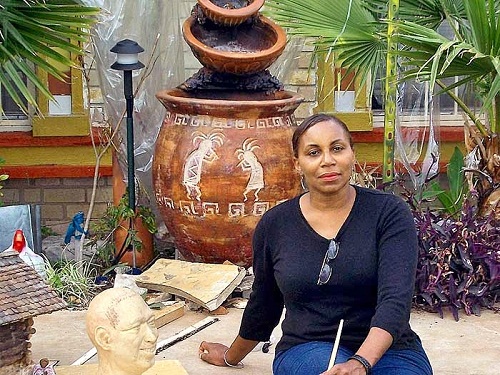
Dianne Smith standing on the site of her installation The Couple 

About Dianne Smith
Dianne Smith is an abstract painter, sculptor, and installation artist. Her work has been exhibited in solo and group exhibitions in New York City’s Soho and Chelsea art districts as well as, numerous galleries and institutions throughout the United States. She is an educator in the field of Aesthetic Education at Lincoln Center Institute (LCI), which is part of New York City’s Lincoln Center for the Performing Arts. Since the invitation to join the Institute over six years ago she has taught k-12 in public schools throughout the Tri-State area. Her work as a teaching artist also extends to under graduate and graduate courses in various colleges and universities such as: Lehman College, Brooklyn College, Columbia University Teachers College, City College, and St. John’s University. Dianne is a Bronx native of Belizean descent. She attended LaGuardia High School of Music and Art, the Otis Parsons School of Design and the Fashion Institute of Technology. Smith recently completed her MFA at Transart Institute in Berlin. She currently lives and works in Harlem, NY.

About the West Harlem Art Fund
The West Harlem Art Fund, Inc. is a fifteen year old public art organization serving neighborhoods around the City of New York. Their public art installations have been seen in the New York Times, Art Daily, Artnet Magazine, Los Angeles Times, DNAinfo, among others. The West Harlem Art Fund, Inc. showcases art and culture in open, public spaces to add aesthetic interest to our part of the city; promote historical and cultural heritage; and support community involvement in local development. 

Monday, October 15, 2012

HOT LINKS: October 15, 2012


Rashid Johnson, 6th of August, 2012, branded red oak flooring, black soap, wax, 96.5 x 132.5 x 3 inches. (Fredrik Nilsen / David Kordansky Gallery) Image via LATimes.com


Over the past few days, the following news items caught the attention of BlackArtistNews:

(L.A. Times)


(PBS.org)

(ChicagoReader.com)

(CarolinaAlive.com)

(TheCincinnatiHerald.com)

(HuffingtonPost.com)

(Richmond Times-Dispatch)

(Oregonlive.com)

(Evansville Courier & Press)

(JacksonFreePress.com)


Sunday, June 10, 2012

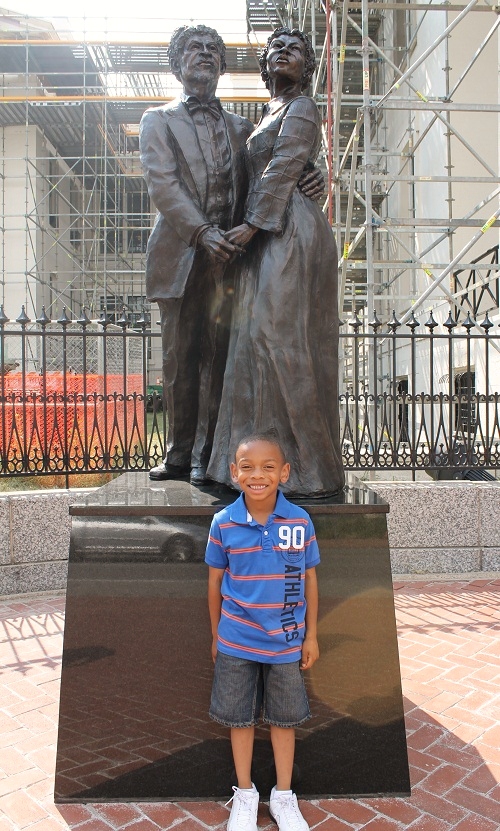
CAPTURED: Daniel Noah Rose with Dred and Harriet Scott

BlackArtistNews photo. All rights reserved. 
BlackArtistNews | June 9, 2012

Daniel Noah Rose proudly poses in front of the newly erected Dred and Harriet Scott statue outside the old courthouse in downtown St. Louis, MO. The Dred Scott Heritage Foundation raised the money for the statue which was created  by Harry Weber

The Dred Scott Heritage Foundation is $100,000 short of being completely paid for. Click here to contribute.

(Fox2Now.com)

(The Joplin Globe)

(The Grio)


Monday, April 16, 2012

POST: Jack Johnson Sculpture To Go the Distance in Galveston


The Jack Johnson Community Park in Galveston, Texas will feature Adrienne Isom’s full-size bronze sculpture of Jack Johnson, the first African-American to win the world heavyweight boxing title. Image via GalvestonDailyNews.com.

Artist's sculpture of boxing legend to be in park named in his honor

From staff reports
The Galveston Daily News
April 15, 2012

GALVESTON — Adrienne Isom, of Austin, completed a life-size statue of Jack Johnson, which will be the focal point of a park honoring the island native who became the first African-American to win the world heavyweight boxing title. Isom, who has twice received a Texas Legislative Commendation for her work, heads Wax Track Gallery International, a nonprofit organization based in Austin and funded in part by the city of Austin Department of Economic Development and Texas Commission on the Arts since 1995, as well as Isom Enterprises, an industrial design and contracting business. 


Q: What did you like most about Jack Johnson?


A: He was an extraordinary man. He did such radical things with his life. He was well-read and a man of international intelligence. 

He was like few people who dared to challenge what he felt should be everyone’s rights — things that should not be inhibited because of laws and actions that did not reflect our constitution. 


Q: You mentioned that photographs show his weight fluctuated quite a bit.


A: Sometimes, he would be heavier than at other times. In studying Jack’s look, I saw he paid more attention to exercise and diet, according to how he valued a challenge of a particular opponent. I think he looked his best right before the world heavyweight bout.

Q: His boxing gloves look small by today’s standards. Did they use less padding back in the day?

A: If you examine the gloves they say were his, those gloves were of the later version and stuffed a bit more with horse hair. I discussed his gloves with quite a few professionals. The gloves you saw him with the most were the slimmer kind. I tossed back and forth on what look he should have physically, as well as the version of gloves he should be wearing before settling on the unstuffed version.

Q: You studied under John T. Biggers, who was a legend at Texas Southern. What did you get most from him?

A: His work ethic. Doc was an international legend. I kept in touch with him from to time. As a young adult, I asked him, “How does an artist become successful?” He replied, “You must work when you have nothing to do. Even when you don’t have a commission, you work.”

I continued every week remembering those words. For everyone, this is what people need to realize if they want to continue to polish their gifts or any profession.

Q: Who are your inspirations?

A: I was, and am, inspired my deceased father, Alton D. Rison, former principal (first, a history teacher for more than eight years), a national education curriculum specialist and playwright, who was a very busy professional but was equally a busy father who took great time to take me, along with my other two sisters, to every cultural event and historical site of any culture he could fill our time with. This helps me to have a maturity of understanding in how I see the world, enabling me also to go beyond many mental barriers in conducting business.

Q: Tell us about how you work.

A: I live in one room — the entire house is work space. I got this concept from an Asian woman here. I was creating a design for the Philippine American Society. When I went into her home and walked inside, I saw the living room was a business. The den was lined up with sewing machines where they made bulletproof vests. There was another room with another business.

I said to myself, “Now this is how you use space!”

People sit around dreaming and suffering financially all of the time in America. Many say they do not have enough money to open a business but have homes with rooms and garages.

They fill up the space with furniture to entertain a few friends five or six times a year. 

After visiting that lady, I spent my following years visiting my concept of what is the real importance of space and what was important to me. I got rid of a 6,000-square-foot studio I was renting, my living room furniture and other bedroom furniture.

Now, I use every inch of my living space, with the exception of my bedroom, which is off limits to sculpting and business projects.

The only other room that is not subject for a project is my workout room.

It is important.

Eventually, I built a two-story shop in the rear of my property, but it seems I never use it much.

Q: Why is the workout room important?

A: To do this type of work, you must stay in shape, having some sort of exercise program and keeping corrosive foods and drinks out of your body.

In this business, I am always up for question and asked subtlety by nearly everyone, “Where is the man who does this?”

When I say I am the sculptress or industrial artist, they just look and stare. You can see in their eyes they are thinking: “Well, that looks like really hard work. She does not look like she could do that.” 

People also need to know that whatever they do takes preparation, such as physical training and quality time spent thinking and researching their goals. It’s not just for football players.

What you do must become a part of who you are to master it. My profession is my sport, my entertainment and my friend.

Adrienne Isom. Image via GalvestonDailyNews.com

Saturday, March 10, 2012

POST: Murals by 'Picasso of Harlem' are at risk of disappearing


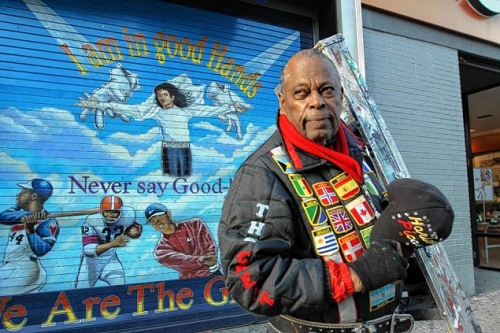
The murals by Franco Gaskin could find a new home at Triboro Plaza. Photo by Marcus Santos for New York Daily News. 

Harlem artist Franco Gaskin spent 35 years creating more than 400 works on roll-down security gates on 125th St.
By Douglas Feiden | New York Daily News
March 5, 2012

Two dozen world-famous murals painted on roll-down security gates on 125th St. by an artist dubbed the “Picasso of Harlem” could find a new home in an outdoor art gallery at the eastern edge of the strip, state officials say.

The iconic artwork of 84-year-old Franco Gaskin — better known as “Franco the Great” to tourists from Japan, Sweden and Brazil — has been rapidly vanishing as spiffy shops and chichi chains transform the neighborhood’s main street.

Enter the state’s Harlem Community Development Corp., which is working with local elected officials and the grassroots group Save the Gates to move the murals to Triboro Plaza, a neglected stretch of 125th St. between First and Second Aves.

“It will expand the cultural corridor all the way to the East River — and create a destination for art, commerce and tourism in a dead zone near the Triboro Bridge where you rarely see any pedestrians,” said HCDC Director of Planning Thomas Lunke.

But the clock is ticking: Gaskin spent 35 years creating more than 400 vibrant works with African-American themes on the corrugated-steel barriers protecting the storefronts — and only 25 of them are now believed to survive as shops are upgraded and gates are junked.

“Harlem’s history is at risk,” said Dana Harper, a retired police officer who has known Gaskin since he walked a beat in the 28th Precinct as a rookie cop in 1982.

“The murals of Franco the Great helped turn 125th St. around and made it a world-famous tourist attraction — but they’ve been thrown into the trash as new merchants without community ties come into the area.”

Born in Panama, Gaskin first came to Harlem in 1958 and watched in horror as dreary-looking metal gates — so-called crime-fighters — sprouted on 125th St. in the decade after the assassination of Martin Luther King in 1968.

“It was like a prison camp,” he said. “The street was a sea of gates — messy and forbidding and covered with gigantic graffiti.”

Starting in the late 1970s, and working on Sundays when the stores were closed, he took up his paintbrush and lifted Harlem’s image with a brand new, globally recognized art form — the storefront gate mural.

Gaskin worked on both side of the street between Broadway and Lexington Ave., portraying black martyrs like King and Malcolm X and lavish scenes from Harlem's jazz clubs, ballrooms and dance halls.

“I did it for love, I did it for beauty, and I did it for 125th St.,” the street artist told the Daily News as he led a four-hour tour of his masterpieces on Tuesday.

He succeeded beyond his wildest dreams, says state Sen. Bill Perkins, who represents central Harlem.

“Those gates were the legacy of crime, and he turned them into works of art and a beautification project,” Perkins said. “He took a desolate, lifeless thoroughfare and showed how the magic of art can revitalize a neighborhood.”

The murals opposite the Apollo Theater — seductive ladies in white mink stoles, gentlemen in tuxedos, dancers gliding in air — became a popular stop for tour buses and, over time, the street roared back to life.

In the past decade, soaring rents and gentrification led to the loss of dozens of the mom-and-pop businesses behind the gates, and when larger corporate retailers took their place, they’d typically chuck out the old murals.

Gaskin became a victim of his own success: “I can’t stop progress,” he says. “But I can sure get heartbroken when I see my gates come down.”

The destruction accelerated when a City Council-approved zoning change in 2008 said roll-down steel gates on 125th St. had to be replaced, over 15 years, with see-through gates made of fiberglass that leave shop interiors visible.

To save the surviving 25 murals — some as wide as 22 feet and as tall as 18 feet — an informal group, the Friends of Franco, is setting up a nonprofit, Save the Gates, which can raise money for framing, perservation and storage.

Meanwhile, state economic development officials — backed by Harlem pols, local merchants and Community Board 10 and 11 — have developed a plan to move the gates to Triboro Plaza, where they'd be displayed in an open-air, 24-hour-a-day art museum.

The block includes city-owned land controlled by the Parks Dept., which must sign off on the HCDC plan. Manhattan Parks Commissioner Bill Castro says he’ll meet with state officials to “further discuss this proposal and weigh the feasibility of this request.”

“It will be a spash of culture in a distressed area,” says state Sen. Jose Serrano (D-East Harlem).

“This is my contribution to Harlem,” says Franco the Great. “It will be wonderful to see it survive.”