Showing posts with label IN PRINT. Show all posts
Showing posts with label IN PRINT. Show all posts
Monday, September 28, 2015
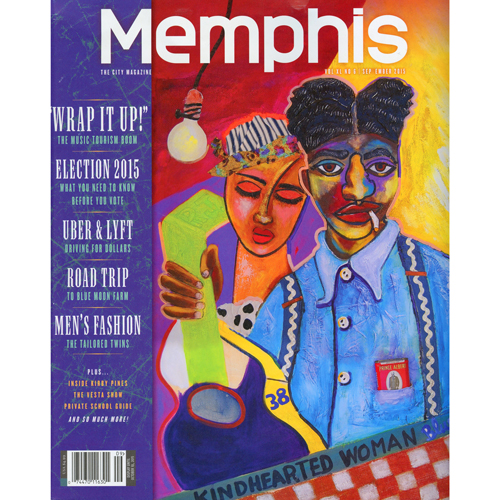
COVER: George Hunt / Memphis / September 2015

Monday, July 6, 2015
COVER: Dread Scott / Sculpture / July-August 2015
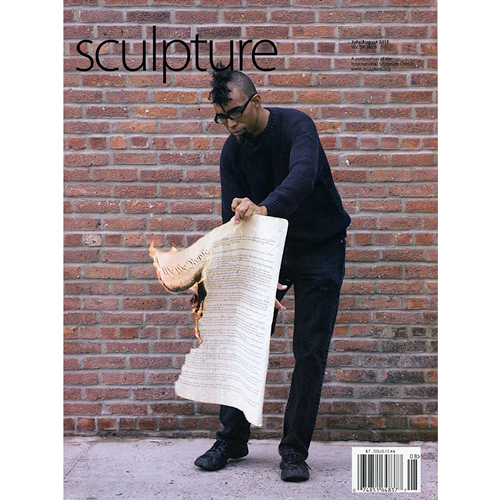 |
| Dread Scott, Burning the US Constitution, 2011. Pigment print, 2.21 x 1.67 ft. Image appears on cover of Sculpture courtesy of the artist. |
Dread Scott: Radical Conscience
Text | A.M. Weaver
Excerpt:
Dread Scott’s edict is make “revolutionary” art -- to propel history forward.” Since the early 1990s, after graduating from the School of the Art Institute of Chicago and completing the Whitney Museum of American Art’s Independent Study Program, Scott has joined the ranks of historical/political artists, following in the footsteps of John Heartfield, George Grosz, and Leon Golub, along with his activist contemporaries Ai Weiwei, Nari Ward, and Berry Bickle. By using his work to raise awareness of social injustices, Scott makes clear his intention of challenging the status quo. He employs irony and humor to make powerful statements pertaining to pressing issues, including freedom of speech on a global level, state-level violence against citizens, class inequality and racially motivated oppression.
In Scott’s lexicon, the phrase “by any means necessary” means deploying performance, installation, collage, and painting to convey his ideas and ideology. without being didactic, he convincingly articulates the concerns of marginalized communities across America -- the incarcerated, urban youth, and the 99%.
To read complete text for “Dread Scott: Radical Conscience” pick up a copy of the July/August 2015 issue of Sculpture magazine, on newsstands now.
Tuesday, March 24, 2015
COVER: David Adjaye / Cultured Magazine / February - March 2015

Social Studies
Architect David Adjaye blends his African roots with cutting-edge contemporary technique to further what he calls “social architecture.”
Text | Ted Loos
Portrait | Simon Watson
Excerpt:
David Adjaye is an outlier in the top tier of international architects in more ways than one. At 48, the Tanzanian-born Adjaye, who moved to the U.K. at age 13, is an unusually talented designer of spaces and structures; but the world has more than one of those. it’s the passionate case he makes for what he calls “social architecture” that is setting him apart these days, pushing him toward even more prominence. to Adjaye, social architecture means creating buildings that tell a story about people, binding them together in ways that go beyond a shared form of shelter.
“From day one, I’ve been committed to this idea of design democracy,” says the London-based Adjaye, who is socially very smooth and polished but can get heated up when it comes to this topic. “Great design is not just for the elite, it’s also for everyone else because it completely empowers people.”
Pick up a copy of the February/March 2015 issue of Cultured Magazine on newsstands now or read article online here.
Monday, December 29, 2014
ARTIST STATEMENT: Cauleen Smith / New City / December 25, 2014
 |
| Cauleen Smith, Play Your Part Series. 2012, ink on graph paper. Image via art.newcity.com. |
Chicago-based artist makes a statement on how
racial injustice and white privilege and supremacy gets processed in America
and in the art world.
Text |
Cauleen Smith for NewCity, December 25, 2014
This year
ends with a whole lot of heartache, rage and the palpable desire for action.
But I
suspect that there is a silent contingent of Chicago’s contemporary art
community who do not feel emotionally wounded by the injustices we’ve been
served; who feel as if offering “the other side” of the argument has no place
in this scene. And so perhaps these folks are riding this thing out—waiting for
the outrage and hand-wringing to blow over like Ken Johnson’s New York Times
review of “Now Dig This” blew over, like Donelle Woolford blew over, like
Exhibit B at the Barbican blew over, like Bjarne Melgaard’s remaking of Allen
Jones’ bondage chairs blew over, so that they can get back to the business of
pure art free from all this tired-ass identity politics stuff. I mean that is
so nineties, right? Well guess what. This is not going anywhere.
I’ve
recently had a few encounters that have me thinking about ways to structure
conversations that don’t put people of color in the position of educating white
folk rather than expanding our own consciousness and developing a weaponized
vocabulary that can slay white supremacy. There is no benefit to leaving one’s
allies hanging. So in that respect, the urgency for this vocabulary is
amplified. My standard response to individuals who come to me for “help” in
understanding racism is to direct them to the library. Then they ask for a
reading list. And then they read a chapter or two, become very uncomfortable
and want to process their estrangement with me. That’s about the time when the
friendship ends. How can a person who lives the inescapable stresses of white
supremacy buttress a person who has the option of accessing that consciousness
by picking up a book—and can then choose to just put the book down? The spirit
of Trayvon, Eric, Big Mike and the more-and-more has ignited a storm that need
not settle. Creative consciousness is rising like Hong Kong umbrellas and
Ferguson banners. And so, in the interest of friendship, some terms for civil
discourse may be needed.
1) White
Privilege: Cultural affirmations of one’s own worth; presumed greater social
status; and freedom to move, buy, work, play and speak freely. The effects can
be seen in professional, educational and personal contexts. The concept of
white privilege also implies the right to assume the universality of one’s own
experiences, marking others as different or exceptional while perceiving
oneself as normal. (from the Wiki)
2) White
Supremacy: The belief that white people are superior to those of all other
races and should therefore dominate society. (from the Wiki)
3) Racism:
The practice of enforcing white supremacy through institutions and mechanisms
of power both public and intimate.
4) Race: A
completely fictitious construction devised to rationalize modern capitalism,
deployed and performed with a force as real as the air that we breathe.
5) Value:
a) relative worth, merit or importance. b) to consider with respect to worth,
excellence, usefulness or importance. (dictionary.com)
Guess
what? Just like you don’t have to be a man to practice chauvinism, or a woman
to be a feminist, you don’t have to be white to be a white supremacist. This
term, white supremacy, as harsh as it is, eliminates the ambiguity of intention
invoked by notions of racism. A person can say, “I didn’t mean to be racist. I
am sorry.” But can that same person honestly say that they do not believe that
whiteness is inherently more valuable and more legitimate? If this is denied,
what would their actions say? What would their bookshelves say? What would
their hiring practices say? What would a sampling of their friends, associates,
co-workers and colleagues reveal? And so, what can be known when we apply these
questions to our own communities and the arenas in which we make, exhibit and
discuss art-work? How do we begin in the journey toward the society that more
closely resembles our ideals? Some individuals who benefit from the privileges
of dominant culture struggle with the experience of no longer being central to
critical narratives. Sometimes, friends, listening is the most powerful gesture
one can make. A receptivity to the black-centric narratives we see activated by
our stalwart protesters in the streets can be extended (and expanded) to the
classroom, the faculty meeting, the workplace, the playground, the museum, the
commercial art gallery.
Some
friends tell me that my idealism is misplaced—a better understanding of the
system in which we live would make it clear to me that the way to win this game
is to play the game, not break the game and build a better one. (I gots mine.)
This cynicism has gotten us exactly nowhere and yet, I feel it, I hear it, and
understand it among people I care about. So I’m joining forces with artists to
work on our own minds so that we can build the tools of liberation we need to
amplify our capacity for love. This is all I can offer my cynical friends. This
is the best offer my estranged friends are gonna get. Maybe they’ll join us. I
mean, I just can’t see changing anything unless we all imagine ourselves to be
a part of a cosmic continuum of love. And who wouldn’t do anything for love?
Sunday, November 9, 2014
IN PRINT: Cecil McDonald Jr. / Contact Sheet 177
 |
| Cecil McDonald Jr., Spectate Space, 2013. Image via cecilmcdonaldjr.com. |
Light Work
Annual 2014
Text | Tempestt Hazel
Excerpt:
Domestic Observations and Occurrences is a glimpse into the everyday moments of a handful of scholars, curators, and artists who live and work in the Washington Park neighborhood on the south side of Chicago. Cecil McDonald allows us to observe the beautifully mundane moments that usually go unseen. From his position as a native of Chicago’s south side, he is able to show a deep appreciation for commonalities in the human experience while also paying homage to a Black experience and a Chicago experience. He merges them which ultimately give a point of entry for anyone, whether you live on the south side of Chicago or not. He makes it easy for anyone to relate, even if the streets beyond the walls of the photographs are seen as foreign and forbidden territory to many people around the globe and even in other parts of Chicago.
To read complete essay and view all images order
a copy of Contact Sheet 177 here.
Monday, November 3, 2014
COVER: Jean-Michel Basquiat / New York Spaces / October 2014

Art in
Balance
Interior
Design | William T. Georgis Architect
Text | Jorge S. Arango
Photograph | Costas Picadas
For an art dealer’s Gramercy Park apartment,
William Georgis creates a livable context for an ever-changing collection of
paintings, sculptures, and furnishings.
Excerpt:
A gallery and a home serve divergent purposes. Art in one is for sale, in the other purely for enjoyment. Furnishings are minimal in the former to maintain the attention to the art, while in the latter the balance between them must be comfortably calibrated for living. But when the homeowner is a prominent private art dealer like this client, these distinctions blur.
Three Basquiats take up so much space that the entry hall seems “papered” in the artist’s imagery. At the end of the hall is a table in front of a Perriand console with works by, among others George Condo and Picasso.
The place is chock-full of works by Alexander Calder, George Condo, On Kawara, Richard Prince, Cy Twombly, Andy Warhol and others. Yet each feels integral to the spaces in which they appear. And the constant swapping of a Christopher Wool painting for a Twombly or a Prouvé commode for the Perriand, makes this a living, breathing barometer of the homeowner’s almost promiscuous curiosity and evolving tastes.
“It’s an interesting study in visual appetite,” says Georgis. “Over time, it shows us the hand of the collector. A lot of designers think of their work as sacrosanct, flies preserved in amber. That’s not interesting to me.”
To read complete story and see more images pick
up a copy of the October 2014 issue of New York Spaces.
Thursday, October 16, 2014
IN-PRINT: Lina Viktor / Galore / Issue #8 / 2014

PHOTOGRAPHY BY LINA VIKTOR
What medium do you enjoy painting with the
most?
I paint and gild with 24-karat gold on canvas. Up until now, as far as painting
goes, canvas has been my medium. But I am now beginning a journey into the
third dimension and working on sculptures and 3D objects.
What music do you listen to when you paint?
I listen to music that envelops me, makes me feel like a conqueror, or gives me
throwback ‘90s vibes—artists like Phillip Glass, James Blake, Björk, Woodkid,
Kelela. But mostly I listen to/watch science and nature documentaries.
Who are your top five favorite artists of
all-time?
Yves
Klein, Constantin Brancusi, Frida Kahlo, Martha Graham and Jeff Koons.
What piece is your favorite in your new
collection?
A piece
called Golden Age, my second painting made entirely out of 24-karat gold.
Usually I mix gold with acrylic and gouache paints, but this piece is all gold.
I actually kept it—I keep one work from each series so it is now part of my
collection.
What is next for you?
I am
shooting an art film this fall that will debut at the Versace mansion during
Miami Art Basel in December [2014].
How would you describe yourself in three words?
Insatiable,
loner and cerebral.

Sunday, October 12, 2014
LISTED: Nick Cave / Paper Magazine / September 2014

ORIGINAL GANSTERS: NICK CAVE
PHOTOGRAPH BY VICTOR SKREBNESKI
September 2014 marked the 30th anniversary of Paper
magazine which honored 37 artists, visionaries, icons and iconoclasts. Artist Nick Cave was one of the individuals
listed.
From Papermag.com:
With bold moves like creating a flash mob composed of humans
wearing giant, colorful fringed horse costumes in the middle of Grand Central
Station (HEARD•NY, 2013),
Chicago-based visual and performance artist Nick Cave brings shocking fashion,
costume and movement to unexpected places -- proving that art can be both
playful and profound.
Nick Cave’s Personal OGs: Rei Kawakubo, Victor & Rolf, Grace Jones, [Anselm] Kiefer, [Gerhard] Richter, David Bowie, Jasper Johns and Michael Jackson.
Have you ever ever felt truly shaken by a criticism or suffered a set-back in your work?
A performance I did in my 20's fell apart and almost crumbled me. But I got right back up on my two feet.
What was the biggest obstacle you had to overcome in your career?
The fear of success and giving myself full permission to be me.
What were you like as a child?
Free and extremely shy.
Do you consider yourself to be a control freak?
A control freak I am not, but, I do know what I want. I am open to others input as long as it remains authentic to my vision or message.
What have you seen recently that's shocked you?
Eric Garner's death in July [2014] -- the NYPD put him in a chokehold and slammed his face to the sidewalk killing him. That could have been me.
What do you consider to be the biggest success of your career thus far?
Success is when I am using my ART as a vehicle for change. I am an artist with a civic responsibility. HEARD•NY was one of those projects.
Read about other
OG’s listed by Paper Magazine here.
Thursday, July 10, 2014
COVER: Randell Henry / ArtVoices / Summer 2014

Text by Amy Bryan
Randell Henry creates large, colorful, paint collages incorporating Abstract Expressionism, Cubism, and the influence of Kente cloth of the West African Akan culture. He is an African American painter from Baton Rouge, Louisiana and has been a painting professor at Southern University there for over twenty years. His most recent interest is in doing miniature paintings as well as large paintings and exploring how they influence each other.
Henry received a Master of Fine Arts from Louisiana State University in 1982 and a Bachelor of Arts from Southern University in 1979. Since then he has exhibited at museums and galleries throughout the United States and in Ghana and Liberia, Africa. In 2010, he exhibited at the University of Liberia and the U.S. Embassy Residence of Ambassador Linda Greenfield-Thomas. He is currently included in The Visual Blues exhibit at LSU Museum of Art at the Shaw Center for the Arts.
Excerpt:
AMY BRYAN: Do you consider yourself an Abstract Expressionist?
RANDELL HENRY: Abstract Expressionism, Cubism, and African designs and textiles are major influences. I call myself a Cubic Expressionist.
AB: Your work displays your intense interest in color. How are you influenced by color?
RH: I learned a lot about color theory from Jean Paul Hubbard. He would paint with students. He used Payne’s gray and other beautiful grays. I learned to mix colors by watching him. He had his students buy high quality Grumbacher paint.
I put colors together that are not supposed to go together. Through simultaneous contrast (the affect that colors being placed with other colors have on their overall appearance) everything works out. I just use the primary colors (red, blue, and yellow) and black and white to make all my other colors. I also got grounded as a kid looking at artists.
I also look at art from African culture, lines in fabric design, [West African, Akan] Kente cloth lines and patterns and East African artists’ fabric designs. I also look at Jackson Pollock. Lines have a lot of personal significance.
Pick up a copy of the Summer 2014 issue of ArtVoices to read complete story and view more images or read online here.
Tuesday, July 8, 2014
COVER: Chris Ofili / Art in America / June-July 2014
 |
Chris Ofili, Afro Margin Eight (detail), 2007, pencil on paper, 40 ¼ by 26 ½ inches. Images appears on Art in America courtesy of David Zwirner, New York/London and Victoria Miro, London.
|
From Art
in America:
This month’s
cover was designed by Turner Prize-winning Chris Ofili. The British-born,
Trinidad-based artist has exhibited at institutions such as the Studio Museum
in Harlem, New York (2005); Tate Britain, London (2005 and 2010); and the
kestnergesellschaft, Hanover (2006). Ofili represented Great Britain in the 50th
Venice Biennale in 2003. A solo exhibition of his work will open at the New
Museum in New York in October 2014.
Thursday, June 12, 2014
MATERIAL WITNESS: The Changing Complex Profile of Black Abstract Painters
 |
| James Little, Juju Boogie Woogie, 2013. Image via artnews.com: Courtesy the artist and June Kelly Gallery, NY. |
Long marginalized by their community and
overlooked by the art market, African American abstractionists are finally
coming into the spotlight
Text | Hilarie M. Sheets for ARTnews
Published | June 4, 2014
“Donald
Judd didn’t have to explain himself. Why do I have to?” asks Jennie C. Jones,
an African American abstract painter who has grappled with the issue of how her
work can or should reflect her race. “Fred Sandback can make this beautiful
line and not have to have it literally be a metaphor for his cultural
identity.”
Jones, 45,
sidestepped the debates around multiculturalism that were raging when she was
in school in the 1980s and gravitated toward Minimalism. Yet over the last
decade, she has forged a conceptual link in her work between the histories of
abstraction and of modern jazz in America—“black guys in the 1950s taking jazz
into the concert hall and making it this bluesy hybrid with Bach,” as she puts
it.
In her
recent show at Sikkema Jenkins in New York, an atonal sound environment
accompanied her monochromatic paintings that had acoustic panels attached to
the canvases. Strips of fluorescent color painted on the edges of the canvases
bounced off the white walls and created a sense of movement, rhythm, and
vibration. “This art and music juncture,” she says, “gave me the permission to
point to something in the room that said, ‘I didn’t fall out of the sky.’”
The
contributions of African American artists to the inventions of abstract
painting have historically been overlooked, or else fraught with the kind of
questions faced by Jones. “Generations of black abstract painters never seem to
be celebrated,” says Valerie Cassel Oliver, senior curator at the Contemporary
Arts Museum Houston, where she recently organized “Black in the Abstract,” a
two-part exhibition that focused on the history of African American painters
working in abstraction. She placed younger artists, including Jones, Shinique
Smith, and Angel Otero, in dialogue with members of the older generation, such
as Felrath Hines, Alma Thomas, and Romare Bearden, who were producing seminal
works in the 1960s.
“You find
these artists being marginalized on both ends of the spectrum,” Cassel Oliver
continues. “There was this manifesto with the Black Arts Movement that you did
work that reflected the beauty of that community in no uncertain terms,” she
says, referring to a group that coalesced in the 1960s to promote social and
political engagement in art and literature. “Oftentimes abstract painting is
not as celebrated as more figurative work by the black community. From the
mainstream art world, it’s just the sense of not being preoccupied with what
black artists are doing, period.”
Read complete story online here.
Thursday, June 5, 2014
IN PRINT: Nick Cave / Juxtapoz / May 2014
 |
| Image by Caleb Neelon via calebneelon.com. |
When the Rodney King verdict was announced in t
1992, Nick Cave was alone in a city park and felt compelled to do something
physical. He gathered sticks. They became the first of his more than 500
Soundsuits – giant wearable costumes that obscure the wearer’s identity, race
and gender. Subsequent materials like plush toys, buttons, potholders, hook
rugs, sequins or pipe cleaners, take on forms that evoke vessels, mountains,
religious attire, and even instrument cases. They became one of the more
identifiable and successful bodies of work by an artist in the past twenty
years, but Nick Cave is stepping away for the time being.
Excerpt:
CALEB NEELON: What is the immediate reaction people have when they put on a Soundsuit for the first time, or I should say, when a Soundsuit wears them?
NICK CAVE: It’s interesting you say that. I talk about the object or the work that you are going to be wearing. I ask them to imagine what it is going to feel like. Prepare yourself for this transition. Touch it, experience it in this imaginary sort of way. And then I tell people, when you put it on, don’t even move at first. Just become one with the object; otherwise it’s wearing you. You’ve got to be able to surrender to this transformative space, or else you really lose control and fall apart. Individuals need to take out the time to surrender to this shift – because what happens is your identity, gender, race, is no longer relevant. I’m forced to look at something without judgment. It’s about projection and conviction. I know that you are in the Soundsuit, but how are you going to establish an identity that allows coming face-to-face with this other. It takes time, but when you do reach that shift, it’s amazing when that happens.
Was Chicago the city of your imagination growing up, and did you always envision being there?
I could have gotten into a lot of shit in New York, but in Chicago I can have an amazing studio environment. I think of Chicago as my open canvas, my testing ground, and that’s how I use it. At one point, I thought I would be living in New York with everybody else. But knowing I have the ability to jump into the center of it all and then jump back is what it’s saying to me – Chicago has protected me from being lost, from being seduced.
You have [a] show looming in the Fall of 2016 at Massachusetts Museum of Contemporary Art, which, for those who haven’t been, is pretty much a massive old New England mill building-turned-museum space that every artist dreams of. Think airplane hangar with exposed brick walls, right near the Berkshires. How are you approaching that one?
What I will say about that project is I’m going to put you in the belly of a Soundsuit. When you know it’s a show that’s going to run for a whole year, it changes things. And there is the Jack Shainman show this fall in New York, which is going to be new work, but no Soundsuits.
Stepping away from Soundsuits had to take some guts.
You know, it really didn’t. I was feeling it, and decided, you know what, I’m doing it. We have to keep it moving. I had been thinking about it for a while. And I’m planning to take a ten-year hiatus. I have ideas for new ones, but I’m ready to talk about some other things.
To read complete interview order a copy of the
May 2014 issue of Juxtapoz here.
Wednesday, June 4, 2014
IN PRINT: Brenna Youngblood / Cultured Magazine / Summer 2014
 |
| Brenna Youngblood. Image scanned from Cultured magazine. All rights reserved. |
Los Angeles artist Brenna Youngblood stands out
in an era of often-tenuous creation
Text | Maxwell Williams
Excerpt:
In this epoch of art that often seems to lack substance and authenticity, finding a painter with both is beyond rare. Los Angeles-based artist Brenna Youngblood may work with abstraction through mixed-media, but there’s a generous point to it all – that art, through the use of veiled-yet-recognizable imagery, can elicit a different emotional response from each viewer.
Youngblood, whose work was recently acquired by the Museum of Contemporary Art and had a solo exhibition, “A Phrase that Fits,” [Spring 2014] at the Tilton Gallery in New York, currently has a solo museum exhibition, “Loss Prevention” – a mix of new and old works – at the Contemporary Art Museum St. Louis through June 22.
To read complete story, pick up a copy of the Summer 2014 issue of
Cultured magazine on newsstands now.
Wednesday, May 28, 2014
IN PRINT: Kara Walker / VOGUE Met Gala 2014 / A Condé Nast Special Edition
 |
| Kara Walker photographed in her Chelsea New York studio by Annie Leibovitz, 2013. |
Kara
Walker Breaks New Ground With Her Latest Work
Text | Kate Guadagnino
Excerpt:
After
wandering the Met’s marble-floored galleries, venture to Williamsburg to see
art star Kara Walker’s first big departure from her famously provocative
silhouettes – a towering sculptural work called A Subtlety, which Creative Time
just opened at the Domino Sugar factory. In the warehouse of the now-defunct
plant (where brown sugar was once made white) sits a sphinxlike woman dressed
as “the help.” She’s made entirely of sugar, with all its thorny connotations
of slavery, empire, and industry. “I am always interested in the place where
fact hits myth,” Walker says.
First, the
artist steeped herself in research. “Did you know that pre-Columbus, sugar was
a precious in Europe as gold?” Walker asks. “Every time I stir sugar into my
coffee or tea – all colonial commodities! – I feel a connection to the
ever-presentness of those histories.” Then she considered the setting, which
she knew would be doing a lot of the metaphorical work for her. She hopes the
piece will be “very straightforward and completely perplexing all at once,”
adding, “I think art should be like that.”
To read complete story pick up a copy of VOGUE Met Gala 2014 on newsstands until August 18, 2014.

Saturday, May 10, 2014
IN PRINT: Kara Walker / Modern Painters / May 2014
 |
| Kara Walker photographed in her New York City studio by Kristine Larsen for Modern Painters, 2014. |
Kara Walker
Text | Thea Ballard
Photographs | Kristine Larsen
Excerpt:
Known for her piercing revisitations of America’s violent relationship with race, Walker is working with characteristically large questions. Her studio looks down on Manhattan’s Garment District, with floor-to-ceiling sketches that recall her famous silhouettes pinned to the walls. Alongside personal ephemera – a White House napkin, an Alvin Ailey Barbie gifted by André Leon Talley – it houses an enviable collection of books, which she mines for both literary and pictorial content.
To read complete story and view more images pick
up a copy of the May 2014 issue of Modern Painters on newsstands now.
COVER: Ebony G. Patterson / Frieze / April 2014

Island Life
Art in the
Caribbean
Comprising 700
islands, 13 states and 17 dependent territories, and hosting a range of
languages including Creole, Dutch, English, French and Spanish, the Caribbean
represents a rich and complex set of cultures and histories. Dan Fox asks six
artists, curators and writers to reflect on how questions of identity,
infrastructure and education shape art in the region today.
Quotes:
“The idea that anything intellectual happens in The Bahamas is anathema to the brand we have projected to the outside world.”
Amanda Coulson,
Director, the National Art Gallery of The Bahamas, Nassau
“It is getting increasingly difficult to draw a border around what is Jamaican art – as is also the case in the rest of the Caribbean.”
Charles Campbell,
artist, writer and Chief Curator of the National Gallery of Jamaica
“Within the region, the contemporary visual arts are battling a legacy of being underdeveloped and underappreciated. There is not an economy of understanding concerning the development of contemporary art, and its evolution has not been supported in practical ways by local governments and federations.”
Holly Bynoe,
artist, curator, writer and Director and Editor-in-Chief of ARC magazine
“Artists in the region are functioning in an arena with a relatively small audience, very limited primary art markets and, in many cases, non-existent secondary markets for contemporary practice. One challenge this poses is that much of the work is appreciated and valued outside of the region, creating a gap between the makers and their homegrown audiences.”
Annalee Davis,
artist and Founding Director of the Fresh Milk Art Platform, Inc.
“This question of identity often presents itself to Caribbean art. Artists either seem to address it directly or are determined to avoid it – both of which accentuate the enormity of the issue.”
John Cox, artist,
curator, teacher, Creative Art Director of Baha Mar Ltd., and founder of
Popopstudios International Center for the Visual Arts
“There are very few independent platforms, galleries or project rooms. The few that do exist are run by artists, with no specific curatorial or commercial strategy.”
Caryl
Ivrisse-Crochemar, founder of espace d’art contemporain 14ºN 61ºW, Martinique,
French West Indies
To read complete
story and view images pick up a copy of the April 2014 issue of Frieze magazine on newsstands now or read online here.
Subscribe to:
Posts (Atom)