Showing posts with label Rashid Johnson. Show all posts

Friday, January 24, 2025

NEW YORK: RASHID JOHNSON

Rashid Johnson: A Poem for Deep Thinkers

April 18, 2025–January 18, 2026

GUGGENHEIM
1071 Fifth Avenue (Between 88th and 89th Streets)
New York, NY 

From guggenheim.org:

For nearly 30 years, artist Rashid Johnson (b. 1977, Chicago) has cultivated a diverse body of work that draws upon an array of disciplines such as history, philosophy, literature, and music. This major solo exhibition highlights Johnson’s role as a scholar of art history, a mediator of Black popular culture, and as a creative force in contemporary art.

Almost 90 works—from black-soap paintings and spray-painted text works to large-scale sculptures, film, and video—will fill the museum’s rotunda, including Sanguine, a monumental site-specific work on the building’s top ramp with an embedded piano for musical performances. Additionally, a dynamic program of events, developed in collaboration with community partners across New York City, will activate a sculptural stage on the rotunda floor.

For more information, click here.

Friday, October 2, 2015

NEW YORK: Rashid Johnson


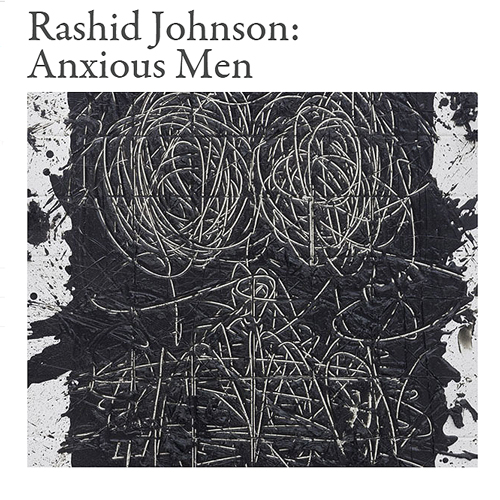
Anxious Men   
October 2 - December 20, 2015


THE DRAWING CENTER  
35 Wooster Street  
New York, NY


Since distinguishing himself as the youngest artist in Freestyle, the landmark 2001 exhibition at the Studio Museum in Harlem, Johnson has established himself as one of the preeminent artists of his generation. Invoking such varied themes as the black experience in America, the dialogue between abstraction and figuration, and the relationship between art and personal identity, Johnson has been discussed within the context of contemporary painting, photography, sculpture, video, installation art, and even performance. Now, with the Anxious Men, drawing enters that list.
Universally accessible and employing common visual tropes such as the monochrome and the grid, Johnson's work is also self-referential making specific allusion to his upbringing in Chicago and the Afrocentric values of his parents. In Rashid Johnson: Anxious Men, the artist creates a site-specific installation in the Drawing Room gallery. The core of the exhibition is a new series of black-soap-and-wax-on-tile portraits that Johnson calls his “anxious men.” Executed by digging into a waxy surface, they enact a kind of drawing through erasure and represent the first time Johnson has worked figuratively outside of photography or film, and on such a small scale. Whereas Johnson’s previous work has taken a more cerebral approach to questions of race and political identity, the drawn portraits confront the viewer with a visceral immediacy. The portraits will be set within a multi-sensory environment that includes wallpaper featuring a photograph of the artist’s father from the year Johnson was born, and an audio sound track comprised of Melvin Van Peebles’s “Love, That’s America,” a song that originally appeared in Peebles’s 1970 film Watermelon Man and that was recently pressed into service by the Occupy Wall Street movement. In this way, the exhibition will create an immersive space that implicates not only the artist but also the viewer in its interrogation of selfhood and identity.

Click here to for exhibit info and images.


Tuesday, June 17, 2014

ATHENS: Rashid Johnson

Rashid Johnson, The New Black Yoga (Video still), 2011, 16 mm film transferred to DVD with sound, 10 min 57 sec duration. Credits: © Rashid Johnson Courtesy the artist and Hauser & Wirth Photography by Martin Parsekian. Image via eyes-toward-the-dove.com.
Magic Numbers
June 23 – August 28, 2014

Opening reception: Friday, June 20, 2014, 7:00 - 9:30pm

Public Conversation: Rashid Johnson with Katherine Brinson, associate curator at the Guggenheim New York, Saturday, June 21, 2014, 12:00 – 1:00pm

80 Kifissias Avenue
Athens, Greece

From press release:

The George Economou Collection is pleased to announce Magic Numbers, a solo exhibition by American artist Rashid Johnson. Curated by the artist in collaboration with Katherine Brinson, associate curator at the Guggenheim Museum New York, and Skarlet Smatana, director of the Economou Collection, the exhibition features a site-specific installation of works largely conceived on the occasion of the exhibition.

Since coming to prominence in the early 200s, Johnson has forged a nuanced and diverse body of work that explores the complex contemporary and historical forces that shape identity. His paintings, photographs, videos, and sculptures draw on a shifting corpus of references spanning music, literature, intellectual history, and pop culture, interwoven with dense autobiographical valences. His installations often take the form of wall-mounted shelves that suspend together found objects such as books, vinyl records, CB radios, plants, and oyster shells, imbuing them with a new, talismanic significance. In recent years, Johnson has also increasingly worked in a purely abstract vein, mining the legacy of modernist abstraction while exploiting the unique expressive potential of his vocabulary of unconventional materials.

Magic Numbers takes as its starting point a film by Johnson in the George Economou Collection, The New Black Yoga (2001). This emblematic work grounds a group of new paintings and sculptures that advance a number of longstanding formal and conceptual impulses in the artist’s oeuvre. In the first gallery, a wall of mirror tiles will form the backdrop to a configuration of objects charged with intensely personal symbolism as well as broader cultural influctions. In relationship to this monumental work, Johnson has drawn on the forms of Brazilian modernist furniture to create an enigmatic vessel for one of his most resonant materials, shea butter – the unctuous fat derived from a nut indigenous to Africa that isprized for its healing emollient properties.

At the heart of the exhibition will be a gallery devoted to The New Black Yoga, a short film that depicts a group of five young African American men in a sublime natural setting performing a series of choreographed movements that are in turn balletic, athletic, and martial. Originating in the artist’s absurd experience of attempting to participate in a yoga class conducted in a foreign language, the work broadens into a disorientating collision of codes and signifiers, playing on Johnson’s pervasive interest in constructing fictive fraternal collectives and ambiguous rituals. The video begins and ends with the image of a crosshairs target – a symbol appropriated from the log of hip hop group Public Enemy which here takes on a more oblique, runic connotation.

The crosshairs icon will resurface in the final gallery, where Johnson’s sculpture Black Steel in the Hour of Chaos (2012) functions as both a stark portent of aggression and a serene study in geometric forms. It will be installed with a group of abstract compositions that deploy burned wood, cast bronze, black soap and wax to forge surging topographies interrupted by the artist’s additive and subtractive mark-making. Together, the works in the exhibition will channel Jonson’s current preoccupation with notions of hybridity and metamorphosis, cohering into an immersive environment freighted with narrative possibilities.

The exhibition is accompanied by an illustrated catalogue that includes an essay by Katherine Brinson, associate curator at the Guggenheim New York.


Rashid Johnson's The New  Black Yoga from Rod Lamborn on Vimeo.


Wednesday, February 19, 2014

DENVER: Rashid Johnson

Rashid Johnson, Phoenix Bird (detail), 2013. Burned red oak flooring, black soap, wax and spray enamel. 96 1/2 x 72 1/2 x 3/10 in. Courtesy the artist and Hauser & Wirth, New York via mcadenver.org.
New Growth
FEBRUARY 21–JUNE 15, 2014

1485 Delgany Street
Denver, CO

From MCA Denver web site:

In Rashid Johnson: New Growth, the artist works with personally and historically loaded material such as shea butter and black soap, combining it with LP covers and books in complex paintings, sculptures and installations. His works challenge conventional representations of collective identity. Beginning with the question, “What would happen if Sun Ra, George Washington Carver and Robert Smithson started a community together in the desert?” New Growth's playful scrutiny intertwines cosmology and escapism in an attempt to blur the lines separating past, present and future.

The physical manipulation of biomaterial into an abstract, aestheticized form is a concept that runs through all of the works in the exhibition. Johnson references the ongoing transformation of both bodies and landscapes, and the identities embedded within them. New Growth features newly commissioned works including the video Samuel in Space and the Shea Butter Irrigation System. Works in wax, burned wood, tile and mirror, as well as brass chairs, wood chairs and rugs round out the exhibition.

Rashid Johnson was born in 1977 in Chicago. He lives and works in Brooklyn, New York. Johnson was recently the subject of the solo exhibition Rashid Johnson: Message to Our Folks at the Museum of Contemporary Art Chicago, an exhibition that traveled to the Miami Art Museum, the Kemper Art Museum and the High Museum of Art. His work has been included in group exhibitions such as Shanghai Biennale, REACTIVATION, Shanghai, China, 2012; Venice Biennale, ILLUMINations, Venice, Italy, 2011; For the Love of the Game: Race and Sports, The Amistad Center for Art & Culture at the Wadsworth Atheneum Museum of Art, Hartford, 2007; and Freestyle, The Studio Museum, 2001. Johnson was the recipient of the 2012 David C. Driskell Prize.


Monday, June 3, 2013

EVENT: Rashid Johnson In Conversation

UPDATE: Sam Gilliam will not attend this event as originally planned. Conversation will take place between Rashid Johnson and curator Laura Hoptman.

CONVERSATIONS: AMONG FRIENDS 
FEATURING ARTIST RASHID JOHNSON 

Moderated by Laura Hoptman, Curator, Department of Painting and Sculpture, MoMA

Thursday, June 27, 2013
7:00 PM Program | 8:15 PM Reception
Doors open at 6:30 PM

The Celeste Bartos Theater (Theater 3)
The Lewis B. and Dorothy Cullman Education and Research Building
4 West 54 Street
New York, NY

General Public Tickets ($35) can be purchased at The Museum Information and Film Desks, online at MoMA.org, or through The Friends Of Education office. All tickets will be held at the door.

Presented by The Friends of Education of The Museum of Modern Art, Conversations: Among Friends explores works of art as reflections of their political and social contexts. The evening features a conversation between artists Sam Gilliam and Rashid Johnson, moderated by Laura Hoptman, a curator in MoMA’s Department of Painting and Sculpture. The program will explore Gilliam and Johnson’s work—and how it is shaped by, responds to, and reflects the artistic, historical, political, and social context of its making. Following the program, guests are invited to continue the conversation and meet the participants at an intimate reception catered by Fantasy Fare in the Cullman Mezzanine.

Rashid Johnson was born in 1977 in Chicago, IL, and studied at Columbia College Chicago and the School of the Art Institute of Chicago. In 2001, Johnson's work was included in Freestyle, an exhibition at the Studio Museum in Harlem curated by Thelma Golden. The show featured 28 up-and-coming artists whose work Golden considered to be “post-black,” a term defined by Golden as “characterized by artists who were adamant about not being labeled as 'black' artists, though their work was steeped, in fact deeply interested, in redefining complex notions of blackness.” Johnson, who was 24 years old at the time and the youngest artist in the exhibition, presented photographs from his Seeing in the Dark series of portraits of homeless African American men in Chicago. The work drew critical attention, and since then, his practice has become central to the “post-black” movement. Johnson's mixed-media work incorporates a wide range of everyday materials and objects, including wax, wood, steel, brass, shea butter, ceramic tile, books, records, VHS tapes, live plants, and CB radios. With shamanistic inspiration from both African American history and art history, many of Johnson's more recent works employ these materials in a way that suggests an indefinite form of mysticism and a role as devotional objects. Johnson's work has been exhibited at the Museum of Contemporary Art in Chicago, the Art Institute of Chicago, the Walker Art Center, and in ILLUMInations, the 54th International Art Exhibition of the Venice Biennale, among others. In 2009, he had a solo show at SculptureCenter in New York. In 2012 Johnson enjoyed his first major solo museum exhibition at the Museum of Contemporary Art in Chicago, had first solo show in the U.K. at the South London Gallery, and won the David C. Driskell Prize. His current solo exhibitions include New Growth at the Ballroom Marfa, TX; and his upcoming shows include Rashid Johnson: Message to Our Folks at the High Museum of Art, Atlanta, GA, and the Kemper Art Museum, St. Louis, MO. Johnson currently lives and works in New York, NY.


Laura Hoptman is a curator of contemporary art in the Department of Painting and Sculpture at The Museum of Modern Art, where she is currently organizing a career retrospective of the German sculptor Isa Genzken, and an exhibition on contemporary painting. Since joining the Museum she has organized Ecstatic Alphabets/Heaps of Language, a group exhibition of contemporary art dealing with language; Artist’s Choice: Trisha Donnelly; and, with Peter Eleey, a mid-career survey of the work of the Los Angeles painter Henry Taylor at MoMA/PS 1. Previously, Hoptman was senior curator at the New Museum where she organized Unmonumental: The Object in the 21st Century, The Generational: Younger Than Jesus, and monographic exhibitions on Tomma Abts, Elizabeth Peyton, Brion Gysin, and George Condo. In 2004/2005 she was the director of the 54th Carnegie International, and, as a drawings curator at MoMA from 1996 to 2002, she curated the first U.S. museum exhibitions of Rirkrit Tiravanija, Maurizio Cattelan, John Currin, and Luc Tuymans among others. In 1997, she was the co-curator of Love Forever: Yayoi Kusama, a show that reintroduced Kusama to international audiences, and in 2002, organized Drawing Now: Eight Propositions, a landmark exhibition of contemporary figurative drawing.


Thursday, April 11, 2013

POST: Sam Gilliam and Rashid Johnson


MENTOR PROTEGE: The Art of Inspiration 

Rising art star Rashid Johnson pays homage to the colorful, defiantly abstract paintings of 79-year-old Sam Gilliam by curating an exhibition devoted to Gilliam's early works.

Text | Chloe Schama 
Photograph | Matthu Placek
Published | Wall Street Journal, March 14, 2013 
"SOME OF THESE GESSOED?" asks the artist Rashid Johnson, gesturing at several colorful canvases leaning against a wall in 79-year-old Sam Gilliam's airy Washington, D.C., studio. "No," Gilliam corrects, speaking more deliberately than Johnson's enthusiastic clip. "They're all raw." Johnson, 35, furrows his brow, bends over and peers at one of the paintings as though it contains code.
Last summer, Gilliam—known for his vibrant, often monumentally scaled paintings—received a call from Johnson, who wanted to curate an exhibition of the older artist's work. Gilliam first made his name in the 1960s as a member of the Washington Color School, a group of D.C. painters that used similar techniques: staining large unprimed canvases, embracing abstraction and energetic color. Unlike many black artists of his generation, he shied away from addressing race head-on, producing geometric paintings, and then, in the late '60s and '70s, the large, draped canvases for which he is best known. In 1976, three Gilliam canvases covered almost an entire external wall of the Philadelphia Museum of Modern Art—like a giant's tie-dyed laundry hung up to dry. "I wanted to brighten things up," Gilliam says, "rather than just be concerned with the problem."
In recent decades—though still admired among contemporary art aficionados—Gilliam has slipped into semi-obscurity. A review of his 2006 retrospective at Washington's Corcoran Gallery in The Wall Street Journal was titled "A Master of Color Too Long in the Shadows." Johnson hopes to change all that.
A rising star of the art world, Johnson has had dozens of solo shows, including one at the Museum of Contemporary Art in Chicago in 2012, the same year he was nominated for the prestigious Hugo Boss Prize. Around Gilliam, however, he is an eager and attentive pupil. Johnson first learned of Gilliam in the early 2000s while in his twenties and still an undergrad in his hometown of Chicago. It seemed to Johnson that Gilliam had been overlooked in favor of black artists who had engaged more directly with identity politics. This spring, Johnson will curate a show of some of Gilliam's early work at the David Kordansky Gallery in Los Angeles (March 28–May 11), where both artists are signed.
"Surprised the hell out of me," says Gilliam about the initial call from Johnson, an amused smile playing across his face.
Gilliam on Johnson
"The Washington Color School gave me a chance to fit into a future, rather than fit into what was domestic. In Washington, in the '60s, you could see where you wanted to go; you could see what you were thirsty for. you could feel the beckoning of the future—the ability to open up, to think about universals, spiritualism, all the things that a world contains.
Rashid is different. He's more of a documentary-type artist. He talks about history. He thinks about the questions that the man on the street wants to think about. That's been the tenet of the younger generation: to handle close problems rather than to be more objective. Rashid is more like a lot of artists today: writes well, speaks well and thinks well. I'm a picture artist; he's conceptual.
Young artists today walk into the art world on their own and do what they want to do. It's the making of the career that's hard. They can't find the shiny path that seems to be what successful artists have. The conflict between what happens in the studio and what happens on the outside is still there—the public wanting things to go a certain way and the artist wanting things to go another way in terms of a career. Figuring out what a career is, how to work, when to work and what to work on—that's the dilemma you talk about with younger artists.
I encourage young artists to know what's in books but to go beyond books, to see what is going on outside of school, because that's what you're actually training for. To see the variables. The fact is, I'm still the same, perhaps, as I was when I was younger. The idea of the work is still the same. You see something as an extension of a certain time or a certain date, rather than the observation that the optimism of the '50s and '60s still continues—quieter but still the same. I see a kind of optimism when I talk with Rashid."

Johnson on Gilliam
"[Gallerist] David Kordansky and I came down to Sam's studio for the first time about a year ago. It felt like a life-changing experience for both of us to see the breadth of the work. We saw a small early canvas and we were like, 'What are these?' And Sam said, 'I made more of them, I was making them in the '60s.' The show that I'm going to be curating focuses pretty heavily on some of those earlier works. It gave me an opportunity to wrap my hands thickly around a moment.
I think that Sam's work deals with bigger human concerns about art and life. You think about Sam making these abstract geometric paintings in 1965. And you think about all the things that are happening in 1965—it's very specific to avoid representation of those things. It's kind of like escape as a protest: I'm going to refuse to participate in this problem, and I'm going to continue to manufacture and make things that I think are part of this bigger conversation.
One of the things I specifically learned [from Sam and his generation] was that when racial discourse was brought to their work, there was a lot of opportunity for projection. What I really hoped to do with my work was to at least be able to define my relationship to race. My composition often goes toward the black middle class, or the black super-wealthy, or strong historical black figures. After starting my work thinking about those signifiers—having loaded my narrative with that stuff—it's given me the flexibility at this stage in my life to deal a lot more with art-making and material. I wanted my art to deal with very formal concerns and to deal with very material concerns, and to deal with antecedents and art history, which for me go very far beyond just the influence of African-American artists.
There's a tremendous amount of respect between us. In some ways I'm still very intimidated by Sam. It's been great to be able to talk to him, to talk a little about his influences. I don't want to bug him too much. I just want to pick up what I can. He's been really generous letting me follow him around, asking him questions for the exhibition. I thought maybe he'd say, 'OK, well, let the kid have a couple of pieces,' and maybe even dictate to me what he thought was the correct approach. But he's really given me a lot of flexibility. He's kind of like, 'Run, young fellow, you like this stuff.'"
—Edited from Chloe Schama's interview with Sam Gilliam and Rashid Johnson.


Monday, October 15, 2012

HOT LINKS: October 15, 2012


Rashid Johnson, 6th of August, 2012, branded red oak flooring, black soap, wax, 96.5 x 132.5 x 3 inches. (Fredrik Nilsen / David Kordansky Gallery) Image via LATimes.com


Over the past few days, the following news items caught the attention of BlackArtistNews:

(L.A. Times)


(PBS.org)

(ChicagoReader.com)

(CarolinaAlive.com)

(TheCincinnatiHerald.com)

(HuffingtonPost.com)

(Richmond Times-Dispatch)

(Oregonlive.com)

(Evansville Courier & Press)

(JacksonFreePress.com)


Wednesday, April 11, 2012

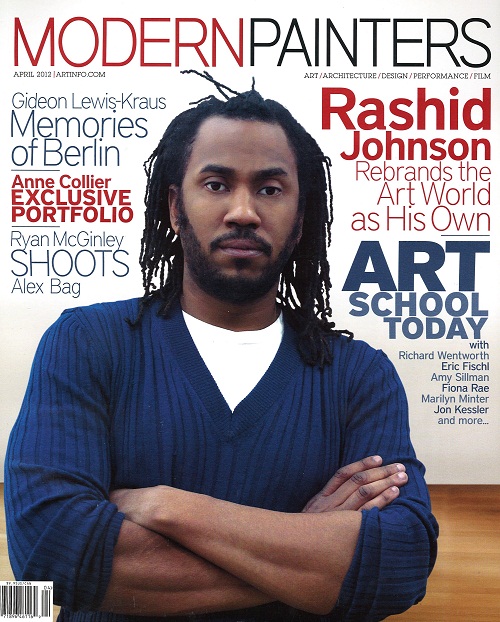
COVER: Rashid Johnson / Modern Painters / April 2012

Rashid Johnson, photographed in his Brooklyn studio by Micah Aaron Schmidt, 2012.

STUDIO CHECK: RASHID JOHNSON
TEXT BY ORIT GAT
PHOTOGRAPHS BY MICAH AARON SCHMIDT

Excerpt:
Johnson spends about a week or ten days on a single wood-flooring  painting, first building the support, and then beginning the slow process of burning and marking the work using brands that he heats in a forge. The labor-intensive practice calls for a large workspace, and Johnson is  looking for an even bigger studio as he prepares for his first major museum show, at the Museum of Contemporary Art in Chicago, opening April 14, along with an exhibition at South London Gallery, scheduled for September. The Chicago show, "Rashid Johnson: Message to Our Folks," which will include some of the pieces depicted here, is particularly thrilling to him: "Chicago is my hometown, I was just there, and it was lovely to see how enthusiastic people are about the show. The exhibition might also have the opportunity to travel, so that's really exciting."  


Pick up a copy of April 2012 issue of Modern Painters to see more photos and read complete story.

Sunday, January 1, 2012

POST: Rashid Johnson / Modern Painters / December 2011 - January 2012

Rashid Johnson, Cosmic Slop "Black Orpheus," 2011, Black soap. 72 x 96 x 1 3/4 inches. 
Photo by Martin Parsekian via Hauserwirth.com. 


Rashid Johnson, who has just joined Hauser & Wirth Gallery, will have his first show at its East 69th Street, New York, branch, opening on January 11. Alanna Martinez visited the artist in his Brooklyn studio to discuss the move and his distinctive sculptural technique.

Why Hauser & Wirth?

It's a gallery with a lot of important artists ans seems to show a tremendous amount of commitment to them. I became even more interested when a friend of mine, Matthew Day Jackson, started showing there. I also like the way my work functions in smaller domestic spaces. Although that space is not particularly small, it does have a strong domestic feel to it -- especially on the second floor.

Can you describe your recent work?

In some ways it hijacks familiar materials from the home. I've been working quite a bit with hardwood flooring, a lot of mirrors, and what are essentially bathroom tiles. I take a domestic space, appropriate them, and give them a different life.

The bathroom tiles are an interesting choice.

When I was in graduate school at the Art Institute of Chicago, I started going to a Russian-Turkish bathhouse once or twice a week. I would sit there in the corner shvitzing like a lunatic  and pouring over whatever I was reading. On the walls they had classic white bathroom tiles, which were often what I looked at when I lifted my head from the page to consider what I'd just read. I think it suggests a cleansing space, a place where I was clearing my head as well as clearing out toxins.

How do you want people to interact with your art in a gallery space?

I've never been interested in dictating. Installation shows give you an opportunity to create a micronarrative. But the people who come into the space don't need to navigate the narrative.


The December 2011/January 2012 issue of Modern Painters is on newsstands now.

January 11 - February 25, 2012
HAUSER & WIRTH NEW YORK
32 East 69th Street
New York, NY


Thursday, June 23, 2011

VIDEO: "Rashid Johnson Makes Things To Put Things On" by New York Close UP/Art 21

Rashid Johnson Makes Things to Put Things On | "New York Close Up" | Art21 from Art21 on Vimeo.

How does an artist contribute his own personal story in the face of prevailing historical narratives? In this film, artist Rashid Johnson discusses the fluid nature of black identity in America and its escapist tendencies, from the Afrocentric politics of Marcus Garvey to the cosmic philosophy of Sun Ra. Johnson’s invented secret society—The New Negro Escapist Social and Athletic Club—is a framework through which the artist humorously upends, through repetition and juxtaposition, conventional expectations of historical influence and legacy. Inspired by a story by the artist Lawrence Weiner in which one character says to another that “a table is something to put something on,” Johnson creates sculptures of shelf-like structures from materials such as black wax, mirror, tile, and branded wood. Each structure is filled with culturally resonant objects—such as Miles Davis and Ramsey Lewis jazz records, books by comedians Dick Gregory and Bill Cosby, and treatises by scholars such as W.E.B. Du Bois and Debra J. Dickerson—as well as the artist’s own photographs and hand-made objects. Featuring works from the exhibitions The Dead Lecturer (2008) and Other Aspects (2009-10), as well as works-in-progress in the artist’s Williamsburg studio.

Rashid Johnson (b. 1977, Chicago, Illinois, USA) lives and works in New York and Brooklyn, New York.

CREDITS | New York Close Up Created & Produced by: Wesley Miller & Nick Ravich. Editor: Mary Ann Toman. Cinematography: Andrew David Watson. Key Grip: John Marton. Sound: Nicholas Lindner & Nick Ravich. Associate Producer: Ian Forster. Production Assistant: Paulina V. Ahlstrom, Don Edler & Maren Miller. Design: Open. Artwork: Rashid Johnson. Thanks: Javier Cordero, Alex Ernst & Brian Lewis. An Art21 Workshop Production. © Art21, Inc. 2011. All rights reserved.