Showing posts with label TRANSITION. Show all posts

Saturday, April 16, 2016

TRANSITION: Malick Sidibé (1936 - 2016)


Malick Sidibé, Photographer Known for Social Reportage in Mali, Dies at 80


Text | William Grimes for NYTimes.com
Published | April 15, 2016

Malick Sidibé, whose black-and-white photographs of young partygoers captured the exuberance of newly independent Mali in the 1960s and ’70s and made him one of Africa’s most celebrated artists after his work was shown abroad in the 1990s, died on Thursday in Bamako, Mali. He was 80.

His son Karim Sidibé said the cause was complications of diabetes, The Associated Press reported.


Read full article here


Tuesday, February 2, 2016

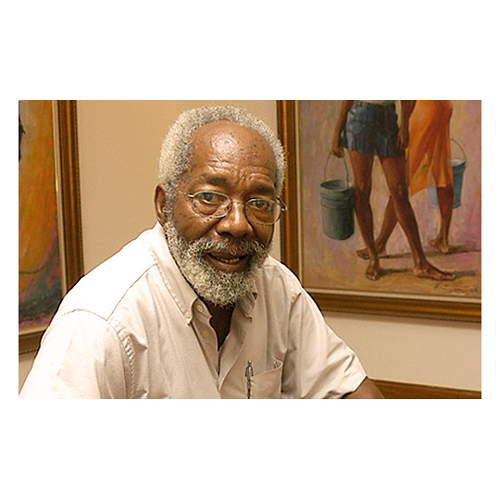
TRANSITION: Barrington Watson (1931 - 2016)


“[Jamaicans] should be more secure in our position in the world of culture. We should be taking all the art that is produced here all over the world."  ~ Barrington Watson


Tuesday, September 1, 2015

TRANSITION: Noah Davis (1983-2015)

Noah Davis. Image via toymachine.com.
Los Angeles painter and founder of Underground Museum dies at 32

Text | Alex Greenberger (with additional reporting by Sarah Douglas) for ARTnews.com
Published | August 30, 2015

Noah Davis, the Los Angeles–based painter of surreal, post-racial images and the founder of the nonprofit space the Underground Museum, has died at 32. Davis’s cause of death has not been announced, but he was sick with a rare cancer, according to a Los Angeles Times article published earlier this summer.
Davis is best known for his paintings of African Americans that have a dreamy, unreal quality to them, despite their muted color palettes and touches of realist detail. Although some of the figures that Davis painted were black, he didn’t consider his works political. “If I’m making any statement,”he told Dazed in 2010, “it’s to just show black people in normal scenarios, where drugs and guns are nothing to do with it.” Davis instead chose to describe his works as “instances where black aesthetics and modernist aesthetics collide.”

In 2012, for a show at the James Harris Gallery, in Seattle, Davis did a series of paintings about reality television, titled “Savage Wilds.” (Davis, who had also shown with Roberts & Tilton, was represented at the time he died by the Los Angeles gallery Papillion.) The works, like many others by Davis, play on the division, or lack thereof, between life and art, and between true personalities and performed ones. In one work, Jerry Springer is shown cautiously picking up a torn-off weave. Because Davis distorts Springer’s face, it becomes hard to tell whether the act is genuine or just for show. In other works in the series, television logos are painted onto the bottom to make clear that what we are seeing are stills.

Davis’s inspirations ranged from Leon Golub to Alfred Hitchcock’s film The Trouble with Harry. Many of Davis’s diverse references can be traced to his time working at MOCA LA’s bookstore after he left New York City. (“I left school because it wasn’t teaching me anything,” Davis said of his time at Cooper Union, where he studied between 2001 and 2004.) His time working at the museum brought him into art history of all kinds, though it was not as if he didn’t have art-world connections of his own—Davis was also friends with Dash Snow and Ed Templeton, who encouraged him to continue painting.

Davis also later founded the Underground Museum in 2012. The nonprofit space, in Los Angeles’s Arlington Heights, is in a space that used to be several storefronts, a pupusería, and a church. Davis ran the space, which became a notable cultural center in Los Angeles, with his brother the video artist Kahlil Joseph, who has worked with Kendrick Lamar and others. They knocked down all three of the original buildings and built a new one that allowed for shows and film screenings, and had a garden and a library.
Davis had several shows there and had plans to curate several more over the coming three years. In 2013, Davis created Imitation of Wealth, an installation in which Davis redid work by blue-chip artists, usually with low-cost materials. A sculpture from Jeff Koons’s “The New” series, for example, was remade using a $70 Hoover vacuum that Davis found on Craigslist. The installation has been restaged and is currently showing at storefront:, a space across the street from MOCA.

The Underground Museum was most recently the subject of the inaugural show at the Bruce High Quality Foundation’s University Gallery (BHQFUG), in New York. That exhibition looked at the way that the Underground Museum could be considered a work unto itself—how Davis’s space was just as much a way of mediating between life and art as any of his paintings, sculptures, or installations. “You’ll be hearing a lot about $400 million museums next week thanks to the opening of the new Whitney,” Christian Viveros-Fauné wrote in the Village Voice when the BHQFUG show opened. “But you won’t see anything nearly as surprising or as radical as Noah Davis and his Underground Museum.”

Davis’s late father was the lawyer Keven Davis, who worked with tennis players Venus and Serena Williams, helping to arrange a $40 million, five year contract with Reebok for Venus in 2000; he died of a brain tumor in 2012.

“I knew him and I know his brother,” Aleim Johnson, the Los Angeles-based publisher of Aleim magazine, told ARTnews of Noah Davis. “He was at dinner parties with me. He was so smart and had such a great sense of humor. He came to visit me recently with his wife. He was sick, but still we spent hours laughing. He was one of the most important young painters of his time.”

“When Noah spoke,” Johnson recalled, “he would often speak with imagery. He would describe something with specificity and detail and you could visualize what he was saying as if it were on a canvas. His words flowed as if he were painting.”

“I own a drawing he did of Venus Williams,” Johnson continued. “It’s in my living room in Los Angeles. It’s my favorite piece.”


Tuesday, June 2, 2015

TRANSITION: Lady Bird Strickland (1926 - 2015)

Lady Bird Strickand. Image via Facebook.

Artist who felt calling to paint black heroes is dead at 88

BlackArtistNews | June 2, 2015


BlackArtistNews has learned of the passing of artist Lady Bird Strickland. The announcement was made today through the Instagram feed of her daughter, legendary fashion icon Pat Cleveland:


“My mom Lady Bird the artist just passed away in peace at 88. God bless her for all her talents.”


No other details were available at the time of this post.

I have this to share about Miss Strickland:

In early 2013, I was fortunate to see an exhibition of her paintings at the Warden’s House Gallery in Mount Holly, NJ.

A decent number of Strickland’s representational works filled five small rooms on two levels of the gallery space. I wanted to document my visit but photography of the artwork was not permitted. The policy annoyed me, but in hindsight, it turned out to be a blessing: it allowed me to study -- even absorb -- the work with deeply committed engagement.

I admired the light and graceful impact of the paintings. They were uplifting. Even Strickland’s compositions on the indignities of American slavery possessed a noble quality.

How can that be?

There’s nothing “noble” about slavery.

I know that.

For me, the paintings were noble in idea and execution.

Strickland’s use of soft, controlled brushstrokes personified the “romantic” notion of the South, but as your eyes read the canvas, you realize the intent of the work is to expose the horrific reality of antebellum south, not romanticize it.

That’s some real black history.  

This realization was a way more powerful take away than any installation photograph I would have taken.

The gallery attendant told me that it was Lady Bird Strickland’s dream to have one of her paintings added to the permanent collection of the Smithsonian.

Truth be told, she deserves that and much, much more.

I hope that dream is realized because Americans will benefit from the valuable history lessons embedded in her work.

I know I have.


Lady Bird Strickland and her daughter Pat Cleveland photographed by Carl Van Vechten


Tuesday, January 27, 2015

TRANSITION: John Wilson (1922-2015)

John Wilson photographed in 2001 by Tom Herde. Image via bostonglobe.com.
Artist spurred by social realities dead at 92

Text | Bryan Marquard for BostonGlobe.com
Published | January 26, 2015

In the Capitol Rotunda in Washington, D.C., stands a 3-foot-tall bronze bust of the Rev. Martin Luther King Jr. that is surely the most viewed creation of John Wilson, an artist who grew up in Roxbury and painted, sculpted, and made prints out of his home studio in Brookline for decades.

Like much of his most important work, the bust brings viewers to the intersection of art and politics, of pure creativity and the desire to examine social injustice. Mr. Wilson, who was 92 when he died Thursday evening in his Brookline home, pursued that path since he was a boy on Roxbury’s streets, learning to sketch and honing a burgeoning talent that eventually would place his paintings and sculptures in the Museum of Fine Arts and far beyond.

“To me the eloquence of the piece is not only in the face, but in the rhythms of the gesture,” Mr. Wilson told the Globe in 1986, just before the bust was unveiled in the Rotunda on what would have been King’s 57th birthday. “The head is tilted forward, as if to communicate with the viewer. I hope the sculpture will stimulate people to learn more about King, to perpetuate his struggle.”

Mr. Wilson’s own journey to prominence was fueled in part by his reaction to art he saw as a teenager during visits to the MFA.

“None of these people looked like me and just by omission the implication was that black people were not capable of being beautiful and true and precious,” he told the Globe in 1995 when “Dialogue: John Wilson/Joseph Norman,” opened at the MFA and his own sculptures and sketches shared museum space with the work that drew his criticism years before.

Of that show, Globe art critic Christine Temin wrote that Mr. Wilson “emerges as a powerful artist, too little known for someone who has produced stellar work for half a century.”

Writing about “Eternal Presence,” a career survey of Mr. Wilson’s work that opened in 2012 in Danforth Art, Globe art critic Sebastian Smee called him “one of Boston’s most esteemed and accomplished artists” and wrote that from Mr. Wilson’s early sketches to his more recent large-scale charcoal drawings, “the impulse has remained the same: It is an impulse toward clarity, toward truth.”

“I think he will gain in importance as time goes on,” said Katherine French, director emerita of Danforth Art, where several of Mr. Wilson’s works remain on display through May 17.

“He will be recognized as a major artist of the 20th century. I really have no doubt about that,” added French, who has finished curating “John Wilson: Boston’s Native Son,” a show that opens in the St. Botolph Club Feb. 18.

The second of five siblings, Mr. Wilson was born in 1922 in Roxbury, where his parents settled after emigrating from British Guiana and found little work once the Great Depression hit. Mr. Wilson always was aware of racial inequities. His father regularly read African-American newspapers such as The Amsterdam News, which seemed to have images of lynchings in “practically every other issue,” Mr. Wilson said in a 2012 interview with French, who wrote an essay about the artist that Danforth Art will soon publish.

Drawn to art classes at Roxbury Memorial High School, Mr. Wilson was art editor of the school newspaper and took classes at the Boys Club from teachers who were students at the School of the Museum of Fine Arts. They showed his work to faculty at the Museum school, which awarded a full scholarship to Mr. Wilson. There, he counted among his teachers Karl Zerbe, a Boston Expressionist born in Germany. Years later, critics would see early evidence of Mr. Wilson’s talent in “Boy with Bow Tie,” drawn in his mid-teens.

In 1945, Mr. Wilson graduated from the Museum school with highest honors, and one of his works was included in “The Negro Artist Comes of Age,” an Albany Institute of History and Art exhibition. He taught at Boris Mirski modern art school in Boston and graduated in 1947 with a bachelor’s degree in education from Tufts University. Among his key works during those years was a print depicting Bigger Thomas, the protagonist of Richard Wright’s 1940 novel “Native Son.” Mr. Wilson also developed an admiration for Mexican muralists, particularly Jose Clemente Orozco

Awarded a traveling fellowship from the MFA, Mr. Wilson moved to Paris and studied with the modern artist Fernand Leger. After returning home, Mr. Wilson visited the Lower East Side in New York City, where he met Julie Kowitch, a teacher who had graduated from Brooklyn College. They married in 1950 and went to Mexico on a John Hay Whitney Fellowship. As an interracial couple, they traveled by necessity in separate cars while passing through the segregated South.

Though Orozco died a few months before he arrived in Mexico, Mr. Wilson was drawn to mural making — art that could be viewed by those who, like him, had grown up in the streets with neither the money for museums nor social access to private collections. A lasting work from this period was “The Trial,” a lithograph depicting three judges, their faces hidden behind white theatrical masks, looming vulture-like over a young black boy who stands awaiting judgment.

Back in the United States, Mr. Wilson produced lithographs for unions in Chicago and taught in New York City before returning to Massachusetts in 1964 to teach at Boston University. Over the years, his work was included in exhibits at museums and galleries including the Museum of Fine Arts and Martha Richardson Fine Art on Newbury Street. Mr. Wilson also worked to create the National Center of Afro-American Artists in Roxbury.

“Essentially, he felt that his main objective as an artist was to deliver a message to people about black dignity, about racial justice, about poor people trying to get a better deal in life,” his wife said. But also, sketching constantly on index cards and any available scrap of paper, Mr. Wilson composed portraits of family members, friends, and life unfolding around him. During one car trip to New York City with his daughter and infant grandson, “he did a series of sketches of him over the backseat of the car,” said his daughter Erica of Brookline. “I have them framed in my hallway.”

A service will be announced for Mr. Wilson, who in addition to his wife and daughter leaves a son, Roy, of Watertown; two brothers, Frederick and James, both of Los Angeles; and four grandchildren. Another daughter, Rebecca Wilson-Sealy, died last year.

A perfectionist in everything he did, Mr. Wilson “was incredibly physical when he worked,” his son recalled. “He moved with tremendous energy. Each stroke seemed decisive.”

In 1986, Mr. Wilson wrapped the King sculpture in blankets and an old sleeping bag, tucked it into the back of his Mazda, and headed to the Capitol Rotunda. Before that trip, he had not stepped inside the Capitol building.

“Somehow it seemed like the epitome of the seat of power, and it alienated me,” he told the Globe in 1986. “I never felt part of it. But when I delivered the sculpture, that changed. I felt, ‘A piece of me is in that building.’ ”


Tuesday, November 25, 2014

TRANSITION: Annie Lee (1935 - 2014)

Annie Lee. Photo via tomjoynerfoundation.org. 
Artist known for her "faceless paintings" dies at 79

Text | BlackAmericaWeb.com
Published | November 24, 2014

Internationally acclaimed artist, Annie Lee, known for her unique ability to celebrate African American culture passed away Monday, November 24th in Henderson, NV. She was 79 years old.

Annie Lee had a very special gift. She let her artwork do the talking.  She had the unique talent to paint a scene that captured people’s emotions. She lured you into her work with her wistful brushes of color. If her painting included people, you could hear them talking and laughing. If her painting had someone playing the harp or a saxophone, you could imagine the music. While Lee’s work featured African Americans, she captured American life from all angles.

Annie Lee’s signature style was to paint figures devoid of faces. Her subject’s body language and setting expressed strong feelings in a unique way that moved her audience.  Her most popular works included My Cup Runneth Over, Blue Monday and most recently a portrait of the first family entitled Oval Office.

Over the decade, Lee has been a huge supporter of the Tom Joyner Foundation. She donated her time and artwork to help the Foundation raise money to help students at Historically Black Colleges and Universities.  Her Higher Education: A Way to Soar painting celebrates student success. Her White Night painting captures the elegance and whimsy of one of the theme nights on board the Fantastic Voyage, an annual weeklong cruise that is a huge fundraiser for the Foundation, where she was a regular exhibitor.

Annie Lee is survived by her daughter Davina Joy, her son Charles and a host of grandchildren and great grandchildren.

Blue Monday by Annie Lee


Tuesday, October 7, 2014

TRANSITION: Geoffrey Holder (1930 - 2014)

Geoffrey Holder, photographed in 1989 by Arnold Newman.
Geoffrey Holder, Multitalented Artist, Dies at 84

Text | Jennifer Dunning and William McDonald for The New York Times
Published | October 6, 2014

Excerpt:

Geoffrey Holder, the dancer, choreographer, actor, composer, designer and painter who used his manifold talents to infuse the arts with the flavor of his native West Indies and to put a singular stamp on the American cultural scene, not least with his outsize personality, died on Sunday, October 5, 2014 in Manhattan. He was 84. 
Painting was a constant for him. Whether life was hectic or jobs were scarce, he could usually be found in the SoHo loft he shared with [his wife Carmen] de Lavallade, absorbed in work that drew on folk tales and often delivered biting social commentary. On canvases throughout the studio, sensuous nudes jostled for space with elegantly dressed women, ghostly swimmers nestled beside black Virgin Marys, bulky strippers seemed to burst out of their skins, and mysterious figures peered out of tropical forests.
His work was shown at the Corcoran Gallery in Washington and at the Guggenheim Museum in New York. And then there was his photography, and his sculpture.
His visual creativity extended to costume designs, “The Wiz” being just one showcase. Another was John Taras’s 1982 production of “The Firebird” for the Dance Theater of Harlem, in which the Russian fairy tale was relocated to a tropical forest. Mr. Holder designed both the sets and the costumes, one of which was a blend of 30 or 40 colors. He earned another Tony nomination for best costume design for the 1978 Broadway musical “Timbuktu!,” an all-black show based on the musical “Kismet.” He also directed and choreographed “Timbuktu!”


Read full obituary here.


Wednesday, September 3, 2014

TRANSITION: Earl Calloway (1926 - 2014)

Earl Calloway, longtime Chicago Defender writer, creator of 'Black Creativity' program, dead at 87

Text | Adrienne Samuels Gibbs, Staff Reporter Chicago Sun-Times
Published | August 23, 2014


Funeral services [were] held Aug. 31 for Earl Calloway, a longtime columnist and fine arts editor for the Chicago Defender who also organized the cultural festival now known as Black Creativity.

Mr. Calloway died Wednesday. He was 87.

Mr. Calloway was born Oct. 4, 1926, in Birmingham, Ala., and graduated from Roosevelt University, where he studied music.

After writing for the Associated Negro Press, the Chicago Courier and Negro Press International, he went to work in 1963 for the Defender, for which the “Earl’s World” columnist wrote for five decades. He was also a founding member of the Chicago chapter of the National Association of Black Journalists.

An accomplished operatic tenor who performed in Chicago and elsewhere, Mr. Calloway founded the yearly event originally called the Black Esthetic Festival, now called Black Creativity. Now hosted by the Museum of Science and Industry, the annual February exhibition and accompanying gala shine a spotlight on African-American excellence in science and technology and also includes a juried art exhibition.

He also was a founder of the Fine Arts Academy and the Philharmonic Youth Choir and Oratorio Society of Shiloh Seventh-Day Adventist Church and served as executive director of the Supreme African American Academy of Arts and Letters.


Sunday, February 9, 2014

TRANSITION: Terry Adkins (1953 - 2014)

Terry Adkins photgraphed by Luca Nostri. Image via upenn.edu.
From Salon 94 e-blast dated February 8,2014:

Dear Friends and Colleagues,

We are saddened to announce the untimely death of artist and friend, Terry Adkins.

Terry was an intrepid and accomplished artist, performer, musician, and educator who approached his life and work with enormous spirit, audacity, humor, and indefatigable intellect. He was a beloved professor of Fine Arts at the University of Pennsylvania, whose influence will be felt by younger artists for years to come. He died suddenly in his home on Fri​day night from heart failure. He was 60 years old.

Born in 1953, Terry graduated from Fisk University in 1975 with a BS, from Illinois State University in 1977 with a MS, and received his MFA from University of Kentucky in 1979. His approach to art making has always been like a composer, demarcating moments for silence, sound, and rhythm.  “Color and surface texture impart voice and character,” he wrote in 1990, along with form, they generate “harmonic resonances which can be absorbed as well as merely seen… The language of [my] work is esoteric, symbolic, abstract.”

Known for his instruments including a variety of immense horns, Terry frequently performed with his long-time band The Lone Wolf Recital Corps. His most recent performances profoundly moved New York City audiences both at The Studio Museum in Harlem and as part of Performa 13. Applying the improvisational and recycling nature of jazz to his exhibitions and sculptural series, Terry has riffed on biographies as a creative framework. His work has recovered and honored such figures as Jimi Hendrix, Zora Neale Hurston, Ralph Ellison, Ludwig van Beethoven, Jean Toomer, John Coltrane, John Brown, Sojourner Truth, and most recently George Washington Carver and Yves Klein.

Terry’s work is currently included in the exhibition Radical Presence, organized by Contemporary Arts Museum Houston, which traveled to the Grey Art Gallery, New York, The Studio Museum in Harlem, and is going to the Walker Art Center in July. His latest work, three-dimensional representations of bird songs made from cymbals and percussion instruments, will be featured in the Whitney Biennial 2014, on view from M​​arch 7 - M​​​a​y 25, 2014.

Terry has presented solo museum exhibitions at The Whitney Museum of American Art (1995), Sculpture Center, New York (1997), Institute of Contemporary Art, Philadelphia (1999), the Bronx-River Art Center (2005), and most recently at the Tang Museum, New York (2012). His work is included in the public collections of The Hirshhorn Museum and Sculpture Garden, Washington D.C., The High Museum of Art, Atlanta, Studio Museum in Harlem, The Metropolitan Museum of Art, New York, The Museum of Modern Art, New York, and most recently, The Tate Collection, London. 

Our heartfelt condolences go out to his wife Merele Williams-Adkins, his son Titus Hamilton Adkins, and his daughter Turiya Hamlet Adkins. We will miss Terry tremendously and mourn the loss of a great artist, performer and enchanter.


With Affection,

Jeanne Greenberg Rohatyn | Founder

Alissa Friedman | Partner and Director


Monday, January 27, 2014

TRANSITION: Morrie Turner (1923 - 2014)

The late Morrie Turner photographed in 2009 at the San Francisco Main Library where his comic strip Wee Pals was the subject of a retrospective. Photo by Brant Ward, The Chronicle.

Text | Kevin Melrose for Comic Book Resources

Published January 27, 2014

Wee Pals creator Morrie Turner, the first nationally syndicated African-American cartoonist, passed away Saturday, January 25, 2014 in a Sacramento, California, hospital. He was 90 years old.

Raised in Oakland, Turner was a self-taught artist who drew cartoons for Army newspapers while serving during World War II with the 477th Bomber group. Following his discharge, he worked as a police clerk while also creating strips for a number of publications.

In 1959, the black daily newspaper the Chicago Defender began publishing his all-black strip Dinky Fellas, created with the encouragement of his friend Charles Schulz after Turner expressed a desire for a comic that reflected his childhood experiences. But it wasn’t until Turner diversified the cast, introducing kids from different ethnic backgrounds, that Wee Pals was born.

“All the kids were different,” the cartoonist recalled in a 2009 interview with the San Francisco Chronicle. “White, Filipino, Japanese, Chinese, black. It was a rainbow. I didn’t know that wasn’t the way it was other places. Oakland was that way before the war. We were all equal. Nobody had any money.”

Introduced for national syndication in 1965, Wee Pals initially appeared in just five major newspapers; integration of the comics page wasn’t easy. But within three months of Martin Luther King’s assassination in 1968, that number grew to 100.

Wee Pals was adapted in 1972 as a short-lived animated television series called Kid Power.

Honored in 2003 with the National Cartoonists Society’s Milton Caniff Lifetime Achievement Award, Turner was also the subject of the 30-minute documentary “Keeping the Faith With Morrie”.

Turner spent much of his free time visiting schools until age and failing kidneys made those appearances difficult. He updated his Facebook page on Thursday, January 23, 2014 writing, “Have been having some medical issues that require surgery — and I’ll be recuperating for a bit.” He also invited fans to keep him company during his dialysis treatments, saying, “No need to call first; simply sign in, don a paper gown and visit!”

He’s survived by his son Morrie Jr., grandchildren and great-grandchildren, and his companion Karol Trachtenburg, with whom he lived in West Oakland.