Showing posts with label Curators. Show all posts

Friday, March 11, 2016

PARIS: Wasteland - New Art from Los Angeles

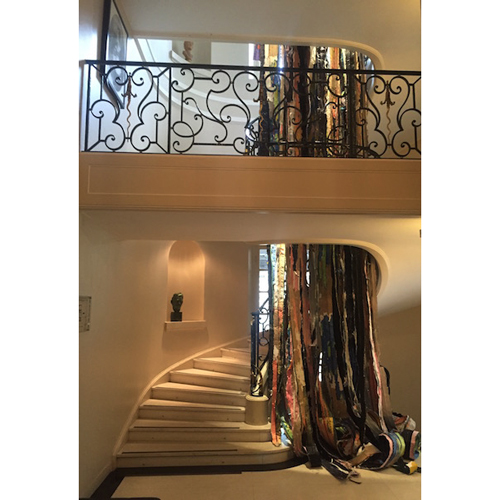
Installation view of Mark Bradford's A Private Stranger Thinking About His Needs (2016).
Photo: Courtesy the Artist and Hauser & Wirth via artnet.com.
Curated by Shamim Momin

Featuring Edgar Arceneaux | Lisa Anne Auerbach | Math Bass | Mark Bradford | Sam Falls | Daniel Joseph Martinez | Jonathan Pylypchuk | Fay Ray | Ry Rocklen | Amanda Ross-Ho | Analia Saban | Shannon Ebner & Erika Vogt | Brenna Youngblood

March 11 - July 17, 2016
MONA BISMARCK AMERICAN CENTER
34 Avenue de New York
Paris, France

March 12 - July 17, 2016
GALERIE THADDAEUS ROPAC
69, Avenue du Général Leclerc
Pantin, France

From nomadicdivision.org:

Wasteland is a group exhibition curated by LAND (Los Angeles Nomadic Division)’s Director and Curator, Shamim M. Momin, at two parallel venues in Paris: the Mona Bismarck American Center and Galerie Thaddaeus Ropac Paris Pantin. The exhibition will be on view from March 11 through July 17, 2016. Hours of viewing at the Mona Bismarck American Center are Wednesday through Sunday, 11am-7pm; Galerie Thaddaeus Ropac, Pantin are Tuesday through Saturday, 10am-7pm. Wasteland features many of the most exciting contemporary artists based in Los Angeles, including Edgar Arceneaux, Mark Bradford, and Brenna Youngblood. The artists will be present for press previews and opening receptions at both venues: Mona Bismarck American Center: March 11,  2016, 7-9pm; Galerie Thaddaeus Ropac Paris Pantin: March 13, 2016, 2-6pm. A roundtable discussion with the artists moderated by Momin will be held at the Mona Bismarck American Center on March 12, 2016 at 3pm.

This unprecedented collaboration between LAND, the Mona Bismarck American Center, and Galerie Thaddaeus Ropac presents a unique opportunity to expand the reach of each institution’s audience, particularly that of LAND with this ambitious exhibition being the organization’s first international endeavor. Furthering the dialogue between two of the most dynamic art cities in the world, LAND and its partners will present curated programming that will take place in both Paris and Los Angeles throughout the run of the exhibition. A full schedule of events will be announced in the coming weeks.

Drawing on T.S. Eliot’s seminal modernist poem, The Waste Land, as the thematic thread between the 14 participating artists, the exhibition presents a reflexive, complex, multi-dimensional conversation about the poetics of despair, the search for true connection, the tenuous state of morality, and the uncertainty, yet necessity, of the future. The original text was published in 1922, written at a moment of disturbing parallel to the present, one of great disillusionment with the state of the world politically (post WWI) and culturally (the modern urban landscape) and individually (the increasing loss of true communication, connection, and faith).

Beyond the literary referent, the title also evokes other definitions and connotations — whether the old chestnut (long disproven but still present) of Los Angeles as a “cultural wasteland,” or a more literal reading of the word applied to the physical geography of both the city and the natural landscape of Southern California. It additionally calls to mind resonant images of the post-apocalyptic, the post-human, the potential future, largely created through the image magic of Los Angeles’ greatest export, Hollywood.

Diverse in nature and practice, the artists in Wasteland, who are all connected to Los Angeles, work in many different media and modes of presentation — a kind of “expanded practice” in which all aspects of their oeuvre are considered equally important; a performance as much as a sculpture, an interactive installation as much as a painting, a music group as much as a photograph. In keeping with this approach, this exhibition is an opportunity to additionally consider site — both the specific venues, as well as the city of Paris itself — as part of the work presented. In every case, the artist will create a newly commissioned work or recombine works to create a conversation with and between the two venues, as well as the two cities.

Furthering the idea of Los Angeles of a wasteland, the exhibition highlights a number of techniques, materials, and themes, examples of which include Edgar Arceneaux’s sculptural labyrinth library of crystallized books and scrolls engaging notions of the trajectory of Art History and African American identity; Lisa Anne Auerbach’s pairings of her political and provocative knitted panels and matching garments; Mark Bradford’s cascading sculptural painting in the staircase at the Mona Bismarck American Center of shreds of paper strips caked with paint and other debris edited from another work, referencing Bradford’s material and artistic waste; and Jon Pylypchuk’s anthropomorphic and otherworldy sculptural figures made of castaway objects such as cigarettes and old tennis rackets.

A catalogue will be published on the occasion of the exhibition, with an overall thematic text by Shamim M. Momin. Los Angeles-based writers, art historians, editors, and curators have been selected to contribute one essay specific to each of the fourteen artists on view. The writers include Andrew Berardini, Carol Cheh, Trinie Dalton, Cesar Garcia, Suzanne Hudson, Laura Hyatt, Jamillah James, Kristina Kite, Sharon Mizota, Julian Myers,Claire Rifelj, and Kate Wolf.






Sunday, February 21, 2016

MAIN ATTRACTION: Franklin Sirmans

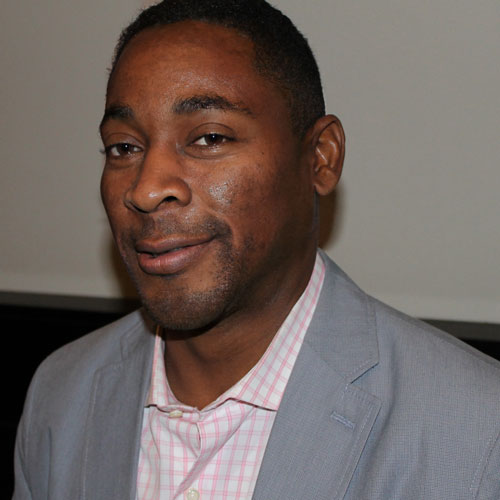
Franklin Sirmans, director of the Pérez Art Museum, welcomes guests and patrons during the third annual Reception for the PAMM Fund for African American Art in Miami, on Tues., Feb. 16, 2016. Photo by Pedro Portal (pportal@elnuevoherald.com) via miamiherald.com
Museum director’s star power draws crowd to Pérez Art Museum Miami

Text | Jane Wooldridge for the MiamiHerald.com
Published | February 16, 2016

Thank the star power of museum director Franklin Sirmans and the convergence of Black Tech Week at the nearby Adrienne Arsht Center for [a] stellar turnout at the Pérez Art Museum Miami’s third annual Ambassadors event.

More than 1,300 — more than double the crowd in previous years — RSVP’d for the reception, an outreach funded by the Knight Foundation in support of the museum’s Fund for African American Art.

Knight Foundation President and CEO Alberto Ibargüen attributed the event’s growth to past success — “people know we throw one of the best parties of the year” — and to interest in Sirmans, who is widely considered a rising star in the art world. “There is no getting around the fact that people are excited about Franklin Sirmans; they’re energized and they’re proud that he’s our museum director.”

Sirmans joined the museum last fall, becoming the first African American to serve as director of the PAMM or its predecessor, the Miami Art Museum.

[The] event was designed to connect the African-American community with the museum and raise both awareness and funds for PAMM’s African American Art Fund, founded with a $1 million donation by the Knight Foundation and museum namesake Jorge M. Pérez to purchase works by African Americans.

The event [drew] the kind of community interest the Knight Foundation had intended, said Ibargüen. “Where I think it could do better is drawing other people to contribute to the fund. I would love for people to step up and put money on the table.”

About 200 have signed up for Ambassador membership, making a minimum $250 annual contribution.

For the first time, the event included performances — one by Jamaican artist Nari Ward, whose Sun-Splashed is on display at the museum, and a second by Girl Power’s Girls’ Choir of Miami.


Friday, February 12, 2016

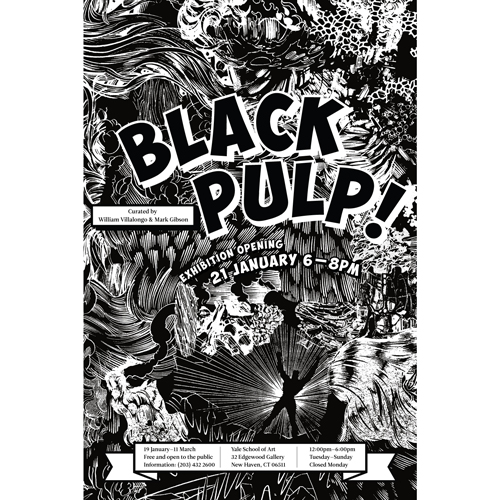
NEW HAVEN: Black Pulp!


Curated by William Villalongo and Mark Gibson Dimensions
January 21 - March 11, 2016

YALE UNIVERSITY SCHOOL OF ART
32 EDGEWOOD GALLERY
32 Edgewood Avenue
New Haven, CT

Text by Beatrix  Archer for The Yale Herald:

A video of a man belly-crawling his way through New York City, rare comic books, prints by Kerry James Marshall, and issues of the Anti-Fascist Front Magazine—these are just a few of the 65 objects and artworks on display in Black Pulp!, a show up at 32 Edgewood Avenue until Mar. 11. William Villalongo, artist and lecturer at the Yale School of Art, and Mark Gibson, ART ’13, curated the show. By displaying the work of black artists and publishers, as well as non-black artists and publishers “allied with foregrounding the black experience,” as the press release for the show explains, Pulp! aims to “challenge racist narratives and change limited notions of black experience.” The show is ambitious, and the expansive range of its content merits multiple visits to the gallery.

The idea for this multimedia exhibit arose from discussions between Villalongo and Gibson, sparked by Kara Walker’s “A Subtlety or the Marvelous Sugar Baby” project in 2014. In that show, Walker created a giant, sugar-coated sculpture in the old Domino Sugar factory in Brooklyn. “Mark and I were floored by how wild and over the top it was,” Villalongo recalled in an email to me. “The aggressiveness and subversiveness of the expression led us to start questioning it as a sort of ‘pulp’ attitude which can be defined as a lurid, satirical and absurd, most readily found in comics and pulp fiction.” When Robert Storr, Dean of the Yale School of Art, asked the faculty for Edgewood Gallery show proposals, Villalongo saw it as a chance to turn musings into a reality.

Villalongo and Gibson began by tracing “a history of printed media that addressed the history of images surrounding African-Americans that used the satirical, printed matter and fiction as a strategy to reconstruct and confront a history of derogatory imagery levied upon black people in the Americas,” Villalongo explained. Though at first unsure of any connection they might find between comics and journals from the time, Villalongo and Gibson quickly found that the visual connections were “undeniable” and “immense.” The work on view starts with the Harlem Renaissance. It was at this time, says Villalongo, that publishing became not only a tool, but a form of activism. “It’s the first time we see a concerted group effort to combat the political and social inequities of black people while producing an image of what that looks like and how black people would like themselves to be seen,” he stated. Works from this era are displayed in cases beside recent works by contemporary artists. By placing these works in the same place, Villalongo notes, the show is able to bring together both “high” and “low” art forms across time. Doing so, he says, allows us to “question these boundaries and address similar problems of image and stereotype in our time.”

Much of the media on display is explicitly about black experiences. Black Panther Party Newspapers, or “The Crisis: A record of the Darker Races,” a publication created during the Harlem Renaissance, are both prime examples. Other objects on display connect more subtly to these experiences. A strip of the comic “Krazy Kat” might first seem irrelevant or slightly absurd in the context of the show: the strip depicts a cat, a mouse, and a worm in and out of a jail and holding various picket signs. But, as the entry written about the piece explains, the comic artist George Herriman’s own mixed racial identity is considered to have had an impact on the subject of his comics and the actions of the characters he created. The Krazy Kat comic is from 1944, and it sits in a display case among other comics from up to 10 years before and 40 years after its publication, an illustration of the show’s extensive reach across time.


Read complete story here


Sunday, February 7, 2016

APPOINTED: Harlem's Studio Museum curator Naima J. Keith named California African American Museum deputy director

Naima J. Keith photographed December 12, 2012. Photo from BlackArtistNews archive.

Text | Carolina A. Miranda for The Los Angeles Times
Published | February 4, 2016

Curator Naima J. Keith, who for five years helped organize lauded exhibitions at the Studio Museum in Harlem, has been named the new deputy director for exhibitions and programs at the California African American Museum  in Los Angeles' Exposition Park. The move brings a nationally recognized curator to the institution, which organizes artistic and historical exhibitions related to African American life in California and beyond.

"She was the top candidate," says the museum's executive director George Davis. "She was so impressive. And I really feel that the California African American Museum will have a great vision as a result of her presence."

In her time at the Studio Museum in Harlem, Keith curated the traveling exhibition"Charles Gaines: Gridwork 1974-1989," the first museum survey devoted to the early works of the L.A.-based abstractionist, which opened at the Hammer Museum early last year.

The show received a nomination for “Best Monographic Museum Show in New York" by the International Assn. of Art Critics — competing against exhibitions at the Metropolitan Museum of Art and the Museum of Modern Art.

Moroever, she organized "Rodney McMillian: Views of Main Street," scheduled to open at the Studio Museum in March, the first major solo museum exhibition devoted to the work of the Los Angeles sculptor and installation artist.

Keith's hire brings a ray of good news to CAAM, a small, largely state-funded institution that had been without a director for roughly a year since long-time director Charmaine Jefferson stepped down in July of 2014.

Read complete story here.

Monday, October 12, 2015

NASHVILLE: Topography (Curated by Jamaal B. Sheats)

Wesley Clark, My Big Black America, 2014, Reclaimed wood pallets, wood, nails, and black stain. 120" x 192"
Image via tinneycontemporary.com 
October 3, 2015 - November 28, 2015


Featuring Wesley Clark, Alfred Conteh, Alicia Henry, Jamea Richmond-Edwards and Jamaal B. Sheats


TINNEY CONTEMPORARY
237 5th Avenue
Nashville, TN


From tinneycontemporary.com:

Tinney Contemporary is pleased to present Topography, curated by Fisk University’s Jamaal B. Sheats. Topography focuses on the context of memory, individuality, community cohesion, and characteristics of social and economic (in)equalities that collectively create layers of a conceptual topographical map.


Saturday, September 5, 2015

APPOINTED: Franklin Sirmans

Franklin Sirmans in 2012. Photo from BlackArtistNews archive. 
Franklin Sirmans named director of the Pérez Art Museum Miami: “A museum is not only a place unto itself”

Text | M. H. Miller for ARTnews.com
Published | September 4, 2015

This week, Franklin Sirmans was named the director of the Pérez Art Museum in Miami. The museum, which opened in 1984, finished a massive renovation project in 2013, with a new building designed by Swiss architects Herzog and de Meuron. Sirmans, currently the curator of contemporary art at the Los Angeles County Museum, will start his directorship next month. He’s been quite in demand over the last decade, having worked previously as a curator of modern and contemporary art at the Menil Collection in Houston, as well as serving as a curatorial advisor for MoMA PS1. Among the many blockbuster shows he’s organized is last year’s excellent Prospect triennial in New Orleans. We reached Sirmans by phone Friday morning. He had flown to Miami for a few days, and had just met with the Pérez staff.
I guess to begin, what are some of your goals as the director of the Pérez?

Well, I start in, like, a month and a half. I think first and foremost—and it’s not a long-term goal—but first is to really just absorb the archive, and to absorb the things that have happened here, from opening in 1984, to becoming a collecting museum in 1996, and now with this amazing building that’s just been open not even two years yet. So that’s the first thing. Just absorb it all, and get a deeper sense of the foundation of where the museum comes from so we understand where we’re going. Of course that entails doing a lot of talking to people and working with Tobias Ostrander, our chief curator, and thinking through those things. That’s the first goal.

Then I guess it becomes more about long-term development. I think it’s safe to say, with the building done—and it’s gorgeous and it functions—to think about ways in which you can really highlight it. It sits right on Museum Park, and you have this great meeting place, where people want to come, and want to run into people, and hopefully see something that is not only entertaining but potentially makes people think and have different experiences that are triggered by art and ideas.

Los Angeles, where you’ve been based for a while, is a kind of endlessly aspirational city, and people are constantly comparing it to something else, usually New York. L.A. is either the next New York, or it was the original New York, or whatever. So, with this in mind, how do you think Miami compares to Los Angeles?

Well, I don’t know. Two very different cities, but with a lot of similarities. I think people have applied the “is it going to be the next New York” thing in the same way [to Miami] as in L.A. We sort of have these old institutions—you think of New York, you think of Boston, and we’re talking about hundreds of years of history. But L.A., one of the cool things about working in L.A., and being a part of that, is that LACMA has only been there since 1965. So you have this incredibly fertile backdrop. You have John Baldessari right there, you have Ed Ruscha right there, telling you how they were able to stay in Los Angeles in the ’60s and make art. So there’s that very direct, primary relationship.

And here, this institution, we’re only talking about the mid-’80s. It’s another young, fast-moving place. That is, I think, a really exciting opportunity, especially to think about this place and its geographic location between North and South America, and part of the Caribbean. Having that as a backdrop is pretty amazing.

In an interview you gave with the New York Times this week, you said something interesting about the curator in the 21st century—that just being somebody who puts together shows isn’t the case anymore, and all curators are also fundraisers as well. I know you haven’t started your role as director yet, but I’m curious if you have any thoughts as to how the role of the museum director has changed as well?

I feel so fortunate having worked for [LACMA’s director] Michael Govan and having known him and seen the way he worked. And then working for someone who’s really different but also passionate—Joseph Helfenstein [the director of the Menil Collection]. So I think that the position—of course speaking from a detached sense—is more of a place where we consider what it means to be a director from the inside and the outside. And I guess that means there was a time, perhaps similar for curators, where directors could think solely about what happened inside the institution. And things like education, things like programs that happen at non-regular open hours weren’t so important.

And there were questions. How does performance play into that? How does public sculpture play into that? How does the museum work as a place that is sort of the nexus for many different kinds of institutions? Because artists are so fertile in terms of creativity and so interdisciplinary, how do we use the museum to talk about those things so we can crisscross with science, with music, with education? All of those things play a role now. And the museum can be that place where it all comes together. And I think the position involves putting forth a multidisciplinary view, like how our best artists, or the artists we admire, push ideas to new boundaries and get people to think in different ways. I think that the director has potentially become more a part of that very open process. At least from my vantage point. I think about directors I’ve seen working—I think of Thelma Golden and what she’s done with the Studio Museum. I think a museum is not only a place unto itself, it’s a place that is important to a community as a whole, and it has become even more important.


Monday, August 31, 2015

APPOINTED: Janet Dees

Janet Dees photographed by Kate Russell. Image via newcity.com.
Contemporary art expert joins curatorial team of Northwestern University’s Block Museum of Art

Text | Peter Kotecki for The Daily Northwestern
Published August 27, 2015

Contemporary art expert Janet Dees will join Northwestern’s Block Museum of Art this fall as a curator.

Dees, who joins the museum Sept. 21, will focus on modern and contemporary art with a global perspective, said Kathleen Bickford Berzock, associate director of curatorial affairs at Block. The new curator will work with international, diasporic, colonial and postcolonial art, Berzock said.

Dees said she is excited to come to NU and looks forward to working with the museum staff.

“The opportunity to work at a museum within the context of a research university is very exciting to me, and the opportunity to connect with faculty and students across disciplines, and the ability to really slow down and dig deeper in the kinds of projects that I’ll be proposing,” she said.

Berzock said Dees, a PhD candidate in 18th-20th century American art history at the University of Delaware, is a great fit for the curator position because of her training in contemporary and American art.

“She also has a strong background with modern art, but she has always approached that from multiple perspectives,” Berzock added.

Throughout her career, Dees has worked with African, African American, Native American and Latin American artists to weave their diasporas into the study of modern and contemporary art, Berzock said.

“Those are all really important strengths for the program that we have here at the Block and (Dees) has specific kinds of expertise that complement the expertise on site already,” she said.

Dees is coming to NU from SITE Santa Fe, a contemporary art organization. In Santa Fe, Dees was part of a team that organized “SITElines: New Perspectives on the Art of the Americas,” a Pan-American biennial exhibition series on contemporary art.

“(Dees’) work specifically at SITE Santa Fe has been very important, both because she has worked a lot with living artists … and also because she has really actualized the kind of global approach that we are committed to,” Berzock said.

Berzock said Dees will join two ongoing projects upon assuming her position. The first is an exhibition on the intersection of modernity and Africa produced by French-Algerian contemporary artist Kader Attia, artist-in-residence at Block for the upcoming academic year. For the second, Dees will be the on-site curator of an exhibition on the work of the late photographer and performance artist Tseng Kwong Chi, opening in Fall 2016.

Berzock said Dees will also work on getting to know NU and its neighboring region to propose exhibition projects of her own to Block.

As part of her engagement with the campus and its surroundings, Dees said she is interested in researching art of the African diaspora at the Melville J. Herskovits Library of African Studies at NU — the largest Africana collection outside the African continent — and learning about the landscape of the Chicago area.

“I think it’s important to get an understanding of the institution and the wider community to see what the needs are, and to see what resonates within that particular context as I think about how I would shape an exhibition program,” Dees said.

Huey Copeland, art history professor and associate dean for academic affairs at The Graduate School, said Dees’ work has repeatedly shown her commitment to new cultural perspectives that remap art and culture across the Americas.

“(Dees) will not only complement cutting-edge engagements with the arts on campus, but also challenge all of us to think more expansively about how questions of colonialism, geography and power at once shape and deform our experiences of the visual world,” Copeland said in a news release.


Thursday, April 2, 2015

NEW YORK: Oluseye

Oluseye image via gallery151.com.
Oluseye: ORI
April 2 - April 23, 2015 at Gallery 151

Curated by Jae Joseph

132 West 18th Street
New York, NY

From Gallery151.com:
Oluseye is a Toronto-based visual artist from Lagos, Nigeria. He combines an interest in Yoruba culture and geometry as a reference to explore universal themes of sexuality, spirituality and identity.
In his first body of work, ORI, he deconstructs and reinterprets notions of the Yoruba term and concept: Ori, literally translated as ‘head’ – the physical attributes including the brain and sensory organs Ori, the mental faculties (intellect, imagination, memory) Ori, the emotional nucleus (conscience, compassion, attraction and sexuality) and Ori, a metaphysical concept that represents the essence of one’s being and individuality – an immaterial force that determines personality and destiny.
By melding these ideas he creates a visual narrative in which concepts of identity & being, body & mind, sex & sexuality, the physical & spiritual are vital and fluid constituents of Ori. As per Yoruba doctrine, ‘Iwa-pele’ – a concept comparable to Maslow’s theory of self-actualisation – is realised only when there is balance amongst these constituents. Working in a monochromatic palette, Oluseye captures a raw and primeval sensibility that evokes mood and an unsettling otherworldly consciousness. He portrays in his subjects a physical-spiritual identity by distorting and combining human, sculptural and mask elements. Each Ori is singular in appearance and experience. However, they are bound together by a metaphoric “geometric chaos”, and a collective sense of vulnerability, melancholy and empathy.


Thursday, February 26, 2015

NEW YORK: NO SUCH PLACE: Contemporary African Artists in America

Sherin Guirguis, Untitled (Wadi II), 2012, Mixed media on hand-cut paper, 48 x 48 inches. Image via Edward Tyler Nahem Facebook page. 
NO SUCH PLACE: Contemporary African Artists in America
February 26 - April 3, 2015


37 West 57th Street
New York, NY

From etnahem.com:

Edward Tyler Nahem Fine Art is pleased to present NO SUCH PLACE: Contemporary African Artists in America, a group exhibition that highlights recent work by eight contemporary African artists living and working in the United States.

NO SUCH PLACE focuses on artists who express cultural duality and punctuate the complexities of African identity. These multi-generational artists from African countries as varied as Egypt, Ghana, Kenya, Nigeria, Senegal, and South Africa, seek to debunk the idea of Africa as a singular, monolithic "place”, therefore initiating discussion on "Africaness" in the context of contemporary culture.

"There is no such thing as contemporary African art – there is only contemporary art from Africa,” said Bisi Silva, independent curator and founder/director of the Centre for Contemporary Art in Lagos, Nigeria. Silva warns against generic geographical descriptions of art from a continent that is so vast and diverse. Taking a cue from Silva’s statement, NO SUCH PLACE investigates the overlapping signifiers and great diversity present in these particular artists’ work, providing a space that fosters a broader dialogue about culture, aesthetics, religion and politics. NO SUCH PLACE dives into artistic intuition, exploring how these eight artists process identity and represent their individual points of view.

According to Nahem "There is a new and talented wave of artists emanating from all corners of the rich cultural tapestry known as Africa. We are excited to share in this exploration of contemporary work from a small group of artists from the diaspora, whose diversity lends itself to age, gender, roots and geography. Their new world is ideally one that opens us up to our own concept of the newness of Africa today. We are excited to provide such a forum and hopefully to be a meeting ground and catalyst for its growth and dissemination."