Showing posts with label Deborah Willis. Show all posts

Thursday, March 27, 2014

NEW YORK: Social in Practice - The Art of Collaboration

Alexandra Diracles,"Be The Witness" installation view, Houston Street, NYC. Image via nathancummings.org.
Curated by Deborah Willis and Hank Willis Thomas
March 27 – October 2, 2014

This exhibition is on view Monday – Friday by appointment only.  Please email exhibits@nathancummings.org to schedule a visit.

475 10th Avenue, 14th Floor
New York, NY


Hosted by the Department of Photography & Imaging at NYU's Tisch School of the Arts and The Nathan Cummings Foundation, Social in Practice: The Art of Collaboration is an innovative exhibition curated by Deborah Willis, University Professor and Chair of the Department of Photography & Imaging, and Hank Willis Thomas, Photography & Imaging alumnus, class of 1998.

Focused on the use of community collaboration and activism in art making, the multimedia exhibition features artists, collectives and organizations based in New York and around the world. All projects presented in the exhibition share themes of community building and social activism and depend on collaboration to achieve their impact. Through portraiture, documentary photography, audio-visual installations, personal narratives and community initiatives, Social in Practice: The Art of Collaboration reflects a wide span of individuals' pursuits to use art as a platform for greater conversation. 


Sonia Louise Davis facilitates sidewalk family portraits to document life along a Harlem street. Russell Frederick mentors inner-city teenage boys in an attempt to guide them away from violence and provide them support and leadership. Wyatt Gallery collects and organizes iPhone photos from photographers who captured the devastating aftermath of Hurricane Sandy. Lonnie Graham's garden project addresses the issues of nourishment, subsistence and prejudice in African American communities. Eric Gottesman works alongside young people in Ethiopia whose lives had been affected by HIV/AIDS, producing photographs and videos to raise awareness about the epidemic. Ayasha Guerin records the triumphs of Bushwick's Afro-Caribbean community in beautifying their neighborhood. Jamila Mohamad Hooker exchanges postcards to help eliminate the xenophobia associated with Muslims and the Arabic language. Kristina Knipe tells a photographic narrative of the personal struggles of people who have engaged in self-harm. Lorie Novak's photographs explore how art can be used to pursue activism and intervention, particularly in regard to social issues in Mexico. Paul Owen's photographs bring attention to the violence against women in Mexico. Lara Stein Pardo's Mobile Public Studio encourages people to have their portrait taken spontaneously in a public space. Richard Renaldi builds unexpected relationships between strangers by asking them to pose together intimately for a portrait. Noelle Theard's audio and photographic collaboration aims to improve the harsh living conditions of three Brooklyn residences. Hong-An Truong's video and audio installations record experimental educational and artistic exercises. Christine Wong Yap's make things (happen) distributes free activity kits to encourage the public to participate in artistic endeavor. Be The Witness is a campaign organized by graduate students at New York University that works to exonerate wrongfully convicted individuals. The Laundromat Project brings art into everyday public spaces, reinforcing the use of creativity in maintaining community networks. Question Bridge Interactive's trans-media initiative seeks to promote dialogue between black males of all backgrounds in order to redefine black male identity in America.

The Nathan Cummings Foundation is rooted in the Jewish tradition and committed to democratic values and social justice, including fairness, diversity, and community. We seek to build a socially and economically just society that values nature and protects the ecological balance for future generations; promotes humane health care; and fosters arts and culture that enriches communities.


Wednesday, February 26, 2014

SCREENING: Through a Lens Darkly: Black Photographers and the Emergence of a People


NEW YORK PREMIERE!
Friday, February 28, 2014, 8:00 p.m.

Discussion with director Thomas Allen Harris and photo historian Deborah Willis immediately after screening

Theater 1 (The Roy and Niuta Titus Theater 1), T1
11 West 53rd Street
New York, NY

Summary: 
Inspired by photographer and curator Deborah Willis's groundbreaking book Reflections in Black, this visual narrative reveals how, since the 1840s, photography by African Americans has played a major role in shaping the identity, aspirations, and social emergence of African Americans from slavery to the present. Directed by Thomas Allen Harris. 87 min.


Thursday, December 6, 2012

CONFERENCE: Black Portraiture[s]: The Black Body in the West

Photo: The Merchant of Venice, 2010, Kiluanji Kia Henda
January 17, 2013 - January 20, 2013

École Nationale Supérieure des Beaux Arts
Paris 7 University, Amphitheater
Musée du quai Branly
Paris, France

Conference organizers:

Henry Louis Gates, Jr., Deborah Willis, Awam Amkpa, Manthia Diawara, Lydie Diakhaté, Cheryl Finley, Thelma Golden, Anne-Christine Taylor-Descola, Anna Laban, Christine Barthe, Jean-Paul Colleyn, Caroline Montel-Glénisson, and Raissa Lahcine

Event details:
 

Paris. an internationally key and highly influential Western space in all things concerning the arts and modernity, is the perfect stage for Black Portraiture[s]: The Black Body in the West, the fifth in a series of conferences organized by Harvard University and NYU since 2004. Black Portraiture[s} explores ideas of the production of self-representation, desire, and the exchange of the gaze from the 19th century to the present day in fashion, film, art, and the archives. How do these images, both positive and negative, define, replicate, and transform the black body? Why and how does the black body become a commodity in the global marketplace and what are its legacies? Also, importantly, what are the responses and implications? How can performing blackness be liberating for performer and audience? How the black body has been imagined in the West has always been a rich site for global examination and contestation. The depiction of black peoples often has been governed by prevailing attitudes about race and sexuality. The conference will draw on the ideas and works of leading and emerging writers, photographers, scholars, artists, curators and filmmakers of our time and will include a broader discussion of Africa in the popular imagination.

Click here for event schedule and more information.


Wednesday, April 20, 2011

FIVE: Deborah Willis, PhD

“FIVE” is a special feature at BlackArtistNews where five questions are posed to an individual artist, curator, gallerist, collector or art lover. Why five questions? Well, there are five fingers on each hand and artists create with their hands hence one, two, three, four, FIVE.
Deborah Willis, PhD. BlackArtistNews photo. All rights reserved.

Earlier this month, art photographer Deborah Willis gathered a who’s who of black visual artists and intellectuals for Beauty and Fashion: The Black Portrait Symposium at New York University where she serves as chair and professor of NYU’s Tisch School of the Arts, Department of Photography and Imaging. As a curator and photo historian she has unearthed photographic treasures that reveal valuable insight to the day-to-day aspects of African American life -- many of which can be seen in the numerous books and monographs under her name. BlackArtistNews witnessed the multi-hyphenated Willis in multi-task mode when after giving a lecture at the DuSable Museum of African American History in Chicago she simultaneously autographed books, smiled for photos, fielded questions from admirers, confabbed with colleagues and answered "FIVE":

Artistically, what are you working on right now? 

As an artist, I’m working on family photographs. I’m photographing family members as well as pregnant women. I’m interested in stories that pregnant women are told about life. I’m trying to tell stories about life and how it extends through words and images in that way. 

Taking into consideration your work as a curator, photo historian and scholar how do you find the time to make art? 

Um, I just make the time. I really make the time because it’s so important to continue. Our stories need to be told and so that’s really important for me to continue in that way. Yeah. 

What was the one image you created that after you saw it you thought to yourself “I’m an artist?” 

Let’s see. (Pauses.) Probably a picture I made of my grandfather in [a] hospital bed. [It's] a really beautiful image of him kind of posing and [trying to look] dignified even though he was dying. I was an art student then. 

What year was the photo taken? 

1973. 

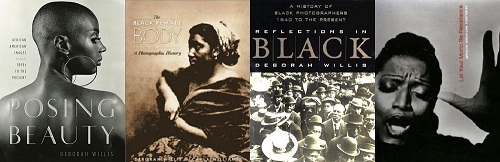
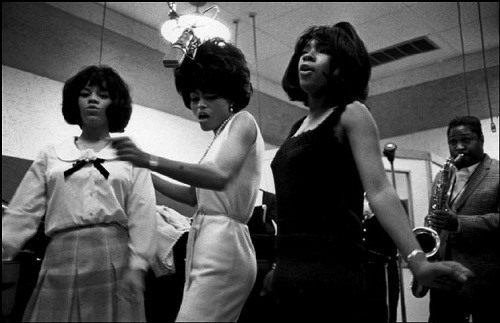
Singer Diana Ross was a recent guest on the Oprah Winfrey Show. She’s personified beauty and glamour since the 1960’s. Is there a reason why there’s no image of her in your book “Posing Beauty”? 

No, no. There’s no reason. She’s in “Let Your Motto Be Resistance.” So yeah, look in that [book]. She’s posed [with the Supremes.] 

Does art matter? 

Yes. Art is what makes all of us survive and keep us hopeful. That’s why I teach art and that’s why I believe [it] matters. Yes, um hum. (Shakes her head up and down.)


Books by Deborah Willis:


The Supremes image referenced in interview:

THE SUPREMES SINGING IN THE STUDIO, 1965
Gelatin silver print, 11 x 14 inches, © Bruce Davidson/Magnum Photos, New York.

2009 video of Deborah Willis and her son photographer Hank Willis Thomas:


Links: