Showing posts with label African Art. Show all posts

Saturday, April 16, 2016

TRANSITION: Malick Sidibé (1936 - 2016)


Malick Sidibé, Photographer Known for Social Reportage in Mali, Dies at 80


Text | William Grimes for NYTimes.com
Published | April 15, 2016

Malick Sidibé, whose black-and-white photographs of young partygoers captured the exuberance of newly independent Mali in the 1960s and ’70s and made him one of Africa’s most celebrated artists after his work was shown abroad in the 1990s, died on Thursday in Bamako, Mali. He was 80.

His son Karim Sidibé said the cause was complications of diabetes, The Associated Press reported.


Read full article here


Thursday, April 14, 2016

CHICAGO: Zohra Opoku

Draped Encounters/Beyond Visage
April 14 - May 14, 2016

Curated by Erin Gilbert

KRUGER GALLERY CHICAGO
3709 North Southport Avenue
Chicago, IL

From krugergallerychicago.com:

Kruger Gallery Chicago presents Draped Encounters/ Beyond Visage, the first US solo exhibition of works by Ghanaian-German artist Zohra Opoku. Opoku is a photographer, filmmaker and installation artist whose work is informed by fashion, nature, Ghana and psychic energy.

Draped Encounters/Beyond Visage presents two recent bodies of work shot between 2012 and 2015. Opoku is a former fashion designer, who employs textiles and the language of fashion to explore issues of identity and representation. In carefully choreographed moments of tropical gardens and urban ruins, Opoku interrogates the relationship of textiles to natural and built environments. In her photographs, films and installations, Opoku uses second hand textiles, imported from Europe and the US to Ghana, to thread an African feminist handwriting in the work. Staged in Accra, Ghana, these images document the travels of a woman of African descent who performatively traced the transatlantic.

The first body of work, entitled Handwash Only, began in 2008 and was originally conceived of as a research series. Named for the washing instructions on clothing tags, this series addresses the daily hassle of washing by hand in Africa.  These images capture clothes hung by the owner and rearranged in a gust of wind. These natural compositions offer a glimpse from the public sphere to the private sphere, mythologizing the owners, seen only through their laundry-hanging rituals. These clothes represent a shared experience. Opoku observed that the African wax print, which she associates with a classical Ghanaian dress code, is seldom seen on traditional clotheslines. To create the illusion of Ghanaian identity, Opoku includes the rarely found African print wax in her clothesline compositions.

The second body of work is a set of film stills from Textures in Motion which bears witness to the engagement between the body, textile and environment. In the video Ms. Opoku uses artists as models, then drapes and disguises them to mimic a distinctly west African mystical practice of masquerade. Rather than the physical identity it is the psychic energy, the movement of the artist, which renders them visible in these draped encounters.

According to Okopu, “The entity or force of a spirit: In the African world the Western differentiation between consciousness and unconsciousness does not exist. Africans invented different names for the soul, which can be located outside a body. It is called “sassa” by the Ashantis. In my disguise practices I capture what we can’t see with our physical eye — the dynamic spirit “sassa.” (Ours Lagos Photo 2015 Festival Interviews).

Zohra Opoku (b.1976) is a German born, Accra-based versatile artist whose work employs media including installations, photography and video to explore the sophistication of textile cultures in disparate spaces targeting fashion’s political and psychological role and socio-cultural dynamics in relation to African history and individualistic or societal identities. Opoku received an MFA from the University of Applied Sciences in Hamburg.

Opoku has been included in exhibitions nationally and internationally. In 2015 alone she was featured Material Effects at the Eli & Edythe Broad Art Museum, East Lansing, Michigan; Future Africa: Visions in Time in Denmark; Making Africa at the Guggenheim Bilbao; and Making Africa at the Vitra Design Museum, Weil am Rhein, Switzerland. Her work has been exhibited in galleries in London; Berlin; Accra, Ghana; and Capetown, South Africa. Her work will be featured in a solo presentation at 1:54 Art Fair in New York, May 6-8, 2016 by Mariane Ibrahim Gallery.


Monday, February 22, 2016

NEW YORK: Adejoke Tugbiyele

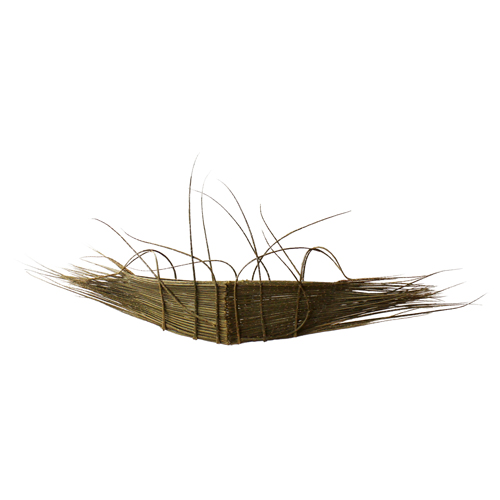
Adejoke Tugbiyele, The Love Boat, 2016, palm spines, copper wire, threaded rods, 26 x 72 x 10 inches.
Image via Skoto Gallery.
Grassroots
February 25 - April 9, 2016

Artist’s reception: Thursday, February 25, 2016, 6:00pm - 8:00pm

SKOTO GALLERY
529 West 20th Street, 5th Floor
New York, NY

From Skoto Gallery e-blast:

Skoto Gallery is pleased to present an exhibition of recent works by the Nigerian-American artist Adejoke Tugbiyele. This is her first solo show at the gallery.
Adejoke Tugbiyele’s work is informed by a sophisticated discourse on traditional philosophical concepts, a deep understanding of the aesthetic and cultural character of the African continent as well as an invigorating inclination and facility with various materials and methods. By inventively handling her material within a formalist sculptural framework, combined with a highly developed experimental approach to making art, she creates work that is unorthodox, persistently innovative, and ignores boundaries between different cultural heritages and socially constructed constraints.
Tugbiyele’s sculptural process combines the weaving of fibrous materials such as palm spines around light metal structures, producing abstract figurative forms with universal elements of androgyny, armor, flight, seduction, myth and mystery. Her practice is influenced by multiple genres including ready-made/assemblage, architecture and performance/film. While her work does not openly narrate the events in her life, they are certainly rooted in her cultural, political and emotional experiences as she continuously explore strategies that fuse her aesthetic concerns with playful ironies and poetic metaphors. Despite the fact that she does not avoid the significance of content in her work, they still manage to tell stories of hope and courage, of compassion and resilience that speak to the triumph of the human spirit.
 
Born in Brooklyn, New York in 1977 to Nigerian immigrants, and raised for seven years in Lagos Nigeria, award-winning artist/activist Adejoke Tugbiyele boldly, yet delicately weaves complex ideas about race, gender, sexuality, spirituality and migration. Tugbiyele's work has been exhibited at reputable institutions around the world including the Brooklyn Museum, The Newark Museum, The Museum of Arts and Design, Spelman College Museum of Fine Art, The Reginald F. Lewis Museum, The Centre for Contemporary Art, Lagos Nigeria, The Goethe-Institut (in Lagos, Nigeria and Washington D.C), The Centre for Contemporary Art, Torun, Poland, and The United Nations. Tugbiyele's work is in the permanent collections of the Brooklyn Museum, The Newark Museum and in significant private collections in the United States and Hong Kong.
Adejoke Tugbiyele is the recipient of several awards including being named Foreign Policy’s 100 Leading Global Thinkers of 2015, a Fulbright U.S. Student Fellowship in 2013, the 2014 Serenbe Artist-in-Residence, the 2013 Amalie Rothschild Award, and the 2012 William M. Phillips Award for best figurative sculpture. In 2014, images of her sculptural works graced the first-ever United States publication of poetry by the African Poetry Book Fund. Her work has been mentioned and featured in numerous publications including The New York Times, The Wall Street Journal, The Huffington Post, Artsy, Financial Mail, This Day Live, The Feminist Wire, The Star Ledger, Intense Art Magazine, Africanah, Okay Africa, Art South Africa, Mail & Guardian, and ArtThrob. In 2014, she appeared on CNN International as the first openly gay woman of Nigerian heritage to come out in the media. Tugbiyele received a Bachelor of Science in Architecture from The New Jersey Institute of Technology and a Master of Fine Arts in Sculpture from Maryland Institute College of Art.


Friday, September 25, 2015

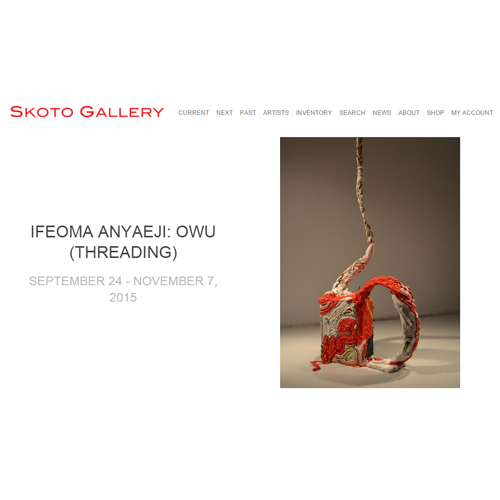
NEW YORK: Ifeoma Anyaeji

Owu (Threading)   
September 24 - November 17, 2015

SKOTO GALLERY  
529 West 20th Street, 5th Floor   
New York, NY

Skoto Gallery is pleased to present Owu (Threading), an exhibition of recent mixed media sculpture by the Nigerian-born artist Ifeoma Anyaeji.
Ifeoma Anyaeji’s recent work continues her exploration of discarded materials, its quality and physical nature, by placing emphasis on process to activate a meaningful engagement and creative openness that strives to reinvigorate newly acquired techniques and ideas. Her work centers on the idea of up-cycling or concept of material re-use such as the ubiquitous non-biodegradable plastic bags and bottles into something of greater value and unorthodox, eliciting unique elements of ripeness and continuous growth. Using traditional hair plaiting techniques from her homeland, she threads and braids discarded plastic bags into plasto-yarns combined with a strong compositional ability into complex yet lyrical visual narratives filtered through cultural memories and contemporary realities that reflect subtle understanding of context and an awareness of the relationship between function and experimentation.


Click here for exhibit info and images.

Tuesday, December 24, 2013

IN PRINT: African Photography from The Walther Collection / Harper’s Magazine / December 2013


Malick Sidibé, Back View, 1964. 

Look at me: Photographs from African past and present

Edwidge Danticat muses on three volume special edition box set produced by The Walther Collection and Steidl. The monographs document the collection’s multi-year exhibition and publishing program.

Excerpt: 
When people walk into a photo studio wearing their best finery, they demand control over how they are perceived, and they are aided by various combinations of props (wall prints, radios, bicycles, or even a single flower) and camera tricks (which might make a subject appear as his own twin, or seemingly put him in the presence of angels and ghosts). I was particularly intrigued by the studio portraits of the Malian photographer Malick Sidibé, in which we see most of his subjects from the back. Many of the photographs show no face at all, just a man’s hat or a woman’s elaborate hairstyle. In others we get a fleeting glance of a face, tilted slightly over the shoulder, as in the image of a young man with his jacket tucked under his elbow as he approaches the white backdrop.


Portraiture, argues the Nigerian-American curator Okwui Enwezor, is “a game of theater and masquerade, premised on the artifice of self-construction. The figure in the image, more than being depicted and displayed, insists on being seen, to be looked at, and desired.”
This yearning to be desired is most identifiable in the portraits that appear to have been meant for private use, such as many by the celebrated Malian portraitist Seydou Keïta. The desire not to be desired is here, too. In what looks like an engagement portrait gone wrong, a young woman seems more willing to hug Keïta’s radio than the young man who is trying to grasp her in his arms. Her defiant glare makes us feel like voyeurs.

Seydou  Keïta, Untitled photograph, 1949-51.

The Walther Collection is a growing international art collection dedicated to exhibiting contemporary photography and video.

Edwidge Danticat is an award winning author and MacArthur Fellow. Her most recent book Claire of the Sea Light (Knopf) was published in August 2013.

To read Miss Danticat’s essay in its entirety, pick up a copy of the December 2013 issue of Harper’s Magazine on newsstands now.


Tuesday, June 4, 2013

POST: Dartmouth's Hood Museum appoints first African Art Curator

Ugochukwu-Smooth Nzewi. Photo by Franko Khoury, National Museum of African Art. Image via artdaily.org
From artdaily.org:

The Hood Museum of Art at Dartmouth College has appointed Ugochukwu-Smooth Nzewi as its first Curator of African Art. A specialist in modern and contemporary African and African Diaspora arts, Nzewi will be responsible for the documentation, preservation, research, and development of the museum’s African art collection—which encompasses some 1,900 historic and contemporary objects from all regions of the continent in a variety of media—and will engage Dartmouth faculty and students in the development of curricular and co-curricular programming related to the museum’s African holdings. He will begin on August 26, 2013.

“Smooth’s deep knowledge of historical African objects, combined with his unique perspective on African contemporary art, makes him an ideal appointment for the position of Curator of African Art at the Hood,” said Michael Taylor, Director of the Hood Museum of Art. “The establishment of this new position affirms the Hood’s aspiration to build an exceptional collection of African art from all time periods and cultures, and to showcase that collection through groundbreaking exhibition and educational programs that inform a greater understanding of the artistic traditions of the African continent, both past and present.”

Born in Nigeria, Nzewi received his Ph.D. in Art History at Emory University, where he wrote his doctoral dissertation on the Dak’Art Biennial and its influence on contemporary African art, from 1992 to the present. He was awarded a Pre-Doctoral Fellowship from the National Museum of African Arts, Smithsonian Institution, in 2012, and earned a postgraduate diploma in the African Program in Museum and Heritage Studies from the University of Western Cape, South Africa. He has curated exhibitions in Nigeria, South Africa, Senegal, and the United States, including most recently Transitions: Contemporary South African Works on Paper at the High Museum of Art in Atlanta in 2009 and Windows Part 1: New Works by Ndary Lo as part of the fringe exhibitions of the Dak’Art Biennial in 2012. A practicing visual artist, Nzewi studied sculpture under the supervision of El Anatsui at the University of Nigeria, Nsukka, where he earned a B.A. in Fine and Applied Art. He has participated in over thirty exhibitions and artist residency programs in Africa, Europe, and the United States, and, in 2011, he received the Robert Sterling Clark Foundation Fellowship for African Artists.

“I am truly honored to accept the Curator of African Art position at the Hood Museum of Art. The Hood has a fantastic history and arguably one of the oldest and finest museum collections of African art on any campus in North America. I am coming to the Hood at a very auspicious moment of exciting possibilities, when it is expanding its facility and growing its African collection. I am excited to be joining the curatorial staff at the Hood and to be able to contribute to the vibrant arts community at Dartmouth,” said Nzewi. “The Hood is noted for encouraging a diversity of peoples and perspectives and for placing the art object at the center of the educational experience. I look forward to working with students, faculty, and staff in the development of programming that will bring to life a greater appreciation and understanding of art from Africa, whether it be contemporary or traditional creations.”

The Hood’s African art collection represents the great range of artistic expression, media, and aesthetics on the African continent, and its objects date from approximately 2040 BCE to the present. The collection has its roots in the first decades of the nineteenth century, when works from ancient Egypt were acquired by Dartmouth, and it expanded significantly in the late nineteenth and early twentieth centuries to include works from sub-Saharan Africa, beginning with a gift of forty-eight objects from South Africa in 1885 by Josiah Tyler, missionary and son of Dartmouth College President Bennett Tyler. Significant gifts made during the second half of the twentieth century enhanced the collection in colonial-era sculpture from West and Central Africa, including approximately fifty sculptural works given by Evelyn A. and William B. Jaffe, Class of 1964H, during the 1960s and 1970s; almost two hundred brass castings, primarily used as body ornamentation, given by Arnold and Joanne Syrop in the 1980s and 1990s; and about eighty sculptures from the Harry A. Franklin Family Collection in the 1990s. Recent additions to the collection of sculptural works from East Africa further diversify the Hood’s collection of African art. A new direction for the museum is represented by the addition of contemporary works by African and African diasporic artists over the past decade, including art by El Anatsui, Magdalene Odundo, and Wangechi Mutu, among others.


Wednesday, December 26, 2012

PROFILE: Okwui Enwezor / Under the Influence / Fall -Winter 2012

Okwui Enwezor photographed by Lydia Gorges via undertheinfluencemagazine.tumblr.com
Renowned curator explains why he's under the influence of contemporary African Art

Interview by Alice Pfeiffer
Photography by Lydia Gorges

Excerpt:
In the early nineties, a Nigerian-born political science graduate, Okwui Enwezor, created the Nka Journal of Contemporary African Art from his Brooklyn apartment. It was dedicated to promoting vibrant artists from his continent of origin -- which at the time played a diminishing role in the western contemporary art scene. Today, Enwezor is considered one the the world's leading experts on the topic of contemporary African art. The director of Munich's Haus der Kunst, he recently curated Paris' Trienniale, and has art-directed art projects ranging form Documenta 11, to Johannesburg's and Gawngju's biennials, as well as shows for the Guggenheim, MoMA and the Tate Modern, to name a few. Interested in ideas of exile, identity and processes of truth formation, he continues to teach worldwide and publish extensively. Under the Influence and Enwezor discussed problems surrounding the notion of nationality, the dialectic between a physical and intangible sense of self -- and why Beyoncé can keep dancing however she pleases.

You've been nicknamed 'Mr. African Art' by journalists, is that an 'unofficial' title you're pleased with, or do you hope people will see beyond that?

No, I don't want people to see beyond that. I am very proud to be associated with such a nickname, even though I believe it is misapplied. But I have to ask the obverse question: Why is it that people always want to see being attached to Africa as a limitation? It's a very big continent; from Nigeria to South Africa is a nine-hour flight. We need, however, to be very careful in the way we pose the question. Thought I was born and raised in Nigeria, and setting aside for the moment my personal identity as an African -- from a purely professional view contemporary African art is one of my areas of specialisation, from an intellectual and disciplinary standpoint. I'm immensely proud to be an expert in this field, which is where I've invested 25 years of research, writing, curating, publishing, and teaching, so I do think it's important. I'm not however, 'Mister Africa' in the sense in which I suspect that the frame is applied. I do want my work and ideas to be understood in a specific professional context as taking Africa as a point of departure into other artistic and cultural worlds that define contemporary art today. I hope this issue of the magazine also comes with a self-interrogation of why Africa is suddenly in vogue. I'm fascinated by the recent rise of Africa and afrophilia in European magazines, such as L'Uomo Vogue (Africa issue May 2012 'Rebranding Africa'), and especially with the fact that Ban-Ki Moon was on the cover.

What is the golden thread between your curatorial and academic projects?

My beginning was militant, I was not ready to accept the fact that working on Africa was inherently a lack. The point was to confound the idea of Africa as a limit. When I founded the magazine Nka nearly 20 years ago, which I still publish, contemporary African art didn't even exist in the New York-American context as part of serious discourse. Maintaining that disciplinary insurgency was very important to me, and has remained in the way I think of that relationship between contemporary art and the global state of the world at large. The disciplinary insurgency is important because the institutional practice oftentimes is unable to make room for numerous thoughts that are just as relevant and can be tested against the prevailing judgment.

One has to make that happen. There are artists working in Mumbai, in China, in Africa that deserve consideration even if their critical language might not be transparently obvious to the settled grammar of the west.

But you have to do that with good faith, on a sense of inquiry and of discovery, not simply as an ideological exploitation of that relationship in response to western cultural arrogance, what could be called the ethnocentrism of superiority. Being a museum director in Europe, I cannot absolutely say that sense of disciplinary insurgency, the way it was when I started, still remains -- but it's still part of the backdrop of my thinking, in order that I do not become too settled in what I call dead certainties.


To read complete interview, pick up a copy of Under the Influence magazine's Africa Issue on newsstands or order online here.

Under the Influence magazine on tumblr.