Showing posts with label POST. Show all posts

Wednesday, July 15, 2015

OP ED: What Does Cosby Art Really Show?

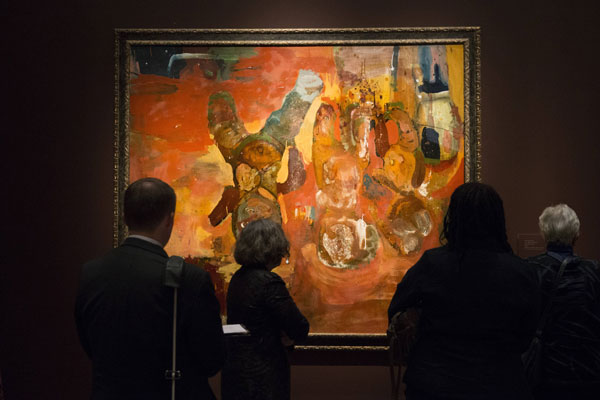
"Hanging Out to Dry" by Erika Ranee Cosby, from the Bill and Camille Cosby collection at the Smithsonian's National Museum of African Art in Washington.(Evan Vucci / AP).
 Image via chicagotribune.com.
Why Smithsonian's Cosby exhibit is still a bad idea
Text | Philip Kennicott for the Washington Post
Published | July 14, 2015
Inside the Castle, it looks as if Smithsonian officials are standing on principle: An exhibition of art owned by Bill and Camille Cosby, on display at the National Museum of African Art, is not an endorsement of Cosby's character, behavior or reputation. This is about the art, and the artists, not the collector, who is accused of sexually assaulting more than 40 women and who acknowledged in a 2005 legal deposition that he intended to give drugs to women he wanted to have sex with.
Although Cosby's name appears dozens of times throughout the exhibition, the Castle will not take it down before the scheduled end of its run in January 2016. To do otherwise, they say, would set a bad precedent and open the institution to public pressure from interest groups far and wide who disagree with or dislike anything on display.

"Exhibits have an intellectual product," said Richard Kurin, the Smithsonian's undersecretary for history, art and culture. "That's why we put them up. So when it's up, we are loath to take them down."
It's not a bad principle, and it shows that the Smithsonian learned something from its last major exhibition controversy, the decision by then-Smithsonian Secretary Wayne Clough to censor a 2011 exhibition of gay and lesbian portraiture at the National Portrait Gallery. That blunder opened the Smithsonian to furious criticism, demonstrated its willingness to capitulate to homophobic slander and did real violence to one of the best and most critically well-received exhibitions it had mounted in a decade or more.
But although Kurin says the institution's leadership learned a valuable lesson in 2011, it hasn't learned when this newfound wisdom applies. Although the Castle developed guidelines to address the issue of tampering with or censoring exhibitions, it seems unaware that for every rule there are exceptions. Cosby isn't guilty of insider trading, or securities fraud, or driving drunk; he stands accused of raping or having inappropriate sexual contact with dozens of women — allegations he has denied. The exhibition was paid for by, and celebrates in myriad ways small and large, a man who, many women alleged, not only sexually assaulted them but in some cases sought to silence them. It is called "Conversations."
This isn't about borrowing art from an unsavory rich guy; it's about hosting an exhibition that celebrates the family life and character — "the personal importance of family to the collectors cannot be overstated," reads one exhibition text — of a married man who by his own admission acquired Quaaludes to give to women he wanted to have sex with.
And so the big crisis of the last Smithsonian secretary leads directly to the first crisis of the new one, David Skorton, who took over the institution at the beginning of this month. And once again, the Smithsonian looks desperately out of touch. When Clough censored the gay-and-lesbian-themed exhibition, "Hide/Seek," American society was in the middle of an astonishingly rapid change of heart about anti-gay prejudice; Clough's blunder will probably be remembered as the last great capitulation in the dying culture wars over sexual identity and expression.
Now the Smithsonian has chosen to stand behind an exhibition celebrating a collector who personifies the nexus of power, wealth and celebrity that allows too many men of high social standing to treat women with violence and impunity. Once again, the culture is rapidly shifting, and the Smithsonian seems to have no idea how its support of the Cosby exhibition looks to the outside world. The public discourse over rape today is different than it was five or 10 years ago. Today, women, and society at large, not only seek to utterly eradicate it but also to shame those who deny it or issue apologetics.
"Conversations" was a bad idea for an exhibition in the first place, and it violated widely held ethical standards in the museum world that warn against displaying the art of living collectors unless that art has been given or bequeathed to the museum. Although the Smithsonian says that it will acknowledge the Cosby controversy with an informational sign, it hasn't yet done so. And so the exhibition remains an exercise in hagiography, full of soft-focus and flattering images of the Cosbys, a painting by their daughter and multiple citations from the couple explaining their love of art.
I revisited the exhibition to remind myself how visible Cosby is in it. After 40 appearances of his name, I stopped counting. Worse, the institution has played down the financial relationship between the Cosbys — who donated more than $700,000 to the African Art Museum — and the institution. Although the Smithsonian asserts that the Cosbys' underwriting of the museum was "publicly available information," a museum spokesman didn't divulge the information when asked a direct question by The Post in an email exchange last November. Only later did it acknowledge this connection to The Post and The Associated Press.
It's understandable that a large cultural institution is wary of being swayed by sudden moves in public opinion. But rape isn't like other crimes, and it is directly related to the history of art and the use of art to defend male privilege. It has been 40 years since Susan Brownmiller published "Against Our Will," which argued that rape "is nothing more or less than a conscious process of intimidation by which all men keep all women in a state of fear." That might seem hyperbolic unless you've spent time in an art gallery, where rape is routinely glorified and eroticized. Art is so enslaved to rape culture that it has its own tropes for discrediting women who have been raped: Just look at Rembrandt's painting of "Joseph Accused by Potiphar's Wife," recounting the false accusation of rape against the biblical patriarch. It is one of perhaps a dozen such images in the National Gallery of Art.
Rape is already inescapable in art museums, which is why the museum should be more sensitive to its Cosby connections. No matter what the Smithsonian asserts, the Cosby exhibition is now inextricably tied to women's portrayal of Cosby as a sexual predator. Its casual celebration of patriarchy and traditional female role models will be read in context of women who claim that he allegedly used drugs to incapacitate them. Once you start looking for rape as a subtext, it leaps out at you with a shocking sense of the obvious.
In the popular, representational imagery preferred by the Cosbys — to the virtual exclusion of socially, politically or racially provocative art — women are represented as tortilla makers, flower bearers, sexual objects, faithful mothers or fertility figures. Only one painting lent by the Cosbys, Robert Colescott's 1991 "Death of a Mulatto Woman," directly engages issues of identity, race and femininity in a sophisticated way, and it is wildly ambiguous, seemingly to posit a connection between mixed racial identity and sexual availability or vulnerability.
Rape thrives on silence and on the ability of men to silence women. Sexual abuse of all sorts thrives within the family, where emotional cohesion, obedience and loyalty are all too often deployed to bury abuse in collective silence. The family themes of the Cosby exhibition — an extension of the fictional family-friendly brand that made Cosby wealthy — now look like an elaborate veil cast over the abuses of the patriarch. Was rape ever a topic of conversation in the house?
Why, in the Cosby-owned painting "Homage to 466 Cherry Street," by Eldzier Cortor, does a magazine spill out of a mailbox with what appears to be a mostly naked African-American woman on the cover? And is the title of the magazine, "Artist Digest," a comment on the use of art to mask illicit desire?
Little things, maybe entirely innocent, look different in this context. What to make of a quilt that includes a panel with these words on it: "What about the word no don't you understand?"
At this point, there is no risk of over-psychologizing the exhibition. It never had any substantial content to begin with, but at least now it can be used as a case study in how women are treated in art and how art supports a cultural infrastructure of contempt, dehumanization and misogyny. Art objectifies women; it allows us to ogle them under the pretense of purely aesthetic pleasure; it defines them romantically and sentimentally as servants and helpmates to men; it punishes them for transgressing their proper role.
If you invest in these images, they will grow in value, especially if you can persuade a respectable museum to display them. And as they grow in value, so, too, your stature will grow. And who would believe a woman's testimony next to that of a successful art collector?




Thursday, July 2, 2015

DISAPPEARING ACT: BAN Photos Mysteriously Vanish

Image via i-am-bored.com.

Entire archive of photos posted on BlackArtistNews site disappear without a trace

BlackArtistNews | July 2, 2015

A few days ago, I noticed that every image ever posted on the BlackArtistNews blog just -- poof! -- disappeared. 

I have no idea what happened but all of my attempts to resolve this issue have been exhausted.

It would be a major task to re-insert all of the images previously posted and -- honestly -- it’s not a project I want to take on. It’s easier to just move forward. It’s what I would do if I lost my job or the building I live in burned down. Instead of being angry or upset, I would accept the loss, mourn it and move on.

And that’s what I’ve decided to do. This response is in keeping with my intent on sharing information that’s current. The “old” content isn’t that relevant to me -- especially now since the posts don’t have visual references.

I’m intrigued (and unafraid) of the possibility of creating something fresh and enticing here.

Over the next few months, I will delete a number of previous posts, but I will also re-insert images in posts that I feel should remain in the ethers of the internet. 

But for now, I’m going to keep it moving. Forward that is.


Friday, March 6, 2015

POST: Eric Mack

Eric Mack photographed in New York City by Christopher Gabello. February, 2015. 
Painting Outside of the Canvas
Text | Antwaun Sargent for Interview Magazine

In 2012, artist Eric Mack displayed his work Honey Hollow during "Fore" (part of The Studio Museum in Harlem's ongoing exhibition series of emerging African American talent), challenging the idea that painting must be represented in a traditional, rectangular format. Mack's "painting," which was actually a blanket painted purple, hung from a wall and swayed in the breeze created by a metal fan sitting on the ground. Honey Hollow foreshadowed many works to come, all of which encompass the conceptual and performative subjectivity of ideas presented by the Maryland-born, New York-based artist.

This past Sunday, Mack's most recent work went on view alongside works by Brian Belott and Noam Rappaport at OHWOW in Los Angeles as part of the group show "Some Stew You Got Inside Your Plastic Bag, and You Always Organize The Parts So Close." Continuing his desire to expand, or perhaps nullify, the boundaries of traditional painting formats, Mack stitched together found, bought, and personal fabrics, frequently adding layers of paint, magazine images, and paper. The 27-year-old artist, who is now completing a residency at The Studio Museum, hangs his works throughout the gallery in a way that forces the audience to come face-to-face with and physically maneuver their way around. With his work Claudine, fabric hangs from a curtain rod, exposing the material's movement, allowing for a temporal understanding between viewer and object.

"It is alienating," the Cooper Union and recent Yale MFA program graduate says about the limiting nature of paintings on canvas. "There is a removal from considering painting as an object, which was a big challenge for me early on. I thought, ‘If painting is an object, then how does it speak?' I'm trying to get people to feel a closeness to painting."

Click here to read complete interview and view additional images.


Wednesday, October 15, 2014

CHEERS: Kerry James Marshall Delivers A Stunner at Zwirner Gallery in London

Kerry James Marshall, Untitled (Rapunzel), 2014, Acrylic on PVC panel, 24 x 30 inches. Image via davidzwirner.com 
Text | Andrew Russeth for ARTNews.com
Published | October 13, 2014


Just how good is Kerry James Marshall’s show at David Zwirner in London’s Mayfair district? So good that the second I left today I began plotting the next time that I could sneak out of the Frieze Art Fair this week to give it another view. Plenty of shows open here in the coming days, and there are plenty more that I have yet to see, but so far Marshall’s seems like the most exciting one in town. People are talking about it.
Titled Look See,” this is his first solo appearance in London since 2005, and his first show with Zwirner. He has delivered a knockout. Fifty-nine on Friday, he has hung 14 new paintings, most of solitary people, who are posing for a screen, or for themselves, or even for you. The mood is intimate, erotic, and occasionally voyeuristic. They may make you uncomfortable—like you are peering in on a private moment—but you will not want to look away.
These are formidable, alluring objects, painted on thick PVC panels. Their surfaces are flat, but the brushstrokes, patterning, and color they contain are luscious. The subject of Untitled (Sofa Girl) (all works 2014), for instance, reclines alone on Daniel Buren-striped fabric, cloaked in a deep-blue-purple-black darkness, remote in hand, watching a television set that is just out of view, but which casts a slight glow over room. She has short hair, a facial expression that is a rare mixture of exhausted, amazed, and dazed—the face of insomnia-induced TV binges (a rare sight in art, but one you have felt)—and an adorable, very sleepy cat. It is an incredible painting, complex but immediate.
Read complete story here.

Friday, September 19, 2014

GOOD FELLOW: Houston artist Rick Lowe wins MacArthur Fellowship

2006 photo of Rick Lowe, founder of Project Row Houses, in front of duplexes designed by Rice University students to provide low-income rental homes as part of the project. Photo by Michael Stravato for The New York Times.
Founder of Project Row Houses given prestigious award to pursue his dreams

Text | Claudia Feldman for the Houston Chronicle
Published | September 16, 2014, updated September 17, 2014

Rick Lowe, Rick Lowe's cellphone wouldn't stop ringing. He ignored the calls from area code 312 and a number he did not recognize.

But finally, the artist stepped outside the Epicure Cafe on West Gray, put his cellphone to his ear and received the call of his life

Lowe, the founder of Project Row Houses in Houston's Third Ward, has been named a 2014 MacArthur Fellow. The prestigious award for creativity comes with a $625,000 grant to be paid during five years and little else - no ceremonial dinners, no speeches, no plaques. Instead, the MacArthur Foundation says, the fellowship provides recipients with flexibility to pursue artistic, intellectual and professional activities without any strings attached.

John Henneberger of Austin, an affordable-housing advocate, also won one of the 21 awards, commonly known as "genius grants."

A model project

Lowe's Project Row Houses, which now spans six blocks and includes 71 structures, was a collection of dilapidated shotgun houses when Lowe envisioned something entirely different: the revitalization of a historical piece of the Third Ward and a place where artists, young single mothers, kids needing a safe haven after school - anybody and everybody - could meet and learn from one another. Twenty years later, it has served as a model for similar redevelopment projects in Dallas, New Orleans, Philadelphia, Los Angeles - even South Korea.

"Rick pioneered a form of art that had no name," executive director Linda Shearer said. "Now his concept is taught in undergraduate and graduate art programs. It's called 'creative place making' and 'social practice.' What's remarkable is that Rick was on this track of socially engaged art and developing community long before anybody thought about it. He imbued those shotgun houses with value that people respect and treasure today."

When President Barack Obama learned about Lowe, Shearer said, he appointed him to the National Council on the Arts.

"Rick doesn't call attention to himself," Shearer said, "and he's not an egomaniac. He's all about being a catalyst and asking, 'How can we transform our communities through art?' "

A change of plan

Lowe, 53, was born in rural Russell County in Alabama. He was the eighth of 12 children, and all of them worked in cotton and peanut fields when they weren't in school.

"We felt like we were the last sharecroppers in the world," Lowe said. "That was my upbringing. I grew up mainly with my mother. My dad wasn't around consistently."

Lowe sums up the life lessons he learned in two words. "Everybody works."

In high school Lowe played enough basketball to earn an athletic scholarship to Alabama State University. But he realized early he wasn't an elite player and transferred to what was then Columbus College in Columbus, Ga.

He paid tuition and other bills by working as a bus boy, dishwasher and waiter. It was a time, Lowe said, "to piece things together and find out how the world worked."

Lowe took his first drawing class as a freshman. Teachers praised his work and encouraged him to become an art major. Nobody, including his mother, asked how he would earn a living with such an impractical degree.

"What my mom taught me was to work hard, have a strong ethical component to my work and live my life right."

Though Lowe teaches classes at Southern Methodist University in Dallas now, he did not graduate from college. He was still in school but struggling when a professor told him, "You're a doer. You should go out into the world and do it."

Lowe moved to the Mississippi Gulf Coast to spend time with one of his brothers. He worked in an ice cream storage plant and as a hair dresser.

In 1984, he moved to Houston "for no particular reason, except that I wanted to be in large city," he said. "I didn't think I'd last very long, but here I am 30 years later."

Lowe remembers it took several years for him to find his niche and artist friends with whom he felt comfortable. He hop-scotched from Spring Branch to an artists' warehouse on Commerce Street to still other artists' studios on Feagan Street near downtown.

By the late 1980s, Lowe realized he had lost touch with his African-American roots, and he spent considerable time trying to connect with Houston's black communities. He took art classes at Texas Southern University. He met black artists including Bert Long, Bert Samples, Jesse Lott, Floyd Newsum, George Smith and James Bettison. He also spent many hours visiting with the executive director of S.H.A.P.E. Community Center, Deloyd Parker.

That, Lowe said, is when he starting thinking about the intersection of art and community, art and social justice, art and social services, art and basic human needs.

"All of us were looking for something," Lowe said, "when I came up with the idea of reclaiming these little shotgun houses on Holman."

The 22 homes built in the 1930s were practically falling down, and some were occupied by drug dealers and addicts. If entrepreneurial Houstonians looked at the shacks and saw town houses, Lowe says his friends gave him the confidence to move forward with his vision.

A focus in Houston

Henneberger, 59, said he intends to use his grant to help low-income neighborhood advocates gain more leverage in their struggles for better housing, more equitable public services and relief from environmental racism. Houston will be a particular focus, he said.

"Houston is of special interest because it is the place where we have seen more effective, democratic community engagement on issues than anyplace else in the state," he said. In addition, "conditions in the neighborhoods are among the most unequal of any place in the state that I've ever encountered."

'Have to be thoughtful'

Lowe hasn't decided what to do with his infusion of cash. "I have to be thoughtful about the best way to use the money," he said. "This is not something I'll play around with and throw away. I do want to have a big impact. And a lot of the money will go to the Third Ward."

When Lowe is not working or traveling for work, he shoots basketball at his gym, the 24 Hour Fitness in Midtown.

"Sometimes it's in the middle of the night, when I can't sleep," Lowe said. "I'm one of those people."

Lowe also plays dominoes with the regulars at Project Row Houses. "We have what we call the humility table, which is a reminder that sometimes you win and sometimes you lose. Sometimes it's about skill and talent, and sometimes it's about luck. But whatever happens, you know to check your ego at the table."

Jazz musician Jason Moran, a native Houstonian who moved to New York, won a MacArthur grant in 2010. Poet Edward Hirsch, who taught literature and creative writing at the University of Houston, earned his MacArthur grant in 1998.

"He left town after he got his," Lowe said of Hirsch. "I'm not going anywhere."


Houston Chronicle Staff writer Mike Snyder contributed to this report.


Wednesday, September 17, 2014

THE RECONSTRUCTOR: How Okwui Enwezor Changed the Art World

Okwui Enwezor photographed by Juergen Teller at the London offices of architect David Adjaye. Image via  WSJ.com.
Next year, the Nigerian-born curator and writer will become the first African director of the Venice Biennale, where he’ll continue his career-long project of challenging the status quo

Text | Zeke Turner for The Wall Street Journal
Published | September 8, 2014

Excerpts: 
Since his 1996 breakthrough as a curator of In/Sight: African Photographers, 1940 to Present, an exhibit of 30 African photographers at the Guggenheim Museum, Okwui Enwezor has alternated between ambitious international exhibitions that seek to define their moment—biennials in Johannesburg, Gwangju and beyond, along with the Paris Triennale in 2012—and historically driven, encyclopedic museum shows centered on topics such as African liberation movements in the 20th century, the arc of apartheid and the use of archive material in contemporary art. Enwezor is the first curator of his generation and the second ever to command two of Europe's most precious cultural territories—Documenta, the five-yearly exhibition in Kassel, Germany, and now the Venice Biennale—and the first African to direct either one. 
In/Sight was one of the first shows anywhere to put contemporary art from Africa in the historical and political context of colonial withdrawal and the emergence of independent African states. Its success led to Enwezor’s appointment as the curator of the second Johannesburg Bienniale in 1996. Enwezor used that platform to show that he could not only execute a biennial but could curate shows around big ideas. Deploying the idea of trade routes, he theatrically changed the terms of the show, bringing in a team of international curators. “I didn’t want to do an African show; I wanted to do an international show,” he says.
 "He's a towering figure who really believes in dealing with the misrepresentation of history," says British-Ghanaian architect David Adjaye. "Okwui is a unique character in the sense that his experience of globalization and the way he sees the world have created who he is."


Read full story here


Sunday, September 14, 2014

JUNKED: DC Public Art Installation Panned by Residents

Abigail DeVille photographed during the installation of her public art project The New Migration.
Photo by @joshuacogan  via Facebook.
Jacob Lawrence inspired installation creates scrap 

Text | Peggy McClone for the WashingtonPost.com
Published | September 12, 2014

First there was singing and dancing. And then the complaining began.

A storefront art installation in Anacostia that is part of 5x5, the city-wide public art festival, will be removed after community members complained that it looked like junk.

The D.C. Commission on the Arts and Humanities said it will take down “The New Migration” by Abigail DeVille, a found-art project installed in a down-at-the-heels section of Good Hope Road SE.

The work opened with a “sunset procession” featuring musicians, dancers and community members who marched in the neighborhood last weekend. The accompanying art installation in two storefronts was expected to be on view through December.

DeVille, an African American artist from the Bronx, journeyed from Washington to Florida to collect objects for an installation that evokes the Great Migration of African Americans who fled north during the Jim Crow era.

Inspired by a Jacob Lawrence painting, DeVille connects the historic migration to the gentrification that now forces many African Americans from their homes.

But community members bombarded city officials with complaints about the work, which they described as both an eyesore and offensive. City officials should promote the area’s redevelopment rather than contribute to its blight, they said.

“It’s one of our main thoroughfares, and people walk down the street and look through the window and see what appears to be junk, ” D.C. Council member Marion Barry (D-Ward 8) said. “It’s embarrassing.”

A spokeswoman for the D.C Commission, a city agency that supports local artists and arts groups, said organizers are seeking a new site for the work.

“The intention of the project is to challenge and engage audiences through art but never to offend. The community reaction has been that the work is not suited to the location. As good stewards of the public trust, DCCAH has determined to remove the installation from its current location,” the spokeswoman said in a written statement.

This is not the first time local residents reacted negatively to the 5x5 festival. In 2012, a piece was taken down, the commission said.

The $500,000 public art event includes five curators and 25 artists who have installed a wide range of art in neighborhoods across the city. They include “Nonuments,” a work honoring non-heroes in a park near the Waterfront Metro station in Southwest, and a mural in a Northeast neighborhood depicting how today’s housing policies will affect future generations.

Some works will be on view through next month, while others are scheduled to come down in December.


Sunday, July 13, 2014

TOTAL RECALL: Remembering the Workers of the Domino Sugar Factory

BlackArtistNews photo. © 2014, All rights reserved.
For 20 years, Robert Shelton punched the clock at Brooklyn's cavernous sugar refinery. He served as a docent at Kara Walker's art exhibit there, sharing with visitors the story of his life.

Text | Leigh Raiford and Robin J. Hayes for theatlantic.com
Published | July 3, 2014

2737-42.  That was the number Robert Shelton punched into a clock at the Domino Sugar factory for 20 years. “As long as you live. You never forget. That’s my number,” Shelton says. And when he returned to the refinery in Williamsburg, Brooklyn, for only the second time since the factory closed in 2004, this time as a volunteer for Creative Time’s installation of Kara Walker’s “A Subtlety, Or the Marvelous Sugar Baby,” “I had tears in my eyes because it brings back the memories.”

Memories of working the dangerous kiln on a shop floor that regularly reached 140 degrees. Of a hazardous but well-paid union job that enabled Shelton to stop working three jobs, buy his first car, and move his family out of the Roosevelt Housing Projects and into a Bedford-Stuyvesant brownstone.  Of friendships made with the diverse group of Polish, Italian, Caribbean immigrants and other African Americans who also worked at the refinery. Of ongoing labor conflict with Domino Sugar Corporation that resulted in the longest strike in the history of New York City.

Today, with its original brickwork, soaring ceilings, stunning sunlight, and East River views it's not surprising that the site will soon be a 35-story residential and commercial “megaproject” in the now very desirable Williamsburg neighborhood. The only other time Shelton has been back to the factory since 2004 was a couple of years ago to advocate for affordable housing in the development. "We don’t want luxury apartments," Shelton says. "Why should someone who has a lot of money come from upstate or from Connecticut and benefit rather than people who have lived there all their life? It has been a long delay because the developers only want to give a small percentage…for regular people like me.”

Shelton is the only volunteer on the floor of the provocative installation who ever worked at Domino’s sugar refinery. Of the several “interpreters” who are on hand to answer visitor questions, his is the only intimate connection to the factory. He found out about the exhibit through an article in the New York Times and knew immediately he wanted to be involved. 

Commissioned by Creative Time arts organization, Walker’s “marvelous sugar baby,” a massive “mammy sphinx” fashioned from 40 tons of compressed white sugar, and the coterie of molasses-covered serving boys, have been seen by thousands of visitors over the course of its nine-week run.  “A Subtlety” powerfully brings the history and feeling of slavery into the present. Like much of Walker’s similarly themed work, it produces “a giddy discomfort” in the viewer. The Mammy Sphinx wears only a head scarf.  Her breasts and labia are massive and exposed, signaling both productive and reproductive labor. 

In the vibrant public conversation that has surrounded this exhibit, the factory itself—its history and especially its workers—have become mere backdrop, a focus on plantation slavery unfortunately muting the history of the industrial urban workers who produced the commodity in factories. It's a history that spanned decades, beginning before the Civil War: The factory complex on the Brooklyn waterfront that now hosts Walker's exhibit originally opened in 1856. By 1870, it was processing more than half of the sugar consumed in the United States, was rebuilt in 1882 after a fire, and continued to refine sugar until its doors closed in 2004.

Robert Shelton’s story sheds light on this forgotten narrative.

Read complete story here.


Thursday, April 10, 2014

POST: Betye Saar named MacDowell medalist

Betye Saar. Image via ledgertranscript.com.
California-based visual artist’s work challenges African-American stereotypes, myth

Text | Amanda Bastoni for Monadnock Ledger-Transcript
Published | Wednesday, April 9, 2014

When Betye Saar takes the podium to receive the Edward MacDowell Medal, she will be 88-years-old. As she accepts the award, Saar — who is famous for her artistic assemblages challenging racial stereotypes and the role of African American women — will become the 55th Medal recipient and coincidently a minority within a minority.

On Aug. 10, Saar will be the oldest and only female African American woman to receive the prestigious award.

“I don’t mind being a minority,” Saar said. “It helps people see that old people, women and people of color are not invisible,” she said speaking by phone from her home in Los Angeles, Calif., on Wednesday.

Saar grew up in Pasadena during the Great Depression, surrounded by creativity. Her mother and grandmother painted ceramics, quilted and embroidered. Although these were considered, “household” or “womens arts,” Saar said the “essence of the creative process” was alive in her home.

After high school, Saar earned a Bachelor of Arts degree from the University of California at Los Angeles.

In 1949 after graduation, Saar began to work in costume design for California theater companies, but her creative outlet shifted when she saw the work of Joseph Cornell.

Cornell, who was born in New York City in 1903 and died in 1972, pioneered the idea of assemblage art. His most characteristic works were simple boxes that held collections of photographs, magazine cut-outs, string and other ephemera or knick-knacks.

Saar attributes Cornell’s influence to helping her see that she had the power to use what she found — everyday objects — to make political statements and fine art.

“I was a kid who loved to collect things,” she explained. “As an artist I often call myself a recycle — not just the recycling physical things, window frames and statues, but also ideas and memories. Things that have value to me as an artist.”

In the late 1960s, Saar began to acquire “black collectibles,” objects that feature racist caricatures of African Americans.

Shortly thereafter she created her own series of assemblages: “The Liberation of Aunt Jemima.” Through these pieces Saar worked to turn negative “mammy” images into positive, empowering symbols for African American women.

“The Liberation of Aunt Jemima,” Saar said, “helped me focus on being a woman warrior for civil rights and my weapon was art.”

Saar said her art typically has three components: political, ritual and personal. Her series “Workers and Warriors and In Service” reflect the similar themes to “The Liberation of Aunt Jemima,” themes of resisting racism and servitude by creating woman warriors armed with brooms.

“In a way, it’s all political though,” she said. “My work is meant to show that black people had lives, that they went to parties and were human.”

Saar said she is often inspired by materials. For example, she did a series using washboards that was meant to be a statement on woman’s work. “I was trying to show the irony in black people washing and ironing the sheets of the Ku Klux Klan.”

Many of her works are made with primitive materials such as wood, or found objects, and in a style that evokes African American cultures as well as voodooism, said Saar.

For this reason, some of Saar’s art has been misunderstood. She has been called a “devil worshiper” and has received some criticism for her use of derogatory images of African Americans in her art. Saar believes that, as she put it, “You have to know where you’ve been before you can know where you are going,” and she hopes her artwork “makes people think.”

Her ultimate goal, she said, is to show the similarity between people. “The bottom line is we are all people. We are all earthlings. Despite our cultural differences, we are people of the planet,” Saar said.

The timing of the MacDowell Medal ceremony is particularly poignant for Saar as this July marks the 50th anniversary of the Civil Rights Act being signed into law.

While creating art, Saar and her husband, Richard, who was also an artist, were raising their three daughters. Two of her daughters, Alison and Lezley, are accomplished artists in their own right.

When asked how she juggled the various roles of wife, artist and mother, Saar answered with a hearty laugh: “There are always ways to sneak [your art] in.”

“Women can be really creative in the kitchen — with spices and textures — or in how they dress or in how you arrange your home.”

Saar recommends that busy working women keep sketchbooks to collect their ideas for later realization.

Saar is looking forward to visiting the Northeast for the Medal Day ceremony. She will come with her youngest daughter, Tracye, and her granddaughter. She hopes to bring back home with her inspiration from New Hampshire, with visits to local flea markets and antique shops.

Throughout her career, Saar has received numerous awards, including two National Endowment for the Arts Fellowships, as well as a J. Paul Getty Fund for the Visual Arts Fellowship. Her work is represented in numerous museum collections, including Los Angeles County Museum of Art, Museum of Fine Arts in Boston, the Metropolitan Museum of Art and the Whitney Museum of American Art in New York.