Showing posts with label African Artists. Show all posts

Saturday, April 16, 2016

TRANSITION: Malick Sidibé (1936 - 2016)


Malick Sidibé, Photographer Known for Social Reportage in Mali, Dies at 80


Text | William Grimes for NYTimes.com
Published | April 15, 2016

Malick Sidibé, whose black-and-white photographs of young partygoers captured the exuberance of newly independent Mali in the 1960s and ’70s and made him one of Africa’s most celebrated artists after his work was shown abroad in the 1990s, died on Thursday in Bamako, Mali. He was 80.

His son Karim Sidibé said the cause was complications of diabetes, The Associated Press reported.


Read full article here


Thursday, April 14, 2016

CHICAGO: Zohra Opoku

Draped Encounters/Beyond Visage
April 14 - May 14, 2016

Curated by Erin Gilbert

KRUGER GALLERY CHICAGO
3709 North Southport Avenue
Chicago, IL

From krugergallerychicago.com:

Kruger Gallery Chicago presents Draped Encounters/ Beyond Visage, the first US solo exhibition of works by Ghanaian-German artist Zohra Opoku. Opoku is a photographer, filmmaker and installation artist whose work is informed by fashion, nature, Ghana and psychic energy.

Draped Encounters/Beyond Visage presents two recent bodies of work shot between 2012 and 2015. Opoku is a former fashion designer, who employs textiles and the language of fashion to explore issues of identity and representation. In carefully choreographed moments of tropical gardens and urban ruins, Opoku interrogates the relationship of textiles to natural and built environments. In her photographs, films and installations, Opoku uses second hand textiles, imported from Europe and the US to Ghana, to thread an African feminist handwriting in the work. Staged in Accra, Ghana, these images document the travels of a woman of African descent who performatively traced the transatlantic.

The first body of work, entitled Handwash Only, began in 2008 and was originally conceived of as a research series. Named for the washing instructions on clothing tags, this series addresses the daily hassle of washing by hand in Africa.  These images capture clothes hung by the owner and rearranged in a gust of wind. These natural compositions offer a glimpse from the public sphere to the private sphere, mythologizing the owners, seen only through their laundry-hanging rituals. These clothes represent a shared experience. Opoku observed that the African wax print, which she associates with a classical Ghanaian dress code, is seldom seen on traditional clotheslines. To create the illusion of Ghanaian identity, Opoku includes the rarely found African print wax in her clothesline compositions.

The second body of work is a set of film stills from Textures in Motion which bears witness to the engagement between the body, textile and environment. In the video Ms. Opoku uses artists as models, then drapes and disguises them to mimic a distinctly west African mystical practice of masquerade. Rather than the physical identity it is the psychic energy, the movement of the artist, which renders them visible in these draped encounters.

According to Okopu, “The entity or force of a spirit: In the African world the Western differentiation between consciousness and unconsciousness does not exist. Africans invented different names for the soul, which can be located outside a body. It is called “sassa” by the Ashantis. In my disguise practices I capture what we can’t see with our physical eye — the dynamic spirit “sassa.” (Ours Lagos Photo 2015 Festival Interviews).

Zohra Opoku (b.1976) is a German born, Accra-based versatile artist whose work employs media including installations, photography and video to explore the sophistication of textile cultures in disparate spaces targeting fashion’s political and psychological role and socio-cultural dynamics in relation to African history and individualistic or societal identities. Opoku received an MFA from the University of Applied Sciences in Hamburg.

Opoku has been included in exhibitions nationally and internationally. In 2015 alone she was featured Material Effects at the Eli & Edythe Broad Art Museum, East Lansing, Michigan; Future Africa: Visions in Time in Denmark; Making Africa at the Guggenheim Bilbao; and Making Africa at the Vitra Design Museum, Weil am Rhein, Switzerland. Her work has been exhibited in galleries in London; Berlin; Accra, Ghana; and Capetown, South Africa. Her work will be featured in a solo presentation at 1:54 Art Fair in New York, May 6-8, 2016 by Mariane Ibrahim Gallery.


Monday, April 4, 2016

NEW YORK: Nicholas Hlobo

Installation view of Nicholas Hlobo  via lehmannmaupin.com. 
February 24 - April 17, 2016

LEHMANN MAUPIN
201 Chrystie Street  
New York, NY

From lehmannmaupin.com:

Lehmann Maupin is pleased to announce its inaugural exhibition for South African artist, Nicholas Hlobo. Presenting both mixed media on canvas paintings as well as leather and wood sculptures, Hlobo’s newest body of work makes use of the migratory patterns of eels as a point of departure, and reconsiders as allegory the personal transformation necessary to his own artistic journey. Centered around organic and corporeal imagery, the exhibition elaborates on recurring themes of the artist’s concern with beauty, pain, pleasure, and cycles of life.

Hlobo (pronounced sloh-boh) is known for his intricate, sprawling installations that incorporate organic sculptures, performance, work on paper, and video installations.  He employs tactile materials such as ribbon, leather, wood and rubber, which he often melds and weaves to create his two- and three- dimensional works. By incorporating influences from his ethnic and cultural background such as the Xhosa language and references to traditional craft, ritual, sexual orientation, gender, and nationality into his works, Hlobo address the constant shifting and subjective nature inherent in these identifiers. The eradication of legalized discrimination and segregation that came with the end of Apartheid in 1994 saw Hlobo and his peers empowered to voice their views under the protection of new laws. This fundamental right to challenge political and societal issues has been exercised and articulated at the core of Hlobo’s work in the years since.

In his first solo gallery show in New York, Hlobo will present a number of new works inspired by the migratory patterns of eels. Cut and stitched together, and woven with leather, the works on canvas (referred to by the artist as paintings) are given greater dimensionality through handmade impressions, which echo the sculptures made of a tree trunk and stump embellished with leather. Hlobo also incorporates found objects into his works. In the work Umkhokeli, which roughly translates to “leader” or “master,” he uses a vintage leather flagpole holster, sewn into tentacle-like ribbon embroidery and fashions it with a leather phallus in place of a flag,

For the artist, the mating ritual of eels is ripe with metaphor. The animals spend the majority of their solitary lives near the shoreline, but swim thousands of miles to the deep ocean when biologically called to spawn, and, ultimately die after their final progenerative act. It is the eels’ abandonment of familiar territory for the ocean’s unknown depths that resonates with Hlobo; the voyage of the eels is symbolic of the existential notions of transformation in the artist’s personal creative journey that is guided by the subconscious. The belief in artistic instinct is essential to Hlobo, who begins production of any piece free from preconception or planned aesthetic result.

Concurrent with his exhibition at Lehmann Maupin, Hlobo’s work will also be included in several major museum shows including the solo exhibition, Imilonji Yembali (Melodies of History) at Museum Beelden aan Zee, The Hague, Netherlands, on view from February 13-May 16, 2016; as well as group exhibitions, History, Art, Architecture and Design from the 80s to Now, Centre Georges Pompidou, Paris, on view through March 7, 2016.


Monday, February 22, 2016

NEW YORK: Adejoke Tugbiyele

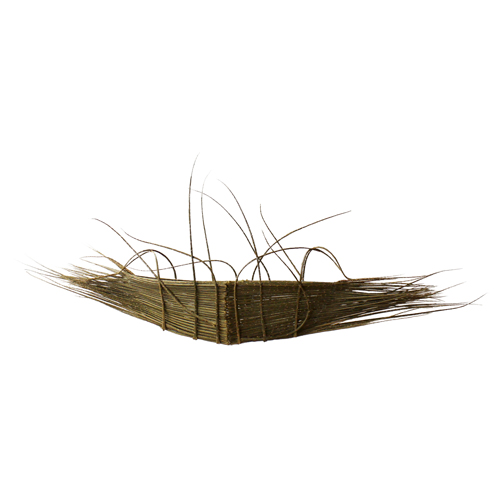
Adejoke Tugbiyele, The Love Boat, 2016, palm spines, copper wire, threaded rods, 26 x 72 x 10 inches.
Image via Skoto Gallery.
Grassroots
February 25 - April 9, 2016

Artist’s reception: Thursday, February 25, 2016, 6:00pm - 8:00pm

SKOTO GALLERY
529 West 20th Street, 5th Floor
New York, NY

From Skoto Gallery e-blast:

Skoto Gallery is pleased to present an exhibition of recent works by the Nigerian-American artist Adejoke Tugbiyele. This is her first solo show at the gallery.
Adejoke Tugbiyele’s work is informed by a sophisticated discourse on traditional philosophical concepts, a deep understanding of the aesthetic and cultural character of the African continent as well as an invigorating inclination and facility with various materials and methods. By inventively handling her material within a formalist sculptural framework, combined with a highly developed experimental approach to making art, she creates work that is unorthodox, persistently innovative, and ignores boundaries between different cultural heritages and socially constructed constraints.
Tugbiyele’s sculptural process combines the weaving of fibrous materials such as palm spines around light metal structures, producing abstract figurative forms with universal elements of androgyny, armor, flight, seduction, myth and mystery. Her practice is influenced by multiple genres including ready-made/assemblage, architecture and performance/film. While her work does not openly narrate the events in her life, they are certainly rooted in her cultural, political and emotional experiences as she continuously explore strategies that fuse her aesthetic concerns with playful ironies and poetic metaphors. Despite the fact that she does not avoid the significance of content in her work, they still manage to tell stories of hope and courage, of compassion and resilience that speak to the triumph of the human spirit.
 
Born in Brooklyn, New York in 1977 to Nigerian immigrants, and raised for seven years in Lagos Nigeria, award-winning artist/activist Adejoke Tugbiyele boldly, yet delicately weaves complex ideas about race, gender, sexuality, spirituality and migration. Tugbiyele's work has been exhibited at reputable institutions around the world including the Brooklyn Museum, The Newark Museum, The Museum of Arts and Design, Spelman College Museum of Fine Art, The Reginald F. Lewis Museum, The Centre for Contemporary Art, Lagos Nigeria, The Goethe-Institut (in Lagos, Nigeria and Washington D.C), The Centre for Contemporary Art, Torun, Poland, and The United Nations. Tugbiyele's work is in the permanent collections of the Brooklyn Museum, The Newark Museum and in significant private collections in the United States and Hong Kong.
Adejoke Tugbiyele is the recipient of several awards including being named Foreign Policy’s 100 Leading Global Thinkers of 2015, a Fulbright U.S. Student Fellowship in 2013, the 2014 Serenbe Artist-in-Residence, the 2013 Amalie Rothschild Award, and the 2012 William M. Phillips Award for best figurative sculpture. In 2014, images of her sculptural works graced the first-ever United States publication of poetry by the African Poetry Book Fund. Her work has been mentioned and featured in numerous publications including The New York Times, The Wall Street Journal, The Huffington Post, Artsy, Financial Mail, This Day Live, The Feminist Wire, The Star Ledger, Intense Art Magazine, Africanah, Okay Africa, Art South Africa, Mail & Guardian, and ArtThrob. In 2014, she appeared on CNN International as the first openly gay woman of Nigerian heritage to come out in the media. Tugbiyele received a Bachelor of Science in Architecture from The New Jersey Institute of Technology and a Master of Fine Arts in Sculpture from Maryland Institute College of Art.


Monday, March 9, 2015

SIGNED: Nicholas Hlobo

Nicholas Hlobo. Image via rolexmentorprotege.com.
South African Artist is Coming to America

From Lehmann Maupin e-blast (March 9, 2015):

Nicholas Hlobo, one of South Africa’s leading contemporary artists, has joined Lehmann Maupin. Known for his intricate installations, Hlobo investigates issues of identity, sexuality, gender, and class in the context of his South African heritage.
Materials play a significant role in Hlobo’s multi-disciplinary practice, which includes painting, drawing, sculpture, performance, works on paper, and video installation. He prefers tactile items such as ribbon, leather, wood, and rubber, exploring the symbolic power of these raw materials and their potential for transformation.
As part of the Xhosa people, Hlobo makes work that is anchored in his South African background. The linguistic flexibility of the Xhosa language, with its poetic idioms, proverbs, and double entendres, allows the artist to discuss the various facets of his own personal identity alongside a wider cultural history.
“Nicholas Hlobo is a fantastic artist with incredible international recognition,” said Rachel Lehmann. “Like a poet, he is exploring the in between places that are difficult to define - such as the area between male and female, between white, gray, and black. The themes he addresses of nationality, race, gender, sexuality, and identity are all strongly engaged with Lehmann Maupin’s programing and have ties to the work of Kader Attia, Robin Rhode, Mickalene Thomas, and Adriana Varejão.”
The artist’s first show with Lehmann Maupin is scheduled for 2016 in New York.
About the artist
Nicholas Hlobo (b. 1975, Cape Town, South Africa) received a Fine Art degree from Johannesburg’s Technikon Witwatersrand in 2002. Hlobo’s exhibition history includes solo exhibitions at Locust Projects, Miami, Florida (2013); National Museum of Art, Architecture and Design, Oslo, Norway (2011); Savannah College of Art and Design, Lacoste, France (2010); Tate Modern, London (2008); the Institute of Contemporary Art, Boston, Massachusetts (2008); and SCAD Museum of Art, Savannah, Georgia (2007). He has participated in several international biennials and notable group exhibitions including The Divine Comedy at the Museum fur Moderne Kunst, Frankfurt (2014); the 18th Biennale of Sydney, Australia (2012); the 54th Venice Biennale (2011); La Triennale at the Palais de Tokyo, Paris (2012); the Liverpool Biennial (2010); the Guangzhou Triennial, China (2008); and Flow at the Studio Museum in Harlem, New York (2008). In November 2015, Hlobo will participate in Performa, the biennial dedicated to performance art in New York. Hlobo’s work is included in numerous collections including the South African National Art Gallery, Cape Town; Savannah College of Art and Design, Georgia; Tate Modern, London; and the Pompidou Centre, Paris. The artist lives and works in Johannesburg, South Africa.

Nicholas Hlobo, Installation of Iimpundulu Zonke Ziyandilandela (All the Lightning Birds Are After Me), 2011, ILLUMInations, 54th Venice Biennale, Venice, Italy. Photo: Mario Todeschini.


Monday, November 17, 2014

EVENT: Conversations Among Friends / New York / November 17, 2014

Zanele Muholi, Vredehoek, 2011; Nomonde Mbusi (detail) by Zanele Muholi.
Featuring artist Zanele Muholi and actress Nomonde Mbusi

Monday, November 17, 2014
 7:00 pm program | 8:15 pm reception
Doors open at 6:45 pm

Tickets ($35 General Admission, $20 Members, $12 Students) may be purchased at the Museum information and film desks, online at MoMA.org, or through The Friends of Education Office.

The Celeste Bartos Theater (Theater 3)
The Lewis B. and Dorothy Cullman Education and Research Building
4 West 54th Street
New York, NY

From moma.org:

Presented by The Friends of Education of The Museum of Modern Art as part of the series Conversations: Among Friends, this evening's program features a conversation between artist Zanele Muholi and actress, director, and playwright Nomonde Mbusi, moderated by Judith B. Hecker, MoMA's assistant curator for drawings and prints. The program will focus on Muholi’s work as a "visual activist" dedicated to issues of race, gender, and sexuality, and will reflect on this year’s 20th anniversary of democracy in South Africa—still a work in progress. Muholi is best known for her photographic series Faces and Phases, five of which are in MoMA’s collection. Begun in 2006, this series portrays black members of the LGBTI community in South Africa and around the world, giving voice to their stories and displacing conventional perceptions. Nomonde Mbusi, one of Muholi’s participants in Faces and Phases and an artist and activist in her own right, joins the discussion. Following the program, guests are invited to continue the conversation at an intimate reception catered by Fantasy Fare in The Cullman Mezzanine. Muholi’s newest book, Zanele Muholi: Faces and Phases 2006–2014 (The Walther Collection/Steidl 2014) will be available for purchase and signing by the artist.

Zanele Muholi was born in 1972 in Umlazi township in Durban, South Africa, and currently lives in Johannesburg. Prior to her photographic journeys, she worked as a human rights activist, raising issues facing black lesbian women in South Africa. In 2009 she founded Inkanyiso, an organization centered on visual arts, activism, media, and advocacy. Muholi studied at the Market Photo Workshop in Johannesburg, and graduated from Ryerson University in Toronto in 2009 with an MFA in documentary media. She is the winner of awards from the 2009 Rencontres de Bamako African Photography Biennial; the 2013 Carnegie International; and recipient of a 2013 Prince Claus Award. Muholi’s work has been featured in the 55th Venice Biennale; Documenta 13; the 29th São Paulo Biennial; and has been shown at prestigious museums worldwide. Her work can be found in numerous museum collections including The Museum of Modern Art, New York; San Francisco Museum of Modern Art; South African National Gallery, Cape Town; Centre Georges Pompidou, Paris; Tate Modern, London; The Menil Collection, Houston; and The Walther Collection, Neu-Ulm, Germany; among others. Her award-winning documentary Difficult Love (2010) has been shown at film festivals around the world.

Nomonde Mbusi was trained in dramatic arts at the University of Zululand. Since 1997, she has performed in numerous theater productions and is best known for her role as Fikile in Flipping the Script, a four women show on gender-based violence (2004-07). In 2004 she cofounded Insika Productions with Muholi, where she worked as artistic director and facilitator. Through Insika, she organized creative arts healing workshops for women survivors of violence in organizations such as POWA-People Opposing Women Abuse and FEW-Forum for the Empowerment of Women. Her recent acting accomplishments include the lead role of Brenda on SABC 1’s drama Usindiso (Redemption), and Thando in Dr. John Kani’s play Nothing but The Truth at the Soweto Theatre, along with several other television and radio performances.

Judith B. Hecker, Assistant Curator, Department of Drawings and Prints at MoMA, organized Impressions from South Africa, 1965 to Now: Prints from The Museum of Modern Art (2011), which featured some 80 prints, artist’s books, posters, and wall stencils by artists living in South Africa that were acquired by the Museum. She co-curated MoMA’s presentation of the touring exhibition William Kentridge: Five Themes (2010), and authored the accompanying publication Trace: William Kentridge, Prints from The Museum of Modern Art.


Saturday, March 22, 2014

FRANKFURT: The Divine Comedy

Edson Chagas, TIPO PASS, Filipe D. Kuangana, 2012. Courtesy of the artist and A Palazzo Gallery, Brescia © Edson Chagas. 
Image via apalazzo.net.

Heaven, Hell, Purgatory Revisited by Contemporary African Artists
March 21 – July 21, 2014

Domstrabe 10
Frankfurt, Germany

From the Museum Für Moderne Kunst web site:

In The Divine Comedy: Heaven, Hell, Purgatory revisited by Contemporary African Artists, the MMK will serve as a stage for Dante’s Divine Comedy on 4,500 square metres of exhibition space. In this early fourteenth-century epic, which combines central notions of Christianity with religious concepts of antiquity, the Italian poet Dante Alighieri (1265–1321) explores theological, philosophical and moral issues which have lost nothing of their social and political topicality to this day. His work forms the foundation for the exhibition developed by curator Simon Njami in cooperation with the MMK and to be presented subsequently at four further venues worldwide.


On three floors, one each devoted to heaven, hell and purgatory, works in a variety of media will be presented: paintings, photographs, sculptures, videos, installations and performances. A large number of the works will be conceived specifically for the MMK interior and premiered by the show. Taking their own widely differing cultural and religious backgrounds as a point of departure, the artists will examine individual thematic sequences of the Divine Comedy. In some cases the otherworldly realms will be visualized as godless places brought to life by the power of imagination; in other works they will be associated with ideas of divinity, hope or loss. 


Against the background of the many Africa-related exhibitions of the past years, the MMK perceives the need to investigate the significance of African art not only in the post-colonial context but also with regard to aesthetics. The exhibition will accordingly not be limited to historical or political depictions; on the contrary, it will set its sights on poetry and art as expressive means of conveying and communicating the unspoken. The exhibition concept transports the universal issues of the Divine Comedy, an incunable of European literature, into the present and places them in a transnational contemporary context.   


Click here for list of artists featured in exhibition.

Click here to view more images in exhibition.