Showing posts with label Franklin Sirmans. Show all posts

Sunday, February 21, 2016

MAIN ATTRACTION: Franklin Sirmans

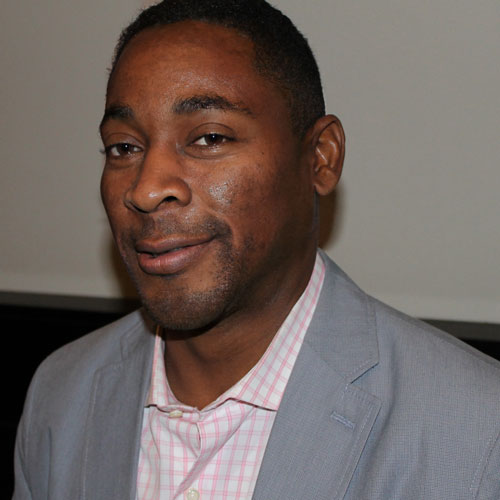
Franklin Sirmans, director of the Pérez Art Museum, welcomes guests and patrons during the third annual Reception for the PAMM Fund for African American Art in Miami, on Tues., Feb. 16, 2016. Photo by Pedro Portal (pportal@elnuevoherald.com) via miamiherald.com
Museum director’s star power draws crowd to Pérez Art Museum Miami

Text | Jane Wooldridge for the MiamiHerald.com
Published | February 16, 2016

Thank the star power of museum director Franklin Sirmans and the convergence of Black Tech Week at the nearby Adrienne Arsht Center for [a] stellar turnout at the Pérez Art Museum Miami’s third annual Ambassadors event.

More than 1,300 — more than double the crowd in previous years — RSVP’d for the reception, an outreach funded by the Knight Foundation in support of the museum’s Fund for African American Art.

Knight Foundation President and CEO Alberto Ibargüen attributed the event’s growth to past success — “people know we throw one of the best parties of the year” — and to interest in Sirmans, who is widely considered a rising star in the art world. “There is no getting around the fact that people are excited about Franklin Sirmans; they’re energized and they’re proud that he’s our museum director.”

Sirmans joined the museum last fall, becoming the first African American to serve as director of the PAMM or its predecessor, the Miami Art Museum.

[The] event was designed to connect the African-American community with the museum and raise both awareness and funds for PAMM’s African American Art Fund, founded with a $1 million donation by the Knight Foundation and museum namesake Jorge M. Pérez to purchase works by African Americans.

The event [drew] the kind of community interest the Knight Foundation had intended, said Ibargüen. “Where I think it could do better is drawing other people to contribute to the fund. I would love for people to step up and put money on the table.”

About 200 have signed up for Ambassador membership, making a minimum $250 annual contribution.

For the first time, the event included performances — one by Jamaican artist Nari Ward, whose Sun-Splashed is on display at the museum, and a second by Girl Power’s Girls’ Choir of Miami.


Saturday, September 5, 2015

APPOINTED: Franklin Sirmans

Franklin Sirmans in 2012. Photo from BlackArtistNews archive. 
Franklin Sirmans named director of the Pérez Art Museum Miami: “A museum is not only a place unto itself”

Text | M. H. Miller for ARTnews.com
Published | September 4, 2015

This week, Franklin Sirmans was named the director of the Pérez Art Museum in Miami. The museum, which opened in 1984, finished a massive renovation project in 2013, with a new building designed by Swiss architects Herzog and de Meuron. Sirmans, currently the curator of contemporary art at the Los Angeles County Museum, will start his directorship next month. He’s been quite in demand over the last decade, having worked previously as a curator of modern and contemporary art at the Menil Collection in Houston, as well as serving as a curatorial advisor for MoMA PS1. Among the many blockbuster shows he’s organized is last year’s excellent Prospect triennial in New Orleans. We reached Sirmans by phone Friday morning. He had flown to Miami for a few days, and had just met with the Pérez staff.
I guess to begin, what are some of your goals as the director of the Pérez?

Well, I start in, like, a month and a half. I think first and foremost—and it’s not a long-term goal—but first is to really just absorb the archive, and to absorb the things that have happened here, from opening in 1984, to becoming a collecting museum in 1996, and now with this amazing building that’s just been open not even two years yet. So that’s the first thing. Just absorb it all, and get a deeper sense of the foundation of where the museum comes from so we understand where we’re going. Of course that entails doing a lot of talking to people and working with Tobias Ostrander, our chief curator, and thinking through those things. That’s the first goal.

Then I guess it becomes more about long-term development. I think it’s safe to say, with the building done—and it’s gorgeous and it functions—to think about ways in which you can really highlight it. It sits right on Museum Park, and you have this great meeting place, where people want to come, and want to run into people, and hopefully see something that is not only entertaining but potentially makes people think and have different experiences that are triggered by art and ideas.

Los Angeles, where you’ve been based for a while, is a kind of endlessly aspirational city, and people are constantly comparing it to something else, usually New York. L.A. is either the next New York, or it was the original New York, or whatever. So, with this in mind, how do you think Miami compares to Los Angeles?

Well, I don’t know. Two very different cities, but with a lot of similarities. I think people have applied the “is it going to be the next New York” thing in the same way [to Miami] as in L.A. We sort of have these old institutions—you think of New York, you think of Boston, and we’re talking about hundreds of years of history. But L.A., one of the cool things about working in L.A., and being a part of that, is that LACMA has only been there since 1965. So you have this incredibly fertile backdrop. You have John Baldessari right there, you have Ed Ruscha right there, telling you how they were able to stay in Los Angeles in the ’60s and make art. So there’s that very direct, primary relationship.

And here, this institution, we’re only talking about the mid-’80s. It’s another young, fast-moving place. That is, I think, a really exciting opportunity, especially to think about this place and its geographic location between North and South America, and part of the Caribbean. Having that as a backdrop is pretty amazing.

In an interview you gave with the New York Times this week, you said something interesting about the curator in the 21st century—that just being somebody who puts together shows isn’t the case anymore, and all curators are also fundraisers as well. I know you haven’t started your role as director yet, but I’m curious if you have any thoughts as to how the role of the museum director has changed as well?

I feel so fortunate having worked for [LACMA’s director] Michael Govan and having known him and seen the way he worked. And then working for someone who’s really different but also passionate—Joseph Helfenstein [the director of the Menil Collection]. So I think that the position—of course speaking from a detached sense—is more of a place where we consider what it means to be a director from the inside and the outside. And I guess that means there was a time, perhaps similar for curators, where directors could think solely about what happened inside the institution. And things like education, things like programs that happen at non-regular open hours weren’t so important.

And there were questions. How does performance play into that? How does public sculpture play into that? How does the museum work as a place that is sort of the nexus for many different kinds of institutions? Because artists are so fertile in terms of creativity and so interdisciplinary, how do we use the museum to talk about those things so we can crisscross with science, with music, with education? All of those things play a role now. And the museum can be that place where it all comes together. And I think the position involves putting forth a multidisciplinary view, like how our best artists, or the artists we admire, push ideas to new boundaries and get people to think in different ways. I think that the director has potentially become more a part of that very open process. At least from my vantage point. I think about directors I’ve seen working—I think of Thelma Golden and what she’s done with the Studio Museum. I think a museum is not only a place unto itself, it’s a place that is important to a community as a whole, and it has become even more important.




Friday, December 24, 2010

POST: Unframed The LACMA Blog / A Conversation with Franklin Sirmans / May 14, 2010

Seeing Anew: A Conversation with Franklin Sirmans

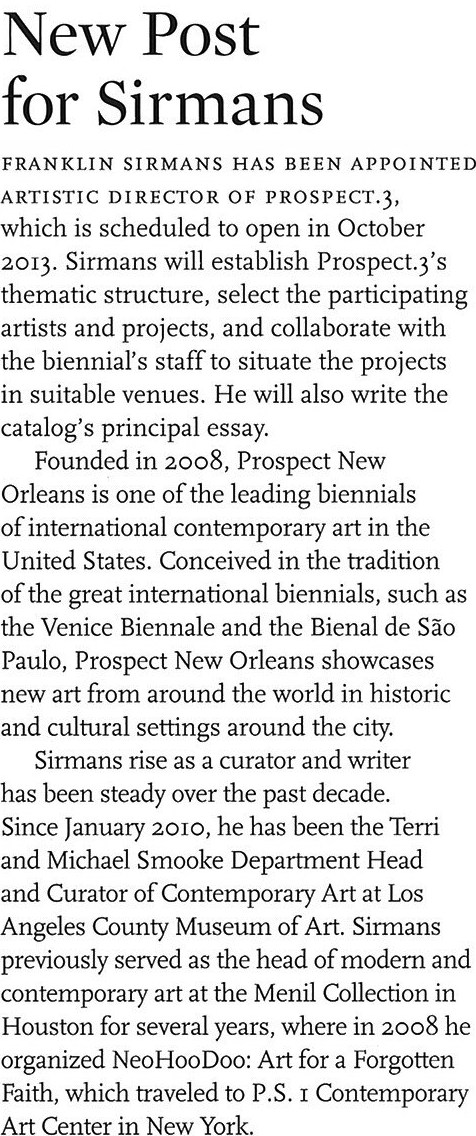
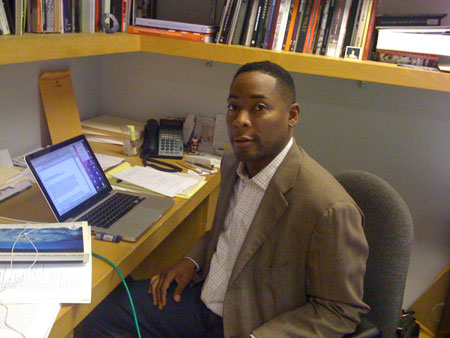
Franklin Sirmans hasn’t wasted any time settling into his new post as head of contemporary art at the Los Angeles County Museum of Art. He’s been visiting studios, galleries, and private collections around town, getting to know the works of art in our permanent collection, and planning upcoming exhibitions. Before coming to LACMA, Franklin served as curator of modern and contemporary art at the Menil Collection in Houston, and worked as an independent curator, critic, writer, and editor. Now that he’s been here for a few months, I checked in to see how he was adjusting to his new surroundings.

What brought you to LA?
It was the opportunity to work with the team assembled here—including director Michael Govan, and my colleagues throughout the museum—at a really exciting time. Also, right now, the art conversation in Los Angeles is so interesting. Art in Los Angeles is still so young. We’re looking back to the grand old past of, what? The 1950s and 60s. We are still in the midst of a conversation about the formation of the art scene in Los Angeles with the people who were here then and are still here now—Ed Ruscha, Joe Goode, Betye Saar, Samella Lewis, just to name a few. That fascinates me.

What are you finding out about Los Angeles?
I’m still checking out the neighborhoods, seeing new places. I went to see Judson Powell in Compton the other day to talk about his work at the Watts Towers in the past and his present work there, building an arts and cultural center.
I feel like I know the Culver City scene but I know that’s very little in the scope of things. That said, Lauri Firstenberg at Laxart, Suzanne Vielmetter Projects, and Roberts & Tilton are always interesting.
I‘ve done studio visits with Betye Saar, who has a wonderful piece in the collection, and Paul McCarthy, also in the collection. I recently did a visit with the curator Samella Lewis, whose work I grew up reading.
I knew a lot of artists before coming here. But I didn’t know the collectors and collections in Los Angeles, so I’m trying to get to know them now, as well as artists. I’m also really interested in what’s happening outside the confines of visual art—what people are doing in film, dance, and music, and the vernacular of the city.

What else, besides art?
I watch a lot of soccer.

What do you miss about Houston and the Menil Collection?
The atmosphere there is so serene. You have the Byzantine Fresco Chapel across the street from the Mark Rothko Chapel. Right there, you also have Barnett Newman’s Broken Obelisk and down the street you have the Menil Collection and behind that you have Cy Twombly’s gallery and behind that you have Dan Flavin’s gallery. It’s like a perfect art experience.
But in a lot of ways, that’s what’s happening here at LACMA, right now.

What’s it like getting to know the collection here?
I’m interested in exploring the synergy between the Broad collection and the LACMA collection, and we’re doing that already in some new installations this fall.
The modern collection here includes some really special pieces—the Giacomettis, for example. The Picassos, those Brancusi birds.
There are some wonderful works I would like to see installed—a Marlene Dumas painting that’s been out on loan for a while, a work by John Outterbridge that I really want to see, and Toba Khedoori, a young artist who interests me. We have a wonderful piece of hers in the collection. It’s huge—I’d really love to see that on view. Not easy to do.
I want to play on the strengths of the collection, those special objects that we have at hand, and also the relationship we have with artists here in Los Angeles, which is something that will play a prominent role in a future exhibition. More news on that shortly.
I want to look at contemporary art in the context of the encyclopedic museum. That was part of the hook, the reason I came here. How, as contemporary viewers, do we look at the art of the past? How can artists help us see the past anew?
Amy Heibel

http://lacma.wordpress.com/2010/05/14/seeing-anew-a-conversation-with-franklin-sirmans/