 | |
NO SUCH PLACE: Contemporary African Artists in America
February 26 - April 3, 2015
Curated by Larry Ossei-Mensah & Dexter Wimberly
Featuring ruby onyinyechi amanze, Modou Dieng, Brendan Fernandes, Derek Fordjour, Sherin Guirguis, Vivienne Koorland, Wura-Natasha Ogunji, and Adejoke Tugbiyele.
37 West 57th Street
New York, NY
From etnahem.com:
Edward Tyler Nahem Fine Art is pleased to present NO SUCH PLACE: Contemporary African Artists in America, a group exhibition that highlights recent work by eight contemporary African artists living and working in the United States.
NO SUCH PLACE focuses on artists who express cultural duality and punctuate the complexities of African identity. These multi-generational artists from African countries as varied as Egypt, Ghana, Kenya, Nigeria, Senegal, and South Africa, seek to debunk the idea of Africa as a singular, monolithic "place”, therefore initiating discussion on "Africaness" in the context of contemporary culture.
"There is no such thing as contemporary African art – there is only contemporary art from Africa,” said Bisi Silva, independent curator and founder/director of the Centre for Contemporary Art in Lagos, Nigeria. Silva warns against generic geographical descriptions of art from a continent that is so vast and diverse. Taking a cue from Silva’s statement, NO SUCH PLACE investigates the overlapping signifiers and great diversity present in these particular artists’ work, providing a space that fosters a broader dialogue about culture, aesthetics, religion and politics. NO SUCH PLACE dives into artistic intuition, exploring how these eight artists process identity and represent their individual points of view.
According to Nahem "There is a new and talented wave of artists emanating from all corners of the rich cultural tapestry known as Africa. We are excited to share in this exploration of contemporary work from a small group of artists from the diaspora, whose diversity lends itself to age, gender, roots and geography. Their new world is ideally one that opens us up to our own concept of the newness of Africa today. We are excited to provide such a forum and hopefully to be a meeting ground and catalyst for its growth and dissemination."
|
Showing posts with label Dexter Wimberly. Show all posts
Showing posts with label Dexter Wimberly. Show all posts
Thursday, February 26, 2015
NEW YORK: NO SUCH PLACE: Contemporary African Artists in America

Saturday, July 20, 2013
NEW YORK: Crossing the Line - Contemporary Drawing and Artistic Process

Curated by Dexter Wimberly and Larry
Ossei-Mensah
July 11 – August 16, 2013
531 West
26th Street, 1st Floor
New York,
NY
Mixed
Greens is proud to present Crossing the
Line: Contemporary Drawing and Artistic Process, a group exhibition
co-curated by Dexter Wimberly and Larry Ossei-Mensah. The curators initiate
an expansive visual discourse that brings the act of drawing front and center,
showing its importance as the foundation of art making. Crossing the Line features new works by a group of emerging female
artists hailing from Nigeria, the Dominican Republic/Haiti, South Korea,
Trinidad, Iran, and the United States. All are exploring drawing within the
context of their dynamic artistic practices and re-defining how drawing fits
into the broader global contemporary art conversation. The exhibition presents
distinct approaches to representational and abstract drawing, as well as
experimental, site-specific mixed media and video installations that are
equally influenced by drawing.
The Artists:
Ruby Onyinyechi Amanze is a Brooklyn-based
artist of Nigerian birth and British upbringing who has found empowerment in
the authenticity of the hybrid. Amanze was recently awarded a Fulbright Scholarship
to create a new body of work in her native Nigeria to fully piece together the
gaps in her identity. She has been greatly influenced by memories of
architecture and space, the politics of home, nomadic stories, and urban
landscapes. Drawing from her background in textiles and printmaking, Amanze’s
drawings reflect a fragmented and layered material sensibility that is highly
intuitive to process. She received a BFA from Tyler School of Art in 2004 and
an MFA from Cranbrook Academy in 2006. Residencies have included Cooper Union
in NYC and Gallery Aferro in Newark, NJ.
Firelei Báez is a Haitian-Dominican
artist who makes large-scale, intricate works on paper indebted to a
convergence of interests in anthropology, science fiction, black female
subjectivity, and “women’s work.” Her art explores the humor and fantasy
involved in self-making within diasporic societies. Such societies often
utilize cultural ambiguities to build psychological and even metaphysical
defenses against cultural invasions. She received a BFA from The Cooper Union’s
School of Art in 2004, participated in The Skowhegan School of Painting and
Sculpture in 2008, and received an MFA from Hunter College in 2010. Her
residencies include The Lower Manhattan Cultural Council Workspace and The
Lower East Side Print Shop. Báez’s work has been written about in The New York
Times, The LA Times, and Art in America, among others. She was a recipient of
the prestigious Joan Mitchell Painters and Sculptors Award as well as the Jaque
and Natasha Gelman Award in Painting.
Born in
Queens NY, Oasa Sun
DuVerney’s works on paper and
video performances use consumerist culture as a means to unmask our society’s
collective aggression. DuVerney received her MFA from Hunter College and is the
2011 recipient of the Tony Smith Award. She exhibits her work nationally and
has been featured in the New York Times, the New York Daily News, and the
Gotham Gazette. She also won awards from the Brooklyn Arts Council and the
Citizens Committee for “The Brooklyn Hi-Art Machine,” a public project which
brings together a small Brooklyn neighborhood every summer to confront
gentrification through art making. In 2012, DuVerney’s work was exhibited in
the three-person exhibition, Through a glass, darkly, at Postmasters Gallery in
NYC and the group exhibition, Me Love You Long Time, at Aljira Art Center in
Newark, NJ. She is currently an LMCC Workspace Artist-in-Residence. DuVerney
lives in Brooklyn.
Sanam Enayati was born in the United States and raised in
Tehran, Iran. Her newest body of work investigates the physicality of basic
human emotions. By identifying one emotion and letting it transform and overlap
with another, Enayati seeks to create a new, non-familiar space/reality through
a series of “feminine” and “domestic” processes, repetitive movements, and
obsessive behaviors. The emotions inspire a series of compulsive movements
within the non-familiar space/reality, transmuting an orderly, obsessively made
space into complete chaos. After making marks as memories of that space,
Enayati then abandons the space and enters into the nostalgic episodes by
making drawings and paintings. Enayati holds a BFA from the Illinois Institute
of Art in Chicago, IL, an MFA from the School of Visual Arts in NYC, and a
Masters of Fashion Design focused on sociology and psychology from Istituto
Marangoni in Milan, Italy.
Heeseop Yoon was born and raised in
Seoul, South Korea. She is known for her large-scale line drawing installations
and very intricate black and white drawings. Yoon’s concentrated freehand
drawings record cluttered spaces and comment most directly on the (in)accuracy
of perception. She holds her BFA from Chung-ang University in Seoul and an MFA
from City College of NY. Yoon has had solo and two-person shows at prestigious
venues including Triple Candie, NYC; Smack Mellon, NYC; and Arario Gallery,
Seoul, South Korea. She has exhibited in museums and art centers
internationally, including MASS MoCA, North Adams, MA; John Michael Kholer Arts
Center, Sheboygan, WI; The Bronx Museum, NYC; Seoul Arts Center, Seoul, South
Korea; and CAST, Australia and Median Art Center, Beijing, China. She has
participated in several residencies including the Marie Walsh Sharpe Studio
Program, Skowhegan’s School of Painting and Sculpture, Artist Alliance Inc, and
Stiftung Künstlerdorf Schöppingen in Germany. She currently lives and works in
Brooklyn.
The Curators:
Contemporary
art curator and entrepreneur, Dexter
Wimberly, was born and raised in Brooklyn. Curatorially, Wimberly focuses
on contemporary urban history. “I love art that reflects our times, and I am
excited to be in the position to work with artists who are shaping contemporary
culture and bringing the beauty of under-exposed aspects of modern life to a
greater public. I feel that this is my calling within the arts.” A passionate
collector and supporter of the arts, Wimberly has personally exhibited the work
of more than 70 individual artists. Dexter Wimberly also maintains a critical
dialogue with emerging artists throughout the world by way of group
exhibitions, public programs, and lectures at institutions such as The Brooklyn
Academy of Music, The Brooklyn Historical Society, the Museum of Contemporary
African Diasporan Arts (MoCADA), The Savannah College of Art and Design, The
Lower Manhattan Cultural Council, and The Brooklyn Arts Council.
Larry Ossei-Mensah is an independent
curator and cultural critic who has emerged as dynamic voice for the rising
creative class. Ossei-Mensah is a modern day flâneur who documents cultural and
contemporary art happenings for various publications such as Arise, Uptown, and
Whitewall Magazine in addition to his personal blog My Global Hustle. His
writings include profiles of Swizz Beatz, El Anatsui, Yinka Shonibare,
Mickalene Thomas, Rashid Johnson, and Derrick Adams. In 2009, Ossei-Mensah was
featured in the NY Times Styles section curated by the legendary Bill
Cunningham “Celebrating Art and Music.” The multihyphenate Ossei-Mensah was
chosen for Young Curators, New Ideas IV in the summer of 2012 where he
demonstrated a curatorial acumen that makes him one to watch. Ossei-Mensah received
his BA from Clark University in Business Management and earned his MBA in
Marketing from Les Roches in Switzerland. He currently serves on the
acquisitions committee for the Guggenheim’s Young Collectors Council and is on
the board for ArtBridge. Ossei-Mensah lives in NYC.
Tuesday, August 23, 2011
POST: Crown Heights Riot 20 Years Later: Crown Heights Gold / Prospect Heights, NY Patch / August 19, 2011
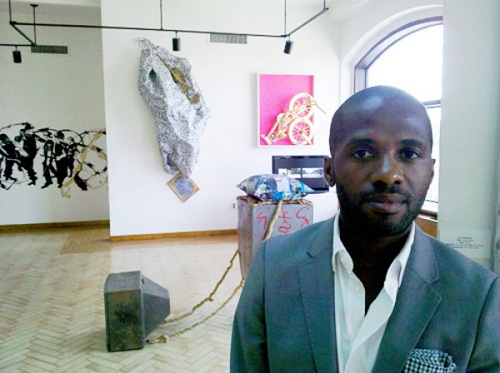 |
Dexter Wimberly, curator of Crown Heights Gold. |
By Jonathan Mandell for the Prospect Heights Patch
On one wall of Crown Heights Gold, an exhibition by 23 artists marking the 20th anniversary of the Crown Heights riot, there are two photographs of happy families – one Hasidic in a park, another Afro-Caribbean on a stoop. Both are entitled “What If?”
What photographer Jamel Shabazz means by that question is: What if on August 19, 1991, seven-year-old Gavin Cato had not been killed in a car accident and 29-year-old doctoral student Yankel Rosenbaum had not been killed in the ensuing riot? What if both had lived?
Gavin Cato would be 27 years old; the bottom photograph is what he and his family might have looked like. Yankel Rosenbaum would be 50; the top photograph is what he and his family might have looked like.
“Put aside all the politics and what remains is that two people lost their lives,” said Dexter Wimberly, curator of “Crown Heights Gold,” which is being held at the Skylight Gallery of the Bedford Stuyvesant Restoration Corporation through the end of October. It is one of two neighborhood exhibitions marking the tragic events; the other, at the Brooklyn Children’s Museum, runs just through this weekend.
In a way, all three dozen works in the exhibition at the Skylight Gallery – photography, painting, collage, video, sculpture – ask the same basic question: How do you turn death into art?
Commissioned to create work for the exhibition, some of the artists, almost all of whom live in Brooklyn, addressed the riots directly. Valerie Caesar, in a piece she entitled, “One of the Cars That Got Burned,” creates a collage out of some two dozen newspaper clippings and the alarming headlines of those three days in August 1991: “RACIAL TENSION FLARES IN B’KLYN: Hasidim & blacks hit streets,” “Little Gavin is laid to rest,” “Dozens injured; cops hit; 16 arrests.”
A number of the works focus on the police. Kiran Chandra’s painting, “1991,” shows a line of helmeted riot police amid a banner-carrying crowd. Monique Schubert’s “Black and Gold” is a large paper cut-out sculpture of barbed wire and cops with billy clubs grabbing a civilian. Kambui Olujimi’s jewelry from “The Blackout Collection” features little handcuffs.
Delphine Fawandu, herself a long-time resident of Crown Heights, chose to focus on a peacemaker. There are three photographs of Richard Green, the founder of the Crown Heights Youth Collective, one of the many organizations founded in the aftermath of the riot that have worked to ease tensions in the community that the riot revealed to the world.
That members of the diverse community have been working together in the 20 years since the riot is at least symbolized by a site-specific installation in the exhibition entitled “Sole Tree” – gold-painted shoes, with candles placed in them, that have been attached to a column of the gallery like so many leaves and branches on a tree. The shoes, which everybody wears, represent how much more we have in common than we realize. The sculpture is also a symbol in that its first-time collaborators, Fiona Gardner and Kenya Robinson, are themselves from diverse backgrounds, an African-American and a Jewish artist.
“Sole Tree” is just one of the many pieces in the exhibition whose connection to the Crown Heights riots is not immediately evident. Oasa DuVerney has created a gold-colored bicycle made entirely out of paper, containing no metal at all. An accompanying video shows a boy trying to ride the bike (unsuccessfully, of course) on a Brooklyn sidewalk. To see a connection, it helps to know that Gavin Cato was fixing his bicycle on the sidewalk in front of his home on President St. in Crown Heights, when the driver of a car in the motorcade of Rabbi Menachem Mendel Schneerson lost control of his vehicle and plowed into him. But there is also a comment in this art piece about the fact that things, no matter how solid they may appear, can fail.
Shortly after the Crown Heights riot, Anna Deavere Smith interviewed more than 50 people involved in one way or another and put together her solo show, “Fires in the Mirror.” It portrayed 26 people – religious leaders, relatives of the victims, and regular Crown Heights residents through using their words, and even their gestures, verbatim. “When things are upside down,” she explained at the time, “there is an opening for a person like me” – by which she meant for an artist.
Twenty years later, as Crown Heights Gold makes clear, there still is.
“Crown Heights Gold” will be shown through October 31, 2011 at the Bedford-Stuyvesant Restoration Corporation Center for Arts and Culture Skylight Gallery, located at 1368 Fulton Street, 3rd floor. Gallery hours are Wednesday through Friday, 11:00am to 6:00pm and Saturdays, 1:00pm to 6:00pm. All the artwork is for sale.
YouTube: Crown Heights Gold: Crown Heights Riot 20 Years Later
Curator Dexter Wimberly tours three of the three dozen art works on display at Crown Heights Gold, an art exhibition marking the 20th anniversary of the Crown Heights riot.
YouTube: Anna Deavere Smith's play "Fire in the Mirror"
This is the first 14 minutes of "Fires in the Mirror" by Anna Deavere Smith, about the Crown Heights riot, as it appeared on American Playhouse.
Subscribe to:
Posts (Atom)