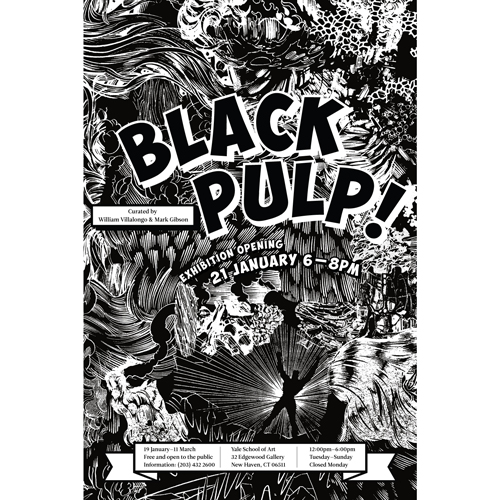
Curated by William Villalongo and Mark Gibson Dimensions
January 21 - March 11, 2016
YALE UNIVERSITY SCHOOL OF ART
32 EDGEWOOD GALLERY
32 Edgewood Avenue
New Haven, CT
Text by Beatrix Archer for The Yale Herald:
A video of a man belly-crawling his way through New York City, rare comic books, prints by Kerry James Marshall, and issues of the Anti-Fascist Front Magazine—these are just a few of the 65 objects and artworks on display in Black Pulp!, a show up at 32 Edgewood Avenue until Mar. 11. William Villalongo, artist and lecturer at the Yale School of Art, and Mark Gibson, ART ’13, curated the show. By displaying the work of black artists and publishers, as well as non-black artists and publishers “allied with foregrounding the black experience,” as the press release for the show explains, Pulp! aims to “challenge racist narratives and change limited notions of black experience.” The show is ambitious, and the expansive range of its content merits multiple visits to the gallery.
The idea for this multimedia exhibit arose from discussions between Villalongo and Gibson, sparked by Kara Walker’s “A Subtlety or the Marvelous Sugar Baby” project in 2014. In that show, Walker created a giant, sugar-coated sculpture in the old Domino Sugar factory in Brooklyn. “Mark and I were floored by how wild and over the top it was,” Villalongo recalled in an email to me. “The aggressiveness and subversiveness of the expression led us to start questioning it as a sort of ‘pulp’ attitude which can be defined as a lurid, satirical and absurd, most readily found in comics and pulp fiction.” When Robert Storr, Dean of the Yale School of Art, asked the faculty for Edgewood Gallery show proposals, Villalongo saw it as a chance to turn musings into a reality.
Villalongo and Gibson began by tracing “a history of printed media that addressed the history of images surrounding African-Americans that used the satirical, printed matter and fiction as a strategy to reconstruct and confront a history of derogatory imagery levied upon black people in the Americas,” Villalongo explained. Though at first unsure of any connection they might find between comics and journals from the time, Villalongo and Gibson quickly found that the visual connections were “undeniable” and “immense.” The work on view starts with the Harlem Renaissance. It was at this time, says Villalongo, that publishing became not only a tool, but a form of activism. “It’s the first time we see a concerted group effort to combat the political and social inequities of black people while producing an image of what that looks like and how black people would like themselves to be seen,” he stated. Works from this era are displayed in cases beside recent works by contemporary artists. By placing these works in the same place, Villalongo notes, the show is able to bring together both “high” and “low” art forms across time. Doing so, he says, allows us to “question these boundaries and address similar problems of image and stereotype in our time.”
Much of the media on display is explicitly about black experiences. Black Panther Party Newspapers, or “The Crisis: A record of the Darker Races,” a publication created during the Harlem Renaissance, are both prime examples. Other objects on display connect more subtly to these experiences. A strip of the comic “Krazy Kat” might first seem irrelevant or slightly absurd in the context of the show: the strip depicts a cat, a mouse, and a worm in and out of a jail and holding various picket signs. But, as the entry written about the piece explains, the comic artist George Herriman’s own mixed racial identity is considered to have had an impact on the subject of his comics and the actions of the characters he created. The Krazy Kat comic is from 1944, and it sits in a display case among other comics from up to 10 years before and 40 years after its publication, an illustration of the show’s extensive reach across time.
Read complete story here


