 |
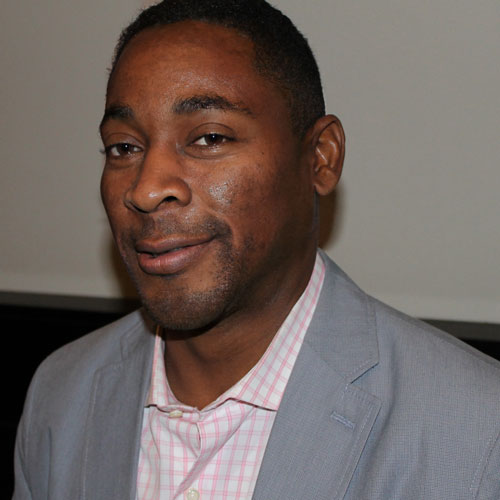
| Franklin Sirmans in 2012. Photo from BlackArtistNews archive. |
Franklin Sirmans named director of the Pérez Art Museum Miami: “A museum is not only a place unto itself”
Text | M. H. Miller for ARTnews.com
Published | September 4, 2015
This week, Franklin Sirmans was named the director of the Pérez Art Museum in Miami. The museum, which opened in 1984, finished a massive renovation project in 2013, with a new building designed by Swiss architects Herzog and de Meuron. Sirmans, currently the curator of contemporary art at the Los Angeles County Museum, will start his directorship next month. He’s been quite in demand over the last decade, having worked previously as a curator of modern and contemporary art at the Menil Collection in Houston, as well as serving as a curatorial advisor for MoMA PS1. Among the many blockbuster shows he’s organized is last year’s excellent Prospect triennial in New Orleans. We reached Sirmans by phone Friday morning. He had flown to Miami for a few days, and had just met with the Pérez staff.
I guess to begin, what are some of your goals as the director of the Pérez?
Well, I start in, like, a month and a half. I think first and foremost—and it’s not a long-term goal—but first is to really just absorb the archive, and to absorb the things that have happened here, from opening in 1984, to becoming a collecting museum in 1996, and now with this amazing building that’s just been open not even two years yet. So that’s the first thing. Just absorb it all, and get a deeper sense of the foundation of where the museum comes from so we understand where we’re going. Of course that entails doing a lot of talking to people and working with Tobias Ostrander, our chief curator, and thinking through those things. That’s the first goal.
Then I guess it becomes more about long-term development. I think it’s safe to say, with the building done—and it’s gorgeous and it functions—to think about ways in which you can really highlight it. It sits right on Museum Park, and you have this great meeting place, where people want to come, and want to run into people, and hopefully see something that is not only entertaining but potentially makes people think and have different experiences that are triggered by art and ideas.
Los Angeles, where you’ve been based for a while, is a kind of endlessly aspirational city, and people are constantly comparing it to something else, usually New York. L.A. is either the next New York, or it was the original New York, or whatever. So, with this in mind, how do you think Miami compares to Los Angeles?
Well, I don’t know. Two very different cities, but with a lot of similarities. I think people have applied the “is it going to be the next New York” thing in the same way [to Miami] as in L.A. We sort of have these old institutions—you think of New York, you think of Boston, and we’re talking about hundreds of years of history. But L.A., one of the cool things about working in L.A., and being a part of that, is that LACMA has only been there since 1965. So you have this incredibly fertile backdrop. You have John Baldessari right there, you have Ed Ruscha right there, telling you how they were able to stay in Los Angeles in the ’60s and make art. So there’s that very direct, primary relationship.
And here, this institution, we’re only talking about the mid-’80s. It’s another young, fast-moving place. That is, I think, a really exciting opportunity, especially to think about this place and its geographic location between North and South America, and part of the Caribbean. Having that as a backdrop is pretty amazing.
In an interview you gave with the New York Times this week, you said something interesting about the curator in the 21st century—that just being somebody who puts together shows isn’t the case anymore, and all curators are also fundraisers as well. I know you haven’t started your role as director yet, but I’m curious if you have any thoughts as to how the role of the museum director has changed as well?
I feel so fortunate having worked for [LACMA’s director] Michael Govan and having known him and seen the way he worked. And then working for someone who’s really different but also passionate—Joseph Helfenstein [the director of the Menil Collection]. So I think that the position—of course speaking from a detached sense—is more of a place where we consider what it means to be a director from the inside and the outside. And I guess that means there was a time, perhaps similar for curators, where directors could think solely about what happened inside the institution. And things like education, things like programs that happen at non-regular open hours weren’t so important.
And there were questions. How does performance play into that? How does public sculpture play into that? How does the museum work as a place that is sort of the nexus for many different kinds of institutions? Because artists are so fertile in terms of creativity and so interdisciplinary, how do we use the museum to talk about those things so we can crisscross with science, with music, with education? All of those things play a role now. And the museum can be that place where it all comes together. And I think the position involves putting forth a multidisciplinary view, like how our best artists, or the artists we admire, push ideas to new boundaries and get people to think in different ways. I think that the director has potentially become more a part of that very open process. At least from my vantage point. I think about directors I’ve seen working—I think of Thelma Golden and what she’s done with the Studio Museum. I think a museum is not only a place unto itself, it’s a place that is important to a community as a whole, and it has become even more important.

