Showing posts with label painters. Show all posts
Showing posts with label painters. Show all posts
Sunday, February 11, 2018

Tuesday, April 12, 2016
NEW YORK: Charles Gaines

PAULA COOPER GALLERY
534 West 21st Street
New York, NY
From paulacoopergallery.com:
The Paula Cooper Gallery is pleased to present a group of eight new large-scale triptychs by Charles Gaines, entitled Numbers and Trees: Central Park Series I. The works constitute a continuation of this prolific artist’s acclaimed series, Numbers and Trees, begun in 1987.
For more than forty years, Charles Gaines’ art has explored the relationship between aesthetics, politics, language and systems. Gaines employs rule-based methodologies to investigate ways in which meaning can be experienced in images and words. Informed by sources as varied as Tantric Buddhist drawings, the systemized work of Hanne Darboven, and John Cage’s notions of indeterminacy, Gaines creates work that often employs plotting and mathematics to organize visual components. While appearing systematic and scientific, Gaines’s works ultimately refrain from producing empirical knowledge, preferring instead to invoke the viewer’s subjective response. They explore an individual’s perception, expression and speculative thought, as they operate both within and against a system.
Charles Gaines’s new work, Numbers and Trees: Central Park Series I, marks an extension of his early interest in serialized projects. For each of his eight triptychs, Gaines divides and mounts a black and white photograph of a tree in Central Park, taken at the time of the artist’s 2014 exhibition at the Studio Museum in Harlem. Enclosing each panel within an acrylic box, screened with grids of half-inch squares, he graphs the silhouette of the tree directly onto the overlaid acrylic surface. Filling cells with vibrant paint, Gaines plots numbers to index the leaves and branches of each tree; he begins at the center of the trunk, counting outward in both directions to create a pixelated image guided by a numerical system. As the series progresses, the catalog of previous trees, each denoted by a different hue, appears on every subsequent triptych, resulting in a prismatic kaleidoscope of layered colors. The cumulative effect bridges the expressive sublime with the schematic referent.
Also on view are six new works from Gaines’s Librettos: Manuel de Falla / Stokely Carmichael series. These works unite a score by composer Manuel de Falla from his 1904 Spanish opera La Vida Breve –a tragic story of a love affair doomed by social mores and class differences– with the language of an impassioned and oratorically rhythmic 1967 speech by Stokely Carmichael (a Black Panther Party member and civil rights activist), in which Carmichael advocates that African Americans refuse to serve in the Vietnam War as an act of self-determination in the face of oppression. Transposing Carmichael’s speech as operatic libretto, Gaines activates text as the measure of process and duration and reveals affinities between these seemingly discordant sources. The nuanced combination of music and text composes a ballad for the enduring history of race-class inequalities as well as the capacity for art to provide emotional egress.
Wednesday, March 16, 2016
NEW YORK: Serge Alain Nitegeka
 | ||
| ||
Colour & Form in BLACK
March 17 - April 23, 2016
Opening reception: Thursday, March 17, 2016, 6:00 - 8:00pm
MARIANNE BOESKY GALLERY
506 West 24th Street
New York, NY
From Marianne Boesky Gallery e-blast:
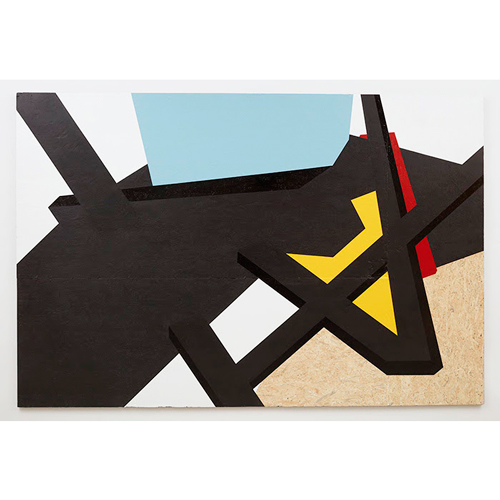
Marianne Boesky Gallery is pleased to present Colour & Form in BLACK, a solo exhibition of new paintings and sculptures by Burundi-born, Johannesburg-based artist Serge Alain Nitegeka at its flagship Chelsea location. The exhibition presents a new body of work that demonstrates the artist’s recent experimentations with form, color, and space. Colour & Form in BLACK is Nitegeka’s second solo exhibition since joining the gallery in 2014.
This exhibition presents the current trajectory of Nitegeka’s practice, in which the artist pursues a visceral and unmediated engagement with formal questions of line, color and volume. Here, Nitegeka deepens his commitment to abstraction, evoking Russian constructivism with these works’ clean, structured lines and boldly oscillating colors, compositions notably born not from forethought, but rather from the freeform aesthetic spontaneity that alights when artist and picture plane meet.
The resultant compositions – in both two and three dimensions – appeal to the viewer’s visual, tactile and spatial senses. Lines and shapes are rendered in shades of black, robin’s egg blue, ivory white, golden yellow, and deep crimson, both shaping space and denying it, framing it and setting it free. Demonstrating the artist’s ongoing move into pure abstraction, they encourage the viewer’s intuitive, aesthetic engagement, in a manner that befits the organic conditions of their own creation.
Nitegeka evokes the transcendental force and rich potential of the colour black to illustrate the ineffable essence of these works:
“The colour black is primordially predisposed to a deep, dark, mysterious simplicity. It doesn’t need to be explained, it refuses to be enlightened. It just is. However, given form and in the company of other colours, the colour black reveals itself robust and beautiful, proving itself a flat mental space void of everything yet rich in anything; a solid, ambiguous colour. The colour black is my point of departure from the unknown into the unknown. I don’t know where I am from or where I am headed. I am from the black heading back into the black.”
Serge Alain Nitegeka’s practice comprises abstract painting, sculpture, large-scale installation, and figurative drawing, repurposing modernist preoccupations with line and the picture plane to address larger cultural and political issues. Nitegeka’s work has been shown throughout South Africa, Senegal, Europe, and the United States. His first solo exhibition at Marianne Boesky Gallery, Morphings in BLACK, opened in November 2014 at the BOESKY EAST, the gallery’s Lower East Side location. In 2015, Nitegeka’s work was included in the South African Pavilion at the 56th international Art Exhibition of la Biennale di Venezia , as well as the Göteborg International Biennial of Contemporary Art, Gothenburg, Sweden. In spring 2015, he presented his largest site-specific installation to date, Structural Response II, at SCAD Museum of Art, Savannah, GA. Nitegeka (b. 1983, Burundi) currently lives and works in Johannesburg.
Sunday, March 13, 2016
NEW YORK: David Hammons

FIVE DECADES
March 15 - May 27, 2016
Opening reception: Tuesday, March 15, 2016, 5:30 - 7:30pm
MNUCHIN GALLERY
45 East 78th Street
New York, NY
From Mnuchin Gallery press release:
Mnuchin Gallery is proud to announce David Hammons: Five Decades, a career survey of David Hammons (b. 1943, Springfield, IL), the first exhibition of its kind in twenty-five years. The show, organized with Hammons’ support, will trace the evolution of the artist’s entire oeuvre from the late 1960s to the present day and build on Mnuchin Gallery’s history of collaboration with the artist, following the gallery’s presentations of new work in 2007 and 2011. Conceived by the artist himself, the installation incorporates never-before-exhibited photographs from Hammons’ personal collection documenting key works and performances throughout his career. A testament to his work’s enduring engagement with music, the artist has filled the galleries with the sounds of the koto and shakuhachi of traditional Japanese court music.
One of the most inventive and influential artists of our time, Hammons creates work that addresses the experiences of African American life and the role that race plays in American society. He began his career in Los Angeles in the late 1960s, where he was influenced by the politically charged imagery of the Black Arts Movement, the found-object assemblages of Dada, and the humble materials of Arte Povera. In his breakout body of work, the body prints of the late 1960s and early 1970s, Hammons paired life-sized depictions of his own face and figure— created by coating his skin and hair with margarine, pressing his greased body onto paper, then covering the imprint with pigment powder— with politically charged symbols, such as spades and the American flag.
By the mid-1970s, in part as a rejection of the status quo of the predominantly-white art market, he abandoned the format of two-dimensional, framed works hung flat on a wall, instead devoting his practice entirely to (often ephemeral) sculptural assemblage, installation, and performance. In these works, Hammons recycled found objects specifically associated with urban African American life— chicken bones, cheap liquor bottles, paper bags, and hair swept from the floors of black barber shops— into witty, increasingly abstract creations that subverted expectations for a work of fine art and spoke specifically to an audience traditionally barred from inclusion in the art world.
In the 1980s, after his relocation to New York, Hammons became known for his public sculptures and installations created in the streets, from materials found on the streets. Famous among these is Higher Goals (1986), a group of five, 20-30-foot tall telephone poles topped with basketball hoops and covered in mosaics of discarded beer bottle caps that were commissioned by the Public Art Fund. As in so many of Hammons works, the title and physical object worked together as a verbal and visual pun to generate meaning—in this case, an allusion to the unrealistic dream of basketball providing an escape from urban poverty, and encouragement for black youths to seek loftier goals than athletic prowess. Hammons continued to explore the theme of basketball in works like the Basketball Chandeliers and the Basketball Drawings, examples of which are on view in this exhibition.
Hammons work of the past decade, such as the Kool Aid drawings, the Tarp paintings, and the Mirrors, explore new levels of abstraction and reengage with traditional artistic means, but to unfailingly subversive ends. In the Kool Aids and Tarps, Hammons creates bright, gestural abstractions—a nod to the Modernist canon—whose lushness he then denies us, shrouding his drawings and paintings in old sheets, crumpled plastic tarps, and torn burlap lifted from construction sites. In the Mirrors, Hammons similarly obscures the baroque gilded frames of mirrors that appear straight from one of the Metropolitan’s period rooms with materials from the street, such as dirtied steel plates and torn fabric, wryly uniting two realms of the city that typically exist side by side, but never touching. They also subvert the concept of portraiture, denying the viewer the Renaissance idea of representing his own “mirror image.”
The exhibition will feature loans from both museums and private collections, and include examples from Hammons’ major series from the past five decades, including Body Prints, found-object assemblages such as the Heads, Basketball Drawings, Basketball Chandeliers, Tarps, Fur Coats, and Mirrors. Hammons’ incorporation of photographs documenting key moments throughout his career serves as a characteristically tongue-in-cheek riff on the most recent “survey” of his work— Triple Candie’s 2006 David Hammons Unauthorized Retrospective, which featured only small, cheaply printed reproductions and no actual works of art.
The exhibition will be accompanied by a fully-illustrated catalogue authored by Dr. Kellie Jones, Associate Professor in Art History and Archaeology and the Institute for Research in African American Studies at Columbia University, with an introduction by Dr. Robert Storr, former Dean of the Yale School of Art, and a contribution by Alanna Heiss, founder and former director of P.S. 1 and current founder and director of Clocktower Productions.
Please note: Due to the nature of the show, Mnuchin Gallery will not allow group tours. Also, pets or strollers will not be permitted inside the gallery during exhibit run.
Exhibit Link
Laughter and Anger: A David Hammons Retrospective
11 Things You Should Know about David Hammons Ahead of His Mnuchin Gallery Show
Laughter and Anger: A David Hammons Retrospective
11 Things You Should Know about David Hammons Ahead of His Mnuchin Gallery Show
Monday, March 7, 2016
ASPEN: Shinique Smith
 |
| Installation view: Shinique Smith, Resonant Tides, 2015. Photo by Tony Prikryl via aspenartmuseum.org. |
Resonant Tides
November 8, 2015 - September 4, 2016
ELK CAMP RESTAURANT, SNOWMASS
Vista Trail
Aspen, CO
From aspenartmuseum.org:
New York–based artist Shinique Smith combines an array of visual sources in her work. Incorporating graffiti, fashion, dance, Abstract Expressionism, and Japanese calligraphy, her practice addresses cultural and social issues around production, consumption, surplus, and waste. For the 2015–16 ski season, Smith created Resonant Tides, a new site-specific work at Elk Camp on Snowmass Mountain, continuing her exploration into the connections and values we ascribe to objects—both discarded and prized—and examining the very notion of “belonging.”
Sunday, March 6, 2016
NEW YORK: Glenn Ligon
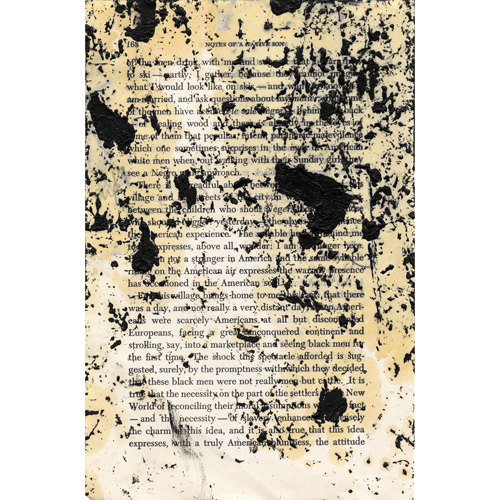 |
Glenn Ligon, Untitled, 2016, From a suite of 17 archival pigment prints, Edition of 5 and 1 artist's proof, 71 x 49 inches.
Image via luhringaugustine.com.
|
What We Said The Last Time
February 27 - April 2, 2016
LUHRING AUGUSTINE
531 West 24th Street
New York, NY
From luhringaugustine.com:
Luhring Augustine is pleased to present What We Said The Last Time, an exhibition of new work by Glenn Ligon, and Entanglements, a curatorial project by the artist. A companion exhibition entitled We Need To Wake Up Cause That’s What Time It Is opened at Luhring Augustine Bushwick on January 16th and remains on view through April 17, 2016.
What We Said The Last Time features a suite of seventeen archival pigment prints that document the paint-spattered pages of the artist’s well-worn copy of James Baldwin’s seminal 1953 essay “Stranger in the Village.” Written during a stay in a remote Swiss mountain hamlet, Baldwin’s text examines complex and urgent questions around blackness, culture, and history. Since 1996, Ligon has used the essay as the basis of his “Stranger” series, including prints, drawings, and dense paintings made with oil stick and often coal dust that oscillate between legibility and obscurity. While creating these canvases, Ligon kept pages of Baldwin’s essay on his studio table for reference, and over the years they became covered with random smudges of black paint, oil stains, and fingerprints. Intrigued by this accumulation of marks, Ligon transformed the book pages into a suite of large-scale prints, using the full text of the essay for the first time in his career. The resulting work is a palimpsest of accumulated personal histories that suggests Ligon’s long engagement with Baldwin’s essay, as well as a new strategy in his ongoing exploration of the interplay between language and abstraction.
Also on view is Entanglements, a curatorial project by Ligon that examines how artists use the studio as a base from which to engage momentous cultural shifts and political events in both direct and oblique ways. Key to the exhibition is Bruce Nauman’s Violin Tuned D.E.A.D. (1969), a video that presents the artist repetitively playing a single note on a violin with his back to the camera. While discussions of Nauman’s video works from this period have focused on issues of performativity, endurance, and the body, Ligon was interested in how Nauman’s discordant note can be heard as a soundtrack to the war in Vietnam or the brutal violence faced by civil rights workers. While not directly commenting on these issues, the ominous soundscape of Violin Tuned D.E.A.D. nevertheless suggests Nauman’s engagement with that turbulent moment in American history and served as a point of departure for Ligon to consider other works in which the artist’s studio has acted as a conduit for contemporary events. Ligon’s selections posit new identities, conversations or modes of sociability as a response to pressing social and political issues. Entanglements features artworks and ephemera by Felix Gonzalez-Torres, David Hammons, On Kawara, Glenn Ligon, Bruce Nauman, Adrian Piper, Bob Thompson, Lynette Yiadom-Boakye, and Andy Warhol.
Glenn Ligon lives and works in New York. He received a Bachelor of Arts from Wesleyan University in 1982, and attended the Whitney Museum Independent Study Program in 1985. A mid-career retrospective of Ligon’s work, Glenn Ligon: America, organized by Scott Rothkopf, opened at the Whitney Museum of American Art in March 2011 and traveled nationally. Ligon has also been the subject of solo museum exhibitions at the Camden Arts Centre in London, the Power Plant in Toronto, the Walker Art Center in Minneapolis, and the Studio Museum in Harlem, among others. He participated in All the World’s Futures at the 56th Venice Biennale (2015), and he curated the group exhibition Glenn Ligon: Encounters and Collisions (2015) with Nottingham Contemporary and Tate Liverpool. Ligon’s work is held in the permanent collections of museums worldwide including Tate Modern, London; Centre Pompidou, Paris; Museum of Modern Art, New York; Whitney Museum of American Art, New York; National Gallery of Art, Washington D.C.; Walker Art Center, Minneapolis; Art Institute of Chicago; San Francisco Museum of Modern Art; and the Los Angeles County Museum of Art.
BROOKLYN: Glenn Ligon
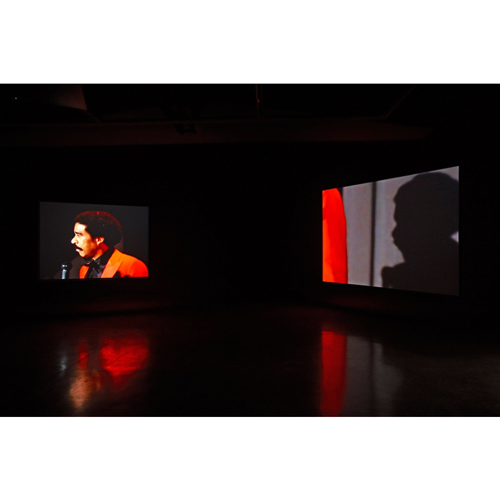 |
| Glenn Ligon, Live, 2014, (Installation view), Seven channel video, Duration: 80 minutes. Image via luhringaugustine.com. |
We Need To Wake Up Because That’s What Time It Is
January 16 - April 17, 2016
LUHRING AUGUSTINE BUSHWICK
25 Knickerbocker Avenue
Brooklyn, NY
From luhringaugustine.com:
Luhring Augustine Bushwick is pleased to present We Need To Wake Up Cause That’s What Time It Is, a new exhibition by the artist Glenn Ligon.
The exhibition features Live (2014), a silent seven channel video installation based on the 1982 film Richard Pryor: Live on the Sunset Strip. Pryor is famous for his darkly humorous and often explicit critiques of society, and Ligon has previously incorporated his standup material in a series of colorful text paintings. In Live, Ligon removes Pryor’s voice, and thereby, the incisive comedy for which he is best known. One channel depicts Pryor in full, while the other six channels each focus on a specific part of his body – his hands, head, mouth, groin, and shadow – to concentrate our attention on his animated delivery and emphatic body language. Each screen is illuminated only when that particular part of the body is visible in the original film, thus the screens flicker off and on intermittently, prompting the viewer to walk around them in order to take in the whole installation.
At a certain moment in the original Live on the Sunset Strip, Pryor discusses his tendency to grow increasingly silent when he becomes angry – “the madder I get, the quieter I get” – and his voice gives way to furious gesturing and the mouthing of obscenities, revealing the sheer physicality of his comedy. By deliberately muting his speech and fragmenting his image, Ligon compels us to see Pryor anew and focus on the non-verbal aspects of his performance – his vivid facial expressions, the perpetual motion of his delicate hands, even his bright red suit. This emphasis on the body invariably raises questions regarding social constructs of race and masculinity. Much of Ligon’s practice explores the limits of language, particularly as it relates to history and identity. Live continues in this vein by eliminating language entirely to consider how meaning is conveyed through the body, as well as conferred upon it.
NEW YORK: Norman Lewis
 |
| Norman Lewis, Figures, 1965, Oil on paper, 63.5 x 48.3 inches. Image via billhodgesgallery.com |
Drawings and Works on Paper
February 18 - April 2, 2016
BILL HODGES GALLERY
529 West 20th Street, 2E
New York, NY
From artsy.net:
ABOUT NORMAN WILFRED LEWIS: Born in Harlem and working within New York City’s downtown art scene, Norman Wilfred Lewis first began painting in a figural style grounded in social realism, focusing on bread lines, police brutality, and the struggles of black Americans. Lewis transitioned to a more abstract style of art during the 1940s and 1950s, continuing to focus on social inequalities but growing increasingly interested in personal expression rather than representation. Lewis’s shift to abstraction was driven in part by his realization that reproducing or mirroring social conditions did not adequately reflect his goals as an artist. His work Evening Rendezvous, for example, addresses political activism and humanitarian concerns through hazy visuals inspired by clandestine Ku Klux Klan gatherings.
Exhibit Link
Thursday, March 3, 2016
ATLANTA: Jean-Michel Basquiat
 |
Jean-Michel Basquiat, Untitled Notebook #1 (Cover), 1980–1981, Mixed media on board. Collection of Larry Warsh. Image via high.org. |
Basquiat: The Unknown Notebooks
February 28 - May 29, 2016
HIGH MUSEUM OF ART
1280 Peachtree Street NE
Atlanta, GA
From High Museum of Art press release:
The High Museum of Art will present its first exhibition focused solely on the life and work of the influential artist Jean-Michel Basquiat (1960–1988).
The exhibition features rarely seen notebooks filled with the artist’s handwritten texts and sketches, the 160 unbound notebook pages will be presented along with 30 related paintings, drawings and mixed-media works drawn from private collections and the artist’s estate. Also on view will be the 1984 Basquiat painting “Untitled (Cadmium)” from the High’s permanent collection.
Basquiat’s notebooks, created between 1980 and 1987, demonstrate how he began to develop the artistic strategies that would inform his large-scale works, which combine text and images in a raw expressionist style to explore culture and society through historical and popular themes. His unique visual language aimed to undermine social hierarchies and rules, taking inspiration from comics, children’s drawings, advertising and Pop art, from Aztec, African, Caribbean, Greek and Roman culture, and from everyday life.
Language was an early medium for Basquiat, and words are an integral part of the notebooks and the large-scale figurative paintings for which he is best known. Handwritten texts run throughout his diverse production, blurring the lines between writing and drawing and between drawing and painting. While the total number of notebooks created by Basquiat remains unknown, the notebooks presented in this exhibition reflect the originality of Basquiat’s thinking and the diversity of his subjects. The eight notebooks in the exhibition and several other works have been borrowed from the collection of Larry Warsh, a New York–based publisher and early collector of Basquiat’s works, who previously served as a member of the Basquiat authentication committee.
Basquiat followed a specific format for his notebook texts, which he wrote primarily in black ink in capital letters similar to those of his street graffiti. Writing only on the right-hand pages, he used color sparingly in the notebooks, with a few exceptions.
Early sketches of subjects that recur in later works, such as tepees, skeletal faces and crowns, appear in the earliest notebooks from 1980 to ’81. The notebook writings range from extended narrative poems and wordplay to observations of New York’s street life, along with lists of celebrities and incidental notes from the artist’s personal life. As in his paintings, fragments of found texts appear throughout the notebooks, incorporating street signage, news stories and references from literature and the Old Testament. Other pages reflect Basquiat’s overriding interest in highlighting racial discrimination and acknowledging the important contributions of African Americans and other people of color as well as his interests in music, world history and popular culture.
“This exhibition offers a very intimate look at the life of an incredibly influential, and somewhat romanticized, figure in contemporary art,” said Michael Rooks, Wieland Family curator of modern and contemporary art at the High. “It’s evident from his writings that Basquiat knew he would find the fame that so fascinated and troubled him, and he recognized that his work spoke to the youth culture of a rapidly changing world. The notebooks give us an opportunity to trace his private thoughts and reflections from their pages to the walls of the gallery. From them, we may develop new perspectives on his artistic practice and a deeper understanding of his life.”
To accompany Basquiat: The Unknown Notebooks, the High has gathered a group of Basquiat’s paintings on view on the Skyway Level of the High’s Wieland Pavilion.
The exhibition will be accompanied by a fully illustrated catalogue published by the Brooklyn Museum and Skira Rizzoli. The volume includes essays by exhibition curator and Basquiat scholar Dieter Buchhart; Henry Louis Gates, Jr., Alphonse Fletcher University professor and director of the W. E. B. Du Bois Institute for African and African American Research at Harvard University; Franklin Sirmans, museum director of the Pérez Art Museum Miami and the High’s 2007 Driskell Prize honoree; and Christopher Stackhouse, a Brooklyn-based writer and visual artist.
Monday, February 29, 2016
SEATTLE: Kehinde Wiley
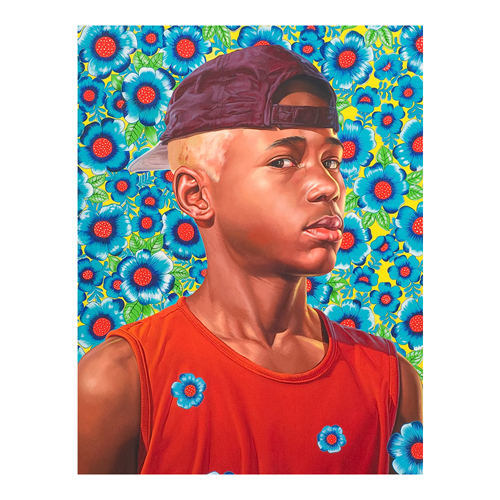 |
| Kehinde Wiley, Randerson Romualdo Cordeiro, 2008. Image via seattleartmuseum.org. |
A New Republic
February 11 - May 8, 2016
SEATTLE ART MUSEUM
1300 First Avenue
Seattle, WA
From seattleartmuseum.org:
Kehinde Wiley is one of the leading American artists to emerge in the last decade and he has been ingeniously reworking the grand portraiture traditions. Since ancient times the portrait has been tied to the representation of power, and in European courts and churches, artists and their patrons developed a complex repository of postures and poses and refined a symbolic language. This language, woven into all aspects of a portrait, described the sitter’s influence and power, virtue and character, or profession. In his consideration of portrait traditions, Wiley has been especially drawn to the grand aristocratic portraits of the 18th century.
The artist began his first series of portraits in the early 2000s during a residency at the Studio Museum in Harlem. He set out to photograph and recast assertive and self-empowered young men from the neighborhood in the style and manner of traditional history painting. Since then he has also painted rap and sports stars but for the most part his attention has focused on ordinary men of color in their everyday clothes. Trained at Yale in the 1990s, Wiley was steeped in the discussions concerning identity politics during this decade and he brings his personal insights and theoretical studies to his practice.
Wiley’s portraits are highly stylized and staged, and draw attention to the dialectic between a history of aristocratic representation and the portrait as a statement of power and the individual’s sense of empowerment.
Tuesday, February 23, 2016
CHICAGO: Patrick Earl Hammie
 |
Inheritance
February 25 - March 26, 2016
Artist reception: Thursday, February 25, 2016, 6:00pm - 9:00pm
Artist talk: Saturday, March 19, 2016, 2:00pm
KRUGER GALLERY CHICAGO
3709 North Southport Avenue
Chicago, IL
From krugergallerychicago.com:
Inheritance, a solo exhibition of paintings and drawings by Patrick Earl Hammie, will be on view at Kruger Gallery Chicago.
Hammie is an American visual artist best known for his large-scale portrait and figural paintings. His work draws from art history and visual culture to examine ideas related to cultural identity, masculinity, beauty, and sexuality. His paintings often use allegory to implicate power structures, and question systems of racism and sexism. Hammie is currently based in Champaign, Illinois.
As an exhibition, Inheritance presents a female and male figure locked in physical dialogue, hefting weight, and reorienting inherited expectations of ruined and objectified bodies that recall and carry on complex legacies of suffering and struggle. Informed by historical representations of Otherness, and recent shifts that locate women and people of color as central influencers of culture and politics, this exhibition provides occasion for us to encounter difference toward considering their capacity for establishing new narratives. Paintings such as Nadir feature a commanding woman rotating a reclined man’s body to his side. Constructing moments where traditionally masculine strengths (dominance) and traditionally feminine strengths (care and empathy) are conflated in the woman’s actions while the man’s body is vulnerable to public critique, Hammie introduces the woman as an active authority and relieves the man from macho performance.
Hammie was recently named an “Artist to Watch,” by the International Review of African American Art, for “producing phenomenal work that reflects their singular talent and merits our attention.” His work is a part of several collections including the Kohler Company Collection, JPMorgan Chase Art Collection, John Michael Kohler Art Center, and William Benton Museum of Art. In 2008, he received the Alice C. Cole ’42 Fellowship through Wellesley College, and in 2011, was an artist-in-residence at the John Michael Kohler Art Center. Hammie has exhibited in galleries throughout the U.S. and abroad including the Kunst in der Carlshütte in Büdelsdorf, Drawing Center in New York, and Indianapolis Art Center and has received awards from the Tanne Foundation, and Alliance of Artist Communities with the Joyce Foundation.
Hammie was born in New Haven, Connecticut in 1981. He received his BA from Coker College and MFA from the University of Connecticut. He currently serves as an Associate Professor at the University of Illinois Urbana-Champaign.
Subscribe to:
Posts (Atom)