Showing posts with label David Hammons. Show all posts

Wednesday, February 12, 2025

LOS ANGELES: DAVID HAMMONS

Concerto in Black and Blue 

February 18 – June 1, 2025 

HAUSER & WIRTH
Downtown Los Angeles, North A & B Galleries 
901 East 3rd Street
Los Angeles, CA

From artdaily.com: 

Presented for the first time since its debut over twenty years ago, artist David Hammons’ acclaimed installation work Concerto in Black and Blue will be reprised at Hauser & Wirth’s Downtown Los Angeles Arts District complex. 

Coinciding with this presentation of Hammons’ work, Hauser & Wirth Publishers will launch a new publication, created entirely under the artist’s direction, that chronicles his major 2019 exhibition at the gallery, the most expansive of his career to date.

For more information, click here.

Sunday, March 13, 2016

NEW YORK: David Hammons


FIVE DECADES
March 15 - May 27, 2016

Opening reception: Tuesday, March 15, 2016, 5:30 - 7:30pm

MNUCHIN GALLERY
45 East 78th Street
New York, NY

From Mnuchin Gallery press release:

Mnuchin Gallery is proud to announce David Hammons: Five Decades, a career survey of David Hammons (b. 1943, Springfield, IL), the first exhibition of its kind in twenty-five years. The show, organized with Hammons’ support, will trace the evolution of the artist’s entire oeuvre from the late 1960s to the present day and build on Mnuchin Gallery’s history of collaboration with the artist, following the gallery’s presentations of new work in 2007 and 2011. Conceived by the artist himself, the installation incorporates never-before-exhibited photographs from Hammons’ personal collection documenting key works and performances throughout his career. A testament to his work’s enduring engagement with music, the artist has filled the galleries with the sounds of the koto and shakuhachi of traditional Japanese court music.
      
One of the most inventive and influential artists of our time, Hammons creates work that addresses the experiences of African American life and the role that race plays in American society.  He began his career in Los Angeles in the late 1960s, where he was influenced by the politically charged imagery of the Black Arts Movement, the found-object assemblages of Dada, and the humble materials of Arte Povera. In his breakout body of work, the body prints of the late 1960s and early 1970s, Hammons paired life-sized depictions of his own face and figure— created by coating his skin and hair with margarine, pressing his greased body onto paper, then covering the imprint with pigment powder— with politically charged symbols, such as spades and the American flag.
By the mid-1970s, in part as a rejection of the status quo of the predominantly-white art market, he abandoned the format of two-dimensional, framed works hung flat on a wall, instead devoting his practice entirely to (often ephemeral) sculptural assemblage, installation, and performance. In these works, Hammons recycled found objects specifically associated with urban African American life— chicken bones, cheap liquor bottles, paper bags, and hair swept from the floors of black barber shops— into witty, increasingly abstract creations that subverted expectations for a work of fine art and spoke specifically to an audience traditionally barred from inclusion in the art world.  
In the 1980s, after his relocation to New York, Hammons became known for his public sculptures and installations created in the streets, from materials found on the streets.  Famous among these is Higher Goals (1986), a group of five, 20-30-foot tall telephone poles topped with basketball hoops and covered in mosaics of discarded beer bottle caps that were commissioned by the Public Art Fund.  As in so many of Hammons works, the title and physical object worked together as a verbal and visual pun to generate meaning—in this case, an allusion to the unrealistic dream of basketball providing an escape from urban poverty, and encouragement for black youths to seek loftier goals than athletic prowess.   Hammons continued to explore the theme of basketball in works like the Basketball Chandeliers and the Basketball Drawings, examples of which are on view in this exhibition.
Hammons work of the past decade, such as the Kool Aid drawings, the Tarp paintings, and the Mirrors, explore new levels of abstraction and reengage with traditional artistic means, but to unfailingly subversive ends.  In the Kool Aids and Tarps, Hammons creates bright, gestural abstractions—a nod to the Modernist canon—whose lushness he then denies us, shrouding his drawings and paintings in old sheets, crumpled plastic tarps, and torn burlap lifted from construction sites.  In the Mirrors, Hammons similarly obscures the baroque gilded frames of mirrors that appear straight from one of the Metropolitan’s period rooms with materials from the street, such as dirtied steel plates and torn fabric, wryly uniting two realms of the city that typically exist side by side, but never touching. They also subvert the concept of portraiture, denying the viewer the Renaissance idea of representing his own “mirror image.”
The exhibition will feature loans from both museums and private collections, and include examples from Hammons’ major series from the past five decades, including Body Prints, found-object assemblages such as the Heads, Basketball Drawings, Basketball Chandeliers, Tarps, Fur Coats, and Mirrors. Hammons’ incorporation of photographs documenting key moments throughout his career serves as a characteristically tongue-in-cheek riff on the most recent “survey” of his work— Triple Candie’s 2006 David Hammons Unauthorized Retrospective, which featured only small, cheaply printed reproductions and no actual works of art.
The exhibition will be accompanied by a fully-illustrated catalogue authored by Dr. Kellie Jones, Associate Professor in Art History and Archaeology and the Institute for Research in African American Studies at Columbia University, with an introduction by Dr. Robert Storr, former Dean of the Yale School of Art, and a contribution by Alanna Heiss, founder and former director of P.S. 1 and current founder and director of Clocktower Productions.

Please note: Due to the nature of the show, Mnuchin Gallery will not allow group tours. Also, pets or strollers will not be permitted inside the gallery during exhibit run.


Tuesday, November 11, 2014

CHAPEL HILL: The First Sweet Music

Lonnie Holley, Gabriel's Horn, 2011, mixed media, 67" x 51" x 18" inches. 

Curated by Rich Blint
Featuring the work of David Hammons, Diedra Harris-Kelley, Lonnie Holley, Jayson Keeling and Jacolby Satterwhite

November 13 – December 13, 2014

Opening Reception: Thursday, November 13, 2014, 6-8 pm

The University of North Carolina at Chapel Hill
115 South Columbia Street
Chapel Hill, NC     

From press release:

"Then of a sudden up from the darkness came music. It was human music, but of a wildness and a weirdness that startled the boy as it fluttered and danced across the dull red waters of the swamp. He hesitated, then impelled by some strange power, left the highway and slipped into the forest of the swamp, shrinking, yet following the song hungrily and half forgetting his fear. A harsher, shriller note struck in as of many and ruder voices; but above it flew the first sweet music, birdlike, abandoned, and the boy crept closer."
 --W. E. B. Du Bois, The Quest for the Silver Fleece (1911)

Under the press of enduring asymmetrical arrangements in global life, visual representations of black Atlantic experience in contemporary art have been preoccupied with scenes of historical slight and modern re-castings of the brutal encounter of subjects throughout the diaspora with the habits of power ordering Western society. Through fantastical re-stagings, strategies of inversion, to expressions of radical self-fashioning and other aesthetic conceits, black artists of the New World south have embraced the convention of “imaging back” to empire—a mode of visual address that has largely proven fertile expressive ground. The First Sweet Music, an exhibition of five cross-generational artists working in photography, painting, sculpture, and video, offers flashes of the “black ecstatic” as another way into this fraught and dense visual terrain, presenting works as a way of orienting the viewer’s gaze to the beauty, grace, and true drama that propels and sustains the heroic activity of human living under the vulgarity of protracted subjugation. Echoing Toni Morrison’s invitation in the opening pages of her novel Sula to the insurance collector descending on a struggling community of the newly free, the exhibition is a metaphorical injunction to “stand in the back of The Greater Saint Matthews Church and let the tenor’s voice dress [you] in silk” in order to see and get “closer” to the higher (or lower) “birdlike” frequencies resonant with the forces that are much of the substance of black survival.

Lonnie Holley’s Gabriel’s Horn (2011) is such a heralding. Thoughtfully mixed in media, this sculpture of found and seemingly disparate objects utilizes the biblical and almost didactic clarity of the horn that crowns it to underscore the need to disturb the slumber in American life concerning the arrested and dangerous state of our democratic project. David Hammons’ untitled sculpture of Venetian blinds (circa 1986) answers this call across time, space, and form in his dramatically elegant and emotionally incisive re-purposing of this everyday material signifying sight and blindness in a time of desperate urban neglect punctuated by crime, drug abuse, and the overall dispiriting loss of human life and energy. Diedra Harris-Kelley’s remarkably successful paintings are studies in abstract and figurative rapture. Depicting the artist laboring with the imaginative in her studio (haunted and aided by “demons” and ancestors), and an open-mouthed, wide-eyed figure with horns for hair, these works startle with a mature interiority. Through his photographs, Jayson Keeling pairs well with Harris-Kelley. Thoughts and Visions of a Severed Head (Whisper)(2012), an archival inkjet pigment print of a cast of the artist’s head produced by John Ahearn, is a contemporary riff on the 1853 short story by the Belgian painter, Antonie Wertz, which details the slow, painful death of a beheaded man. Keeling’s appropriated self-portrait contemporizes Wertz’s critique of the rise of capital punishment, relating it to a severed black body politic represented here not simply as the dead and gone, but the quietly powerful, with light radiating from the top of the head and those blinding eyes—to say nothing of the purse of the mouth and spiritual quality of the whisper. Jacolby Satterwhite’s Reifying Desire 6 (2014) once again extends the artist’s studied pursuit of what he identifies as infinite visual possibility. For him, “visual restraint lies within my body of archives ranging from collected movements by myself and other performers, my mother’s drawings...Merging them together into a dense crystal of information results in the reification of process, a concrete time-based visual system bleeding formal, philosophical, and political ideas”. Like the boy in Dubois’ century-year-old novel, these artists are not fearful of the more dissonant notes that attend corporeal “blackness” and seek to draw closer to a visual vocabulary that renders the existentiality, the “inside thing” of life down here below legible and endlessly seductive.


Monday, October 13, 2014

LONDON: David Hammons

Image via whitecube.com.

October 3, 2014 – January 3, 2015

25 – 26 Mason’s Yard
London, UK

From whitecube.com:

White Cube is pleased to present an exhibition by American artist David Hammons. This survey of new and recent works is the artist’s first major gallery show in London.

Over the course of his career, Hammons has carved out a singular position. He first came to prominence in the 1970s – when issues of politics, race and sexuality were coming to the fore in the art world – with a series of prints made using his own body. He went on to make performances (selling snowballs on the street), sculptures (rock heads covered with hair clippings from Harlem barbershops), and installations (a darkened gallery where visitors were given tiny flashlights). His work draws on an eclectic range of tactics and techniques and reveals affinities and influences as diverse as Marcel Duchamp, jazz and improvisation, Bruce Nauman, the Watts Tower, Ed Kienholz, and street culture. Yet he discreetly injects sociological content into the tropes of conceptual art, offering mordant commentary on the position of African-Americans within the dominant culture – as well as his own status as a maverick black artist within an elite art system. His strategies for engaging with this system, as well as his incursions into the market, have rendered him a legendary figure whose impact is all the greater for his apparent elusiveness. Hammons is a provocateur par excellence, the fox in the henhouse of conceptual art.

The ground floor gallery showcases four basketball drawings. Hammons produced these abstract compositions by repeatedly bouncing a basketball against a piece of white paper. Formally, these drawings, like the body prints, are the by-product of a physical movement, with the throwing of the ball hearkening back to the procedures of American gestural abstraction. The use of humble materials, the dirt and dust from the street which the basketball stamps into the paper, also acknowledges the influence of Arte Povera. The grime of the street is implicitly opposed to the sterility and fussiness of institutional spaces. The artist has placed nondescript suitcases behind several of these works, in some instances using them to push the drawing out from the wall. The addition of a concealed object not only invests these flat works with a sculptural dimension but also intensifies the sardonic note of social commentary. For many black people in America, basketball was and is a way out of the ghetto, of ‘making it’ – but the title of two of the drawings, Traveling, invokes the foul of carrying the ball too far, and with it implies that such advances may be temporary or illusory.

The larger lower ground floor gallery features four of Hammons’s latest paintings. In this series, the artist has draped a tarp or plastic sheet scavenged from the street over a canvas painted in a lush Abstract Expressionist style. The tension between distressed material and the abstract forms of the partially concealed surface beneath yields a mysterious formal beauty. Here, high abstraction is crossed with street culture, and the purity of the picture plane is interrupted by the lo-fi cover. The use of the cover also endows these two-dimensional works with a strong physical presence, blurring the line between painting and sculpture. These hybrid compositions stand in ambiguous, and perhaps critical, dialogue with European Modernism. At the same time, by turning on the polarities of visibility and invisibility, perception and omission, insider and outsider, they can be read as veiled commentaries on racial politics, art history, and misrecognition.

Also on exhibition is The New Black (2014), a work from Hammons’s most recent sculpture series: an African tribal mask that the artist has painted over in orange. While the sculpture may be read as a riff on the faux primitivism of Picasso, its title is a piece of Duchampian word play that invokes race, pop culture, and more particularly fashion – the fashions of the art world, its intermittent flirtations with black artists and black subject matter, as well as street fashion.

As a coda to the exhibition, one of Hammons’s fur coat sculptures is exhibited in the smaller downstairs gallery. The fur coat, a symbol of privilege, wealth, and perhaps the collector, has been streaked with paint, as if vandalized or graffitied. The irony, of course, is that here it is the mark of the artist’s hand which confers value. The sculpture reflects a shift in the artist’s work towards satirizing the vanities and pretensions of an art establishment that, even in 2014, remains a whiter shade of pale.

David Hammons was born in Springfield, Illinois in 1943. He moved to Los Angeles in 1962 and studied art at the Chouinard Art Institute (now CalArts) from 1966 – 1968 and the Otis Art Institute from 1968 – 1972. He settled in New York City in 1974, living and working in Brooklyn.


Monday, August 18, 2014

ASPEN: David Hammons

David Hammons, Untitled (Kool-Aid Drawing), 2003. Image via aspenartmuseum.org.
David Hammons Yves Klein / Yves Klein David Hammons
August 9 – November 30, 2014

637 East Hyman Avenue
Aspen, CO

From aspenartmuseum.org:

An unprecedented coupling of two of the most significant artists of our time, David Hammons Yves Klein / Yves Klein David Hammons explores points of aesthetic harmony within two seemingly different practices. Weaving a larger narrative through Hammons’s Basketball and Kool-Aid Drawings, Klein’s Fire Paintings and Monochromes, to both artist’s exploration of performance and public intervention, the exhibition looks at Hammons and Klein as artists who perform a kind of aesthetic alchemy – investing the humblest of everyday materials with deep aesthetic significance.


The joint exhibition of French post-war master Yves Klein and postmodern American artist David Hammons fills two gallery spaces on the ground floor [of the Aspen Art Museum.] A walk around the Klein/Hammonds show is a tour of a curated conversation between the two on topics like race, religion and art itself. The wide-ranging show includes Klein’s signature works in blue and Hammons’ signature use of American flags and human hair. Klein’s “Untitled Shroud Anthropometry” is positioned beside Hammons’ “Pray for America,” featuring a man literally shrouded in an American flag with hands in prayer.

Aspen Art Museum director and CEO Heidi Zuckerman Jacobson said she has been working on Hammons and on the Klein estate for 15 years to put the joint show together.

“I’ve wanted to do this show my entire career,” Zuckerman Jacobson said. “It’s basically an undoable show. … I think this show only could have happened right here, right now.”


Thursday, March 27, 2014

COVER: Oscar Murillo / L'Officiel Art / Issue 9 / March - April - May 2014


From L’Officiel Art:

This ninth artist cover allows L’Officiel Art to go even more collector. For the first time, the logo has also been left to an artist’s reinterpretation. Oscar Murillo used this carte blanche to deliver a very personal work, which he conceived while he was working on his exhibition at the Mistake Room in Los Angeles.

For the logo, Oscar Murillo chose to use David Hammons’ work African American Flag which he had photographed in Harlem. He used it as a pattern to customize the three letters of the word “ART.”

“Carlos my uncle had become a travel companion and collaborator, a witness to some of the wonders that one encounters on the marathon that is being an artist. On a pre-Christmas trip to LA in preparation for the Mistake Room, Carlos and I were invited to stay in a beautiful 1930s villa, the Pink Panther! It was a week of indulgence in Beverly Hills. Concurrently it was a physical, psychological and cultural clash, the perfect opportunity to establish an image for what it has meant to no longer work Sundays. This picture of Carlos is the quintessence of my project: ‘I don’t work Sundays’ is the subtext and the manifested antithesis of a series of earlier exhibitions, installations, performances and video works.”


200 copies of the magazine with this collector cover version have been printed.


Tuesday, February 21, 2012

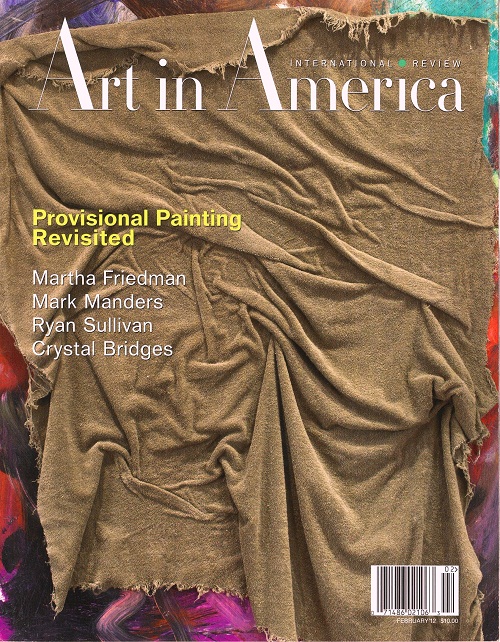
COVER: David Hammons / Art in America / February 2012

David Hammons, Untitled, 2010, mixed mediums, 64 x 46 inches.
Photo by Tom Powel Imaging. Appears courtesy of L&M Arts, New York.

Provisional Painting 2: To Rest Lightly On The Earth
Article by Raphael Rubinstein

In a sequel to his 2009 article "Provisional Painting," the author reflects, via artists named and unnamed, on the lure of the unfinished and the uses of doubt.

Excerpt:


Provisional paintings can show signs of struggle and can also look "too easy." In the case of easy-looking provisionality, we encounter a paradox: the struggle with the problematics of painting results in a painting that shows no signs of struggle in the sense that the finished piece displays a minimum amount of work (Michael Krebber, for instance). But in other cases we can see the record of the artist's struggles, though not necessarily accompanied by Giacometti-style anguish (Raoul De Keyser). But whether it looks easy or arduous, the provisional work is always opposed to the monumental, the official, the permanent. It closes the door on the era of the high-production-value art market (Hirst-Koons-Murakami-Currin). It wants to hover at the edge of nonexistence. It wants to rest lightly on the earth.

 Pick up a copy of Art in America's February 2012 issue
or read article online here.


Sunday, July 24, 2011

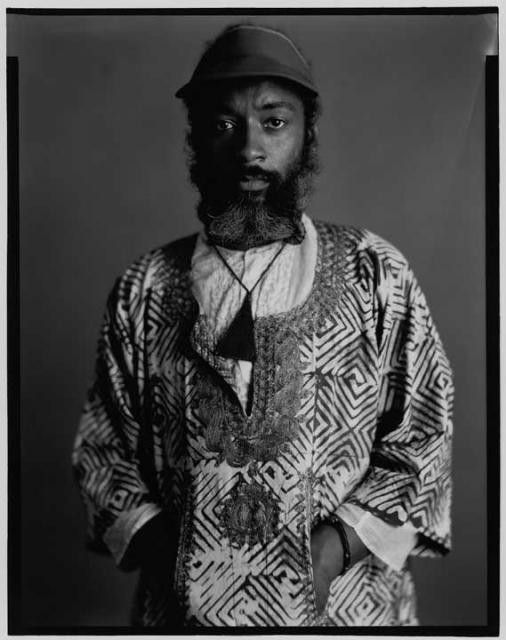
GENESIS: David Hammons / July 24, 1943

David  Hammons photographed by Timothy Greenfield-Sanders.
"I can't stand art actually. I've never, ever liked art, ever."
--David Hammons