Showing posts with label drawing. Show all posts

Thursday, March 3, 2016

ATLANTA: Jean-Michel Basquiat


Jean-Michel Basquiat, Untitled Notebook #1 (Cover), 1980–1981, Mixed media on board. Collection of Larry Warsh.
Image via high.org.

Basquiat: The Unknown Notebooks
February 28 - May 29, 2016

HIGH MUSEUM OF ART
1280 Peachtree Street NE
Atlanta, GA

From High Museum of Art press release:

The High Museum of Art will present its first exhibition focused solely on the life and work of the influential artist Jean-Michel Basquiat (1960–1988).

The exhibition features rarely seen notebooks filled with the artist’s handwritten texts and sketches, the 160 unbound notebook pages will be presented along with 30 related paintings, drawings and mixed-media works drawn from private collections and the artist’s estate. Also on view will be the 1984 Basquiat painting “Untitled (Cadmium)” from the High’s permanent collection.

Basquiat’s notebooks, created between 1980 and 1987, demonstrate how he began to develop the artistic strategies that would inform his large-scale works, which combine text and images in a raw expressionist style to explore culture and society through historical and popular themes. His unique visual language aimed to undermine social hierarchies and rules, taking inspiration from comics, children’s drawings, advertising and Pop art, from Aztec, African, Caribbean, Greek and Roman culture, and from everyday life.

Language was an early medium for Basquiat, and words are an integral part of the notebooks and the large-scale figurative paintings for which he is best known. Handwritten texts run throughout his diverse production, blurring the lines between writing and drawing and between drawing and painting. While the total number of notebooks created by Basquiat remains unknown, the notebooks presented in this exhibition reflect the originality of Basquiat’s thinking and the diversity of his subjects. The eight notebooks in the exhibition and several other works have been borrowed from the collection of Larry Warsh, a New York–based publisher and early collector of Basquiat’s works, who previously served as a member of the Basquiat authentication committee.

Basquiat followed a specific format for his notebook texts, which he wrote primarily in black ink in capital letters similar to those of his street graffiti. Writing only on the right-hand pages, he used color sparingly in the notebooks, with a few exceptions.

Early sketches of subjects that recur in later works, such as tepees, skeletal faces and crowns, appear in the earliest notebooks from 1980 to ’81. The notebook writings range from extended narrative poems and wordplay to observations of New York’s street life, along with lists of celebrities and incidental notes from the artist’s personal life. As in his paintings, fragments of found texts appear throughout the notebooks, incorporating street signage, news stories and references from literature and the Old Testament. Other pages reflect Basquiat’s overriding interest in highlighting racial discrimination and acknowledging the important contributions of African Americans and other people of color as well as his interests in music, world history and popular culture.

“This exhibition offers a very intimate look at the life of an incredibly influential, and somewhat romanticized, figure in contemporary art,” said Michael Rooks, Wieland Family curator of modern and contemporary art at the High. “It’s evident from his writings that Basquiat knew he would find the fame that so fascinated and troubled him, and he recognized that his work spoke to the youth culture of a rapidly changing world. The notebooks give us an opportunity to trace his private thoughts and reflections from their pages to the walls of the gallery. From them, we may develop new perspectives on his artistic practice and a deeper understanding of his life.”

To accompany Basquiat: The Unknown Notebooks, the High has gathered a group of Basquiat’s paintings on view on the Skyway Level of the High’s Wieland Pavilion.

The exhibition will be accompanied by a fully illustrated catalogue published by the Brooklyn Museum and Skira Rizzoli. The volume includes essays by exhibition curator and Basquiat scholar Dieter Buchhart; Henry Louis Gates, Jr., Alphonse Fletcher University professor and director of the W. E. B. Du Bois Institute for African and African American Research at Harvard University; Franklin Sirmans, museum director of the Pérez Art Museum Miami and the High’s 2007 Driskell Prize honoree; and Christopher Stackhouse, a Brooklyn-based writer and visual artist.



Thursday, October 8, 2015

NEW YORK: Martin Puryear

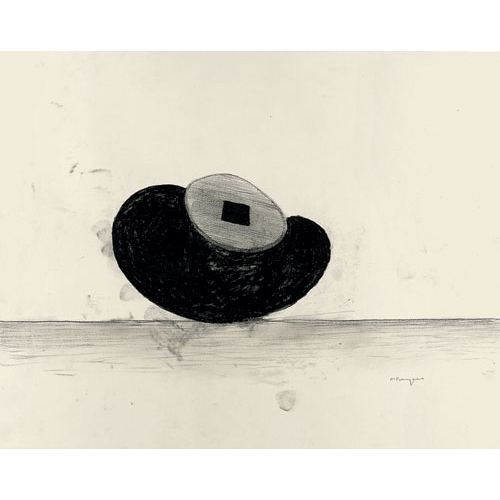
Martin Puryear, Drawing for Maroon, 1986/88. Black Conté crayon, with smudging, over graphite, on ivory wove paper. Courtesy of the artist. © Martin Puryear, Courtesy Matthew Marks Gallery via themorgan.org.

Multiple Dimensions   
October 9, 2015 - January 10, 2016

Artist Talk: A Conversation with Martin Puryear, Tuesday, October 27, 2015, 6:30PM

THE MORGAN LIBRARY & MUSEUM
225 Madison Avenue at 36th Street
New York, NY

From themorgan.org:

One of the most important contemporary American artists, Martin Puryear (b. 1941) is known primarily for the refined elegance of his abstract, hand-made sculptures. However, throughout his career he has consistently turned to drawing to elaborate ideas and forms for works in three dimensions. Martin Puryear: Multiple Dimensions, on view at the Morgan Library & Museum from October 9 through January 10, 2016, is the first exhibition to explore the essential role drawing plays in the artist’s practice. The show includes over seventy works—from quick sketches to monumental, finished compositions—borrowed largely from Puryear’s own collection. Most of the drawings have never been exhibited and span the artist’s undergraduate years to the present. The exhibition will also include a selection of prints and sculptures related to the drawings.


Thursday, January 30, 2014

COLLEGE PARK: Charles White

Charles White, Jubilee, 1974, Oil on board. Courtesy of Landau Traveling Exhibitions/Heritage Gallery, Los Angeles, CA.

Heroes: Gone But Not Forgotten…
January 30 – May 23, 2014

Opening reception: Thursday, January 30, 2014, 5:00 - 7:00pm

1214 Union Drive
College Park, MD

Charles White – Heroes: Gone But Not Forgotten…, contains 47 works created by artist Charles White, features drawings, prints, and paintings spanning from the 1930s to the 1970s. From early drawings to works that incorporate the experience of a lifetime, the works in this exhibition represent a broad slice of a storied and rich career.

Charles White (1918-1979) flourished in the face of conflict. His work draws much of its strength from the racism he faced during his childhood in Chicago. In the later part of his career, he struggled to maintain a representational style when the mainstream of American art was shifting towards the Pop Art and Abstract Expressionism of artists like Andy Warhol and Jackson Pollock; again, these difficulties served as a catalyst to propel the quality and scope of his work. White envisions steadfast heroes: heroes not born of privilege or power, but rather created by the achievement of the human spirit.

Whether the piece is a drawing, painting, linocut, or lithograph, White uses strong lines to instill in his richly detailed figures a sense of dignity and quiet heroism. In Awaiting His Return (1946, charcoal on paper), White presents a woman, head in hand, eyes sad yet hopeful. The altered perspective lines of the drawing invite the viewer to look beyond what is plainly visible; the soft charcoal shading contained within the harsh, sharply angular confines of her body indicate the distances between pain and resolve—the struggle of the hero.

The majority of the works in this exhibition—the largest collection of White’s work displayed in several decades—have never before been seen. The works come from the Arthur Primas Collection, which includes more than five hundred works of art by African American artists and artists of the Diaspora. The exhibition is curated by Charlotte Sherman of the Heritage Gallery in Los Angeles, CA. It is organized by Landau Traveling Exhibitions and has traveled to the North Carolina Central University Art Museum in Durham, North Carolina in 2012; the exhibition will continue to travel following its closing at the Driskell Center.

In conjunction with the Heroes exhibition, the David C. Driskell Center is proud to feature several works by Charles White from the Center’s permanent art collection, most notably Sammy Davis Jr. (1959, graphite drawing mounted onto acrylic painted board) and Creole Madonna (1934, color crayon on paper), recently donated to the Center from the Sandra and Lloyd Baccus Collection. In addition, the Center will organize a Drawnathon, a day when students and local art enthusiasts will attempt to complete the longest drawing ever created at the University of Maryland, College Park campus. The event will be held on Saturday, April 26, 2014. Additional details will be available on Driskell Center website.


Friday, January 17, 2014

COVER: Toyin Odutola / ARTnews / January 2014

Toyin Odutola, New Growth (Maebel), detail, 2013, pen ink and bronze marker on board, 13 x 14 inches.
Appears courtesy of the artist and Jack Shainman Gallery, NYC. 
Ballpoint Is on a Roll

Accessible and affordable, the ballpoint pen has become the medium of choice for artists to make obsessive abstractions, extreme drawings, and playful riffs on venerated ink traditions

Text | Trent Morse

Excerpt:

Last August, Toyin Odutola brought a stack of ballpoint pens and markers into the Asian Art Museum in San Francisco, sat down, and drew a picture. A large screen projected her progress as she filled the paper with thousands of marks. Museumgoers circled around her and asked her questions. “One lady was like, ‘Is that pen? I don’t believe it!’” Odutola recalls. “I was drawing, and she took the pen out of my hand and looked at it.”

To shut out these kinds of distractions and focus on the task at hand, Odutola put on headphones and listened to dance music. Four hours after she started drawing, she was done, having produced a densely limned portrait of an Asian woman with golden hair and eyebrows, her skin composed of Odutola’s signature sinewy ballpoint lines, with blue, green, and flesh tones rising from underneath. “It was shocking that I finished, because I’d never really performed drawing,” says Odutola, who was born in Nigeria and grew up in the Bay Area and Alabama. “It’s normally a very solitary act within my studio.”


To read complete story and view art created with ballpoint pen, pick up a copy of the January 2014 issue of ARTnews on newsstands now or read online here.