Showing posts with label Abstractionist. Show all posts

Tuesday, April 12, 2016

NEW YORK: Charles Gaines


March 31 - April 30, 2016

PAULA COOPER GALLERY
534 West 21st Street  
New York, NY

From paulacoopergallery.com:

The Paula Cooper Gallery is pleased to present a group of eight new large-scale triptychs by Charles Gaines, entitled Numbers and Trees: Central Park Series I. The works constitute a continuation of this prolific artist’s acclaimed series, Numbers and Trees, begun in 1987.

For more than forty years, Charles Gaines’ art has explored the relationship between aesthetics, politics, language and systems. Gaines employs rule-based methodologies to investigate ways in which meaning can be experienced in images and words. Informed by sources as varied as Tantric Buddhist drawings, the systemized work of Hanne Darboven, and John Cage’s notions of indeterminacy, Gaines creates work that often employs plotting and mathematics to organize visual components. While appearing systematic and scientific, Gaines’s works ultimately refrain from producing empirical knowledge, preferring instead to invoke the viewer’s subjective response. They explore an individual’s perception, expression and speculative thought, as they operate both within and against a system.

Charles Gaines’s new work, Numbers and Trees: Central Park Series I, marks an extension of his early interest in serialized projects. For each of his eight triptychs, Gaines divides and mounts a black and white photograph of a tree in Central Park, taken at the time of the artist’s 2014 exhibition at the Studio Museum in Harlem. Enclosing each panel within an acrylic box, screened with grids of half-inch squares, he graphs the silhouette of the tree directly onto the overlaid acrylic surface. Filling cells with vibrant paint, Gaines plots numbers to index the leaves and branches of each tree; he begins at the center of the trunk, counting outward in both directions to create a pixelated image guided by a numerical system. As the series progresses, the catalog of previous trees, each denoted by a different hue, appears on every subsequent triptych, resulting in a prismatic kaleidoscope of layered colors. The cumulative effect bridges the expressive sublime with the schematic referent.

Also on view are six new works from Gaines’s Librettos: Manuel de Falla / Stokely Carmichael series. These works unite a score by composer Manuel de Falla from his 1904 Spanish opera La Vida Breve –a tragic story of a love affair doomed by social mores and class differences– with the language of an impassioned and oratorically rhythmic 1967 speech by Stokely Carmichael (a Black Panther Party member and civil rights activist), in which Carmichael advocates that African Americans refuse to serve in the Vietnam War as an act of self-determination in the face of oppression. Transposing Carmichael’s speech as operatic libretto, Gaines activates text as the measure of process and duration and reveals affinities between these seemingly discordant sources. The nuanced combination of music and text composes a ballad for the enduring history of race-class inequalities as well as the capacity for art to provide emotional egress.


Wednesday, March 16, 2016

NEW YORK: Serge Alain Nitegeka


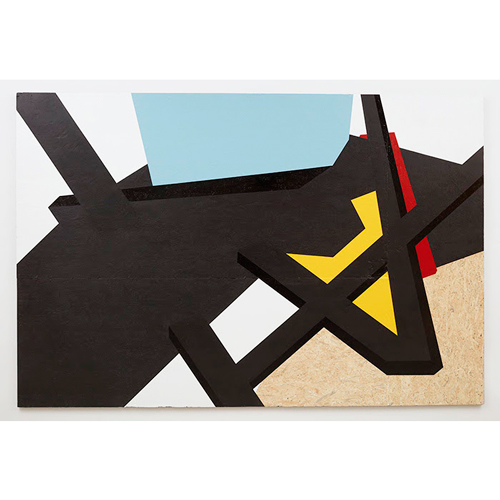
Serge Alain Nitegeka, Field Configuration XVIII, 2015, Paint on wood, 83 1/2 x 124 3/4 inches  212 x 317 cm. © Serge Alain Nitegeka. Photo credit: Jason Wyche via marianneboeskygallery.com.


Colour & Form in BLACK
March 17 - April 23, 2016

Opening reception: Thursday, March 17, 2016, 6:00 - 8:00pm

MARIANNE BOESKY GALLERY
506 West 24th Street
New York, NY

From Marianne Boesky Gallery e-blast:

Marianne Boesky Gallery is pleased to present Colour & Form in BLACK, a solo exhibition of new paintings and sculptures by Burundi-born, Johannesburg-based artist Serge Alain Nitegeka at its flagship Chelsea location. The exhibition presents a new body of work that demonstrates the artist’s recent experimentations with form, color, and space. Colour & Form in BLACK is Nitegeka’s second solo exhibition since joining the gallery in 2014.

This exhibition presents the current trajectory of Nitegeka’s practice, in which the artist pursues a visceral and unmediated engagement with formal questions of line, color and volume. Here, Nitegeka deepens his commitment to abstraction, evoking Russian constructivism with these works’ clean, structured lines and boldly oscillating colors, compositions notably born not from forethought, but rather from the freeform aesthetic spontaneity that alights when artist and picture plane meet.

The resultant compositions – in both two and three dimensions – appeal to the viewer’s visual, tactile and spatial senses. Lines and shapes are rendered in shades of black, robin’s egg blue, ivory white, golden yellow, and deep crimson, both shaping space and denying it, framing it and setting it free. Demonstrating the artist’s ongoing move into pure abstraction, they encourage the viewer’s intuitive, aesthetic engagement, in a manner that befits the organic conditions of their own creation.

Nitegeka evokes the transcendental force and rich potential of the colour black to illustrate the ineffable essence of these works:

“The colour black is primordially predisposed to a deep, dark, mysterious simplicity. It doesn’t need to be explained, it refuses to be enlightened. It just is. However, given form and in the company of other colours, the colour black reveals itself robust and beautiful, proving itself a flat mental space void of everything yet rich in anything; a solid, ambiguous colour. The colour black is my point of departure from the unknown into the unknown. I don’t know where I am from or where I am headed. I am from the black heading back into the black.”

Serge Alain Nitegeka’s practice comprises abstract painting, sculpture, large-scale installation, and figurative drawing, repurposing modernist preoccupations with line and the picture plane to address larger cultural and political issues. Nitegeka’s work has been shown throughout South Africa, Senegal, Europe, and the United States. His first solo exhibition at Marianne Boesky Gallery, Morphings in BLACK, opened in November 2014 at the BOESKY EAST, the gallery’s Lower East Side location. In 2015, Nitegeka’s work was included in the South African Pavilion at the 56th international Art Exhibition of la Biennale di Venezia , as well as the Göteborg International Biennial of Contemporary Art, Gothenburg, Sweden. In spring 2015, he presented his largest site-specific installation to date, Structural Response II, at SCAD Museum of Art, Savannah, GA. Nitegeka (b. 1983, Burundi) currently lives and works in Johannesburg.


Sunday, March 6, 2016

NEW YORK: Norman Lewis

Norman Lewis, Figures, 1965, Oil on paper, 63.5 x 48.3 inches. Image via billhodgesgallery.com

Drawings and Works on Paper
February 18 - April 2, 2016

BILL HODGES GALLERY
529 West 20th Street, 2E
New York, NY

From artsy.net:

ABOUT NORMAN WILFRED LEWIS: Born in Harlem and working within New York City’s downtown art scene, Norman Wilfred Lewis first began painting in a figural style grounded in social realism, focusing on bread lines, police brutality, and the struggles of black Americans. Lewis transitioned to a more abstract style of art during the 1940s and 1950s, continuing to focus on social inequalities but growing increasingly interested in personal expression rather than representation. Lewis’s shift to abstraction was driven in part by his realization that reproducing or mirroring social conditions did not adequately reflect his goals as an artist. His work Evening Rendezvous, for example, addresses political activism and humanitarian concerns through hazy visuals inspired by clandestine Ku Klux Klan gatherings.

Exhibit Link


Tuesday, February 9, 2016

SARATOGA SPRINGS: Alma Thomas

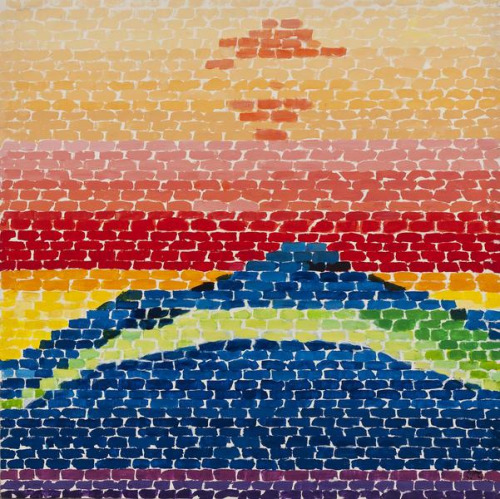
Alma Thomas, Apollo 12 "Splash Down", 1970, acrylic and graphite on canvas, 50.25 x 50.25 inches.
Image via tang.skidmore.edu; courtesy of Michael Rosenfeld Gallery, NY.

February 6 - June 5, 2016

THE FRANCES YOUNG TANG
TEACHING MUSEUM AND ART
GALLERY AT SKIDMORE COLLEGE
815 North Broadway
Saratoga Springs, NY

From tang.skidmore.edu:

Alma Woodsey Thomas (1891 - 1978) is known for her vibrant, colorful paintings. A black woman who grew up under the racial violence of Jim Crow and experienced the Civil Rights Movement firsthand, she did not seriously pursue an artistic career until her retirement at age 69. She resists conventional categorization, whether as an Abstract Expressionist, a Washington Color School painter, or as a female or black artist. Instead, they reveal an artist negotiating her own space amid Washington, D.C.’s, artistic movements, both white and black, of the mid-twentieth century. Frequently included in group exhibitions, she has not been honored with a solo show since 2001.

Born in Columbus, Georgia, Alma Thomas moved with her family to Washington, D.C., in 1907 to escape Atlanta’s erupting racial tensions and so that she and her three younger sisters could receive a better education. She attended Howard University from 1921 to 1924, and then worked until 1960 as an art teacher at a local junior high school. She received her master’s in art education from Columbia University Teachers’ College in 1934. Beginning in 1950, Thomas enrolled in American University, earning her MFA in painting in 1960. In 1972, at age 80, she became the first black woman to have a solo exhibition at New York’s Whitney Museum of American Art.

Thomas actively participated in the art world throughout her life, despite her late entry into professional painting. She remained friends with James V. Herring, the founder of Howard University’s Art Department and one of the founders of Howard’s Barnett Aden Gallery. In the late 1940s she participated in Lois Mailou Jones’s Washington salons for black artists, and was close to Jacob Kainen, with whom she studied at American University. She is frequently cited as a member of the Washington Color School and her work maintains a dialogue with artists and critics such as Morris Louis, Kenneth Noland, Howard Mehring, Gene Davis, Clement Greenberg, and Sam Gilliam.
In her mature style, bright primary colors fill Thomas’s paintings; they are indicative of her study of Johannes Itten, her visit to New York’s Museum of Modern Art’s 1961 exhibition of Henri Matisse’s cut outs, and the work of artists, such as Josef Albers and Wassily Kandinsky. Her visible, regular brushstrokes display the hand of the artist, differentiating her work from the flatness of the Washington Color School. Instead, she paints loosely but constructs her canvases carefully, filling the surface with a dense latticework of color, with subtle patterns emerging from the remaining white spaces. The tensions emerge from the interactions of the bright colors, her brushstrokes, and the negative spaces, creating a continual but controlled sense of movement, an almost musical or dance-like rhythm.

Thomas grounds her paintings, though abstract, in the natural world, evoking leaves, flowers, light, and air. She cites as inspiration "watching the leaves and flowers tossing in the wind as though they were singing and dancing," a reference to a frequent subject of her work, a holly tree outside her window whose leaves created an ever-present play of light.

During the late 1960s and early 1970s, Thomas’s work became increasingly popular, prompting laudatory reviews from critics, including Harold Rosenberg. These reviews described her paintings as “shimmering with color” and admired her for painting “with a verve, an unjaundiced eye, a freedom that is given to few.” Other critical responses have considered the role of her sex and race, investigating her ability to excel at a time and within a style that had been previously dominated by white men.

The exhibition Alma Thomas is organized by The Tang Teaching Museum and Art Gallery at Skidmore College and The Studio Museum in Harlem. The show will open February 2016 at the Tang and be on view at the Studio Museum in Summer 2016. Additional traveling venues to be announced. The exhibition is curated by Ian Berry, Dayton Director of the Tang Museum and Lauren Haynes, Associate Curator, Permanent Collection at the Studio Museum. A major catalogue will accompany the exhibition with extensive images and new essays on Thomas's important work and influential legacy.


Friday, September 12, 2014

NEW YORK: Norman Lewis


From the Margins: Lee Krasner and Norman Lewis, 1945 – 1952
September 12, 2014 – February 1, 2015

1109 5TH Avenue at 92nd Street
New York, NY

From thejewishmuseum.org:

Through select paintings by both artists, this exhibition offers a revealing parallel view of two key Abstract Expressionists. Lee Krasner and Norman Lewis, a woman and an African American, each experimented with approaches that joined abstraction and cultural specificity. Their work similarly brims with gesture, image, and incident, yet was often overlooked by critics in their time.

This exhibition brings together two New York painters whose works offer unique and compelling approaches to abstraction. Born one year apart, Lee Krasner (1908 – 84) and Norman Lewis (1909 – 79) shared similar family situations and came of age in the economic, social, and historic complexities of the 1930s. They formed their creative identities in the artistic and cultural ferment of New York City that was to catapult it to the center of the art world after World War II.

Lee Krasner was born in Brooklyn to a Russian Jewish immigrant family. She studied at the Cooper Union and the National Academy of Design. From 1934 through 1943 she supervised a section of the mural division of the Federal Art Project of the Works Progress Administration. Krasner married the painter Jackson Pollock in 1945.

Norman Lewis’ parents were immigrants from Bermuda. His family lived on Lenox Avenue in Harlem. He studied drawing and commercial design in high school before joining the merchant marine and sailing throughout the Caribbean and South America. In the early 1930s Lewis worked with Augusta Savage, the founder and director of the Savage Studio of Arts and Crafts in Harlem. Like Krasner, he was a beneficiary of the public-works programs of the Depression years, teaching art under the auspices of the Federal Art Project.

Krasner and Lewis reached their mature styles during the 1940s and 1950s. Their works of these years suggest intriguing parallels. Both painters developed many of the signature elements of Abstract Expressionism – a rejection of realist representation; a decentered, all-over approach to the picture plane; spontaneous, gestural brushwork; and a free use of non-naturalistic color. Both reveled in the sensual pleasures of design. A key aspect of their experimental method was the use of line – loose and organic or formal and gridlike. Both artists also drew upon sources with personal meanings: ancient and nonwestern art, contemporary music, forms of writing, references to urban life. The parallel viewing of two innovative mid-century painters offers insights into both their artistic achievements and this transformative era in America.


Thursday, June 12, 2014

MATERIAL WITNESS: The Changing Complex Profile of Black Abstract Painters

James Little, Juju Boogie Woogie, 2013. Image via artnews.com: Courtesy the artist and June Kelly Gallery, NY.
Long marginalized by their community and overlooked by the art market, African American abstractionists are finally coming into the spotlight

Text | Hilarie M. Sheets for ARTnews
Published | June 4, 2014

“Donald Judd didn’t have to explain himself. Why do I have to?” asks Jennie C. Jones, an African American abstract painter who has grappled with the issue of how her work can or should reflect her race. “Fred Sandback can make this beautiful line and not have to have it literally be a metaphor for his cultural identity.”

Jones, 45, sidestepped the debates around multiculturalism that were raging when she was in school in the 1980s and gravitated toward Minimalism. Yet over the last decade, she has forged a conceptual link in her work between the histories of abstraction and of modern jazz in America—“black guys in the 1950s taking jazz into the concert hall and making it this bluesy hybrid with Bach,” as she puts it.

In her recent show at Sikkema Jenkins in New York, an atonal sound environment accompanied her monochromatic paintings that had acoustic panels attached to the canvases. Strips of fluorescent color painted on the edges of the canvases bounced off the white walls and created a sense of movement, rhythm, and vibration. “This art and music juncture,” she says, “gave me the permission to point to something in the room that said, ‘I didn’t fall out of the sky.’”

The contributions of African American artists to the inventions of abstract painting have historically been overlooked, or else fraught with the kind of questions faced by Jones. “Generations of black abstract painters never seem to be celebrated,” says Valerie Cassel Oliver, senior curator at the Contemporary Arts Museum Houston, where she recently organized “Black in the Abstract,” a two-part exhibition that focused on the history of African American painters working in abstraction. She placed younger artists, including Jones, Shinique Smith, and Angel Otero, in dialogue with members of the older generation, such as Felrath Hines, Alma Thomas, and Romare Bearden, who were producing seminal works in the 1960s.

“You find these artists being marginalized on both ends of the spectrum,” Cassel Oliver continues. “There was this manifesto with the Black Arts Movement that you did work that reflected the beauty of that community in no uncertain terms,” she says, referring to a group that coalesced in the 1960s to promote social and political engagement in art and literature. “Oftentimes abstract painting is not as celebrated as more figurative work by the black community. From the mainstream art world, it’s just the sense of not being preoccupied with what black artists are doing, period.”


Read complete story online here.


Tuesday, January 14, 2014

NEW YORK: Ed Clark

Big Bang
January 14 – February 22, 2014
Opening reception: January 14, 2014 6-8pm

8 East 76th Street
New York, NY

Tilton Gallery is pleased to present Big Bang, a retrospective exhibition of paintings by Edward Clark. This is the first gallery exhibition of the artist’s work in New York since 2006 and the title says it all: Clark's paintings are an explosion of energy, light and color.

Born in New Orleans, Clark is one of the most prominent African American Abstract Expressionists and is acknowledged as the first artist to create shaped canvases. He studied at the School of the Art Institute of Chicago (1947-51) and L'Academie de la Grande Chaumiere (1952) in Paris.

Clark's work is in numerous museum collections, including the Art Institute of Chicago, the Detroit Institute of Arts, the Studio Museum in Harlem, New York and the John & Mable Ringling Museum, Sarasota, Florida. He is the recipient of many awards including the Joan Mitchell Foundation Award (1998), and the Legends and Legacy Award from the Art Institute of Chicago (2013).


Friday, January 10, 2014

NEW YORK: Beyond the Spectrum

Alma Thomas, Lunar Rendezvous-Circle of Flowers, 1969, oil on canvas, 50" x 48", signed and dated. 
Abstraction in African American Art, 1950 – 1975

January 11 – March 8, 2014

Reception: Saturday, January 18, 5:00-7:00PM

100 Eleventh Ave at 19th Street
New York, NY

I think all art is abstract . . . the earliest art of human beings was figurative and abstract. Period. So there was never a time that human beings didn’t deal with both modes. To conceive of something from the world you experience, and then create or recreate based on it, is an abstract process anyway.
- Melvin Edwards

Representation versus abstraction, black versus abstraction: two analogous constructions, each artificial to the core.
- Jonathan Binstock

Michael Rosenfeld Gallery is pleased to present Beyond the Spectrum: Abstraction in African American Art, 1950-1975, an exhibition of over thirty paintings and sculptures by leading abstractionists including major works by Charles Alston, Frank Bowling, Ed Clark, Harold Cousins, Beauford Delaney, Melvin Edwards, Sam Gilliam, Richard Hunt, Norman Lewis, Al Loving, Howardena Pindell, Alma Thomas, Jack Whitten, William T. Williams, and Hale Woodruff. Since its inception, Michael Rosenfeld Gallery has consistently exhibited work by African American abstractionists, in solo exhibitions (Thomas, Delaney, Cousins, Lewis) and group shows—on mid-century American abstraction, abstract expressionism, and within its celebrated African American Art: 20thCentury Masterworks series. While many of these artists have been a constant presence in the gallery’s exhibition history, Beyond the Spectrum marks the first time that work by Bowling, Clark, Loving, Pindell, Whitten, and Williams will be on view at Michael Rosenfeld Gallery.

Beyond the Spectrum follows in the curatorial footsteps of Kenkeleba Gallery’s (New York City) groundbreaking 1991 show The Search for Freedom: African American Abstract Painting, 1945-1975 and the more recent Energy/Experimentation: Black Artists and Abstraction 1964-1980 (2006) at the Studio Museum in Harlem. Like these predecessors, Beyond the Spectrum is not intended to be a comprehensive survey of twentieth century African American abstractionists. Instead, the show presents abstract painting and sculpture by a group of American artists working in the years just before, during, and after the Civil Rights Movement. While their identity as black Americans is not the motivation for their inclusion in the show, this identity is nonetheless significant in that many found themselves marginalized in a white-dominated art world that granted limited admission to black artists and again within the Black Arts movement, which rested on a revolutionary ethos that saw abstraction as a site of established privilege, limited in its ability to express political dissent and contribute to the struggle for racial equality.

As the title suggests, Beyond the Spectrum plays on notions of spectra—of ranges and degrees between fixed polarities. Just as refraction reveals light to be far more complex than our immediate perception allows, the artists in this show reveal a plethora of positions and possibilities within the seemingly unified categories of “painting,” “sculpture,” “abstraction,” and “political/apolitical art”. In paintings by Alma Thomas and William T. Williams, the color spectrum is mined for its aesthetic and expressive potential as vivid hues are juxtaposed in dynamic compositions that pulse with energy. Working with a more limited palette, Howardena Pindell and Beauford Delaney explored the wide range of shades and intensities within a given color in their luminous paintings. Moving between media, the draped canvases of Sam Gilliam and the torn paintings of Al Loving exist on the spectrum between painting and sculpture. Finally, within the varied strands that make up abstraction, Richard Hunt, Harold Cousins and Melvin Edwards embraced welded metal to explore abstraction in the third dimension.

The works in Beyond the Spectrum attest to the array of approaches and styles within American abstraction, and they challenge two persistent tendencies: to conceive of abstraction as the purview of white artists and to limit notions of authenticity to figural representations of African American culture where black artists are concerned. The first hides the monumental contributions African and African American culture have made to modernism. As American art historian Thomas McEvilley has written, it was not by accident that abstract expressionism emerged in tandem with bebop. Furthermore, to routinely omit artists such as Norman Lewis, who participated in the famous closed-door Studio 35 sessions defining abstract expressionism, is to disregard abstraction’s debt not only to black culture, but to the artists who shaped its contours and analyzed its place in art history and theory.

The second issue, concerning “authenticity” and “the black experience” is generally discussed in relation to the Black Arts movement and its preference for images that contested the pervasive vilification, ridicule, and disparagement of African Americans in US popular culture. But the split that imagined “African American artist” as incompatible with “abstract artist” predates the Black Arts movement by decades. As abstraction gained momentum after the war, black American artists were at the forefront of aesthetic debates, but unlike their white counterparts, they also had to contend with an art world that saw them first as black and second as artists. In his 1946 essay “The Negro Artist’s Dilemma,” Romare Bearden criticized the tendency to evaluate work by black artists based on “sociological rather than aesthetic” criteria. Although Bearden himself worked in a more representational vein, he was acutely aware that as long as the sociological dominated the conversation, the formal innovations of both figural and abstract artists of color would continue to be dismissed.

Beyond the Spectrum highlights precisely these formal innovations. Emphasizing the stylistic accomplishments of artists whose careers were diminished or who were marginalized or excluded solely on the basis of racial categorization, the exhibition argues that not only did black artists shape American modernism in a vital way, but also that, like the division between figuration and abstraction, the notion that abstract art cannot be either “black” or political is entirely false.


Tuesday, September 10, 2013

NEW YORK: Eugene J. Martin

Eugene J. Martin, Chef and the Kid, 1994, Acrylic on canvas, 31 x 49 inches. Image courtesy of the Estate of Eugene James Martin.
Satirical Abstraction: Works by Eugene J. Martin
July 21 – September 30, 2013 (by appointment)

Gallery event: September 12, 2013, 6-8 PM  

ASC PROJECTS AT GALLERY 304
526 West 26th Street, Room 304
New York, NY

ASC Projects at Gallery 304 is pleased to present Satirical Abstraction: Works by Eugene J. Martin, the first New York showing of the long-neglected African American artist. Eugene J. Martin (1938-2005) was a pioneering figure in the 1960s and 1970s in the transition from Abstract Expressionism to geometric, constructed and biomorphic abstraction, as well as a model for today’s loose border between abstraction and representation. The solo exhibit focuses on acrylic paintings on canvas and paper from the 1990s that juxtapose soft-edged and free-flowing organic forms with hard-edged geometric structures. Martin called many of his works straddling abstraction and representation "satirical abstracts,” a leitmotif evident in graphite drawings from 1978, whimsical pen and ink drawings from  1986-1988 and a 1974-1997 mixed media heterochronic collage.

Martin was born in Washington, DC, where he attended the Corcoran School of Art from 1960 to 1963. In 1996 he moved to Lafayette, Louisiana, where he lived and created art until his death. Recent museum exhibitions include solo shows in 2012 at the Masur Museum of Art in Monroe, LA; the Ohr-O’Keefe Museum of Art in Biloxi, MS; and the New Orleans African American Museum in New Orleans, LA,  in  2011.  Works by Eugene Martin, Ed Clark and John T. Scott were included in the significant three-person Beyond Black exhibition at the Louisiana State University Museum of Art in Baton Rouge, LA, in 2011.

Martin’s art is found in many public and private collections worldwide. These include the permanent collection of the Schomburg Center for Research in Black Culture in New York, NY; the Walter O. Evans Collection of African American Art in Savannah, GA; the Paul R. Jones Collection of African American Art at the University of Delaware in Newark, DE; the Sheldon Museum of Art in Lincoln, NE; the Masur Museum of Art in Monroe, LA; the Louisiana State University Museum of Art in Baton Rouge, LA; the Ogden Museum of Southern Art in New Orleans, LA; the Alexandria Museum of Art in Alexandria, LA; the Ohr-O'Keefe Museum of Art in Biloxi, MS; the Walter Anderson Museum of Art in Ocean Springs, MS; the Mobile Museum of Art in Mobile, AL; the Stowitts Museum & Library in Pacific Grove, CA; and the Munich Museum of Modern Art.

Gallery hours by appointment only

Contact Ayn S. Choi at skc404@gmail.com