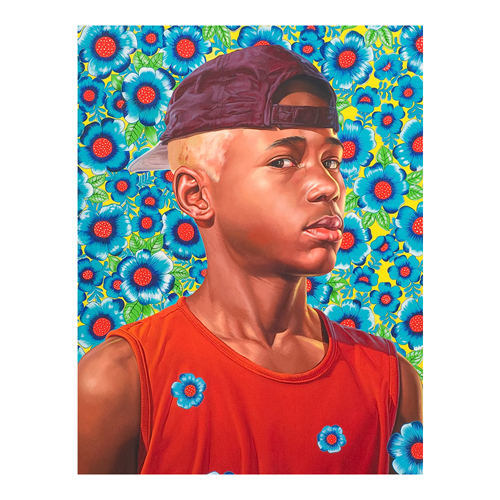
Kehinde Wiley, Randerson Romualdo Cordeiro, 2008. Image via seattleartmuseum.org.
A New Republic
February 11 - May 8, 2016
SEATTLE ART MUSEUM
1300 First Avenue
Seattle, WA
From seattleartmuseum.org:
Kehinde Wiley is one of the leading American artists to emerge in the last decade and he has been ingeniously reworking the grand portraiture traditions. Since ancient times the portrait has been tied to the representation of power, and in European courts and churches, artists and their patrons developed a complex repository of postures and poses and refined a symbolic language. This language, woven into all aspects of a portrait, described the sitter’s influence and power, virtue and character, or profession. In his consideration of portrait traditions, Wiley has been especially drawn to the grand aristocratic portraits of the 18th century.
The artist began his first series of portraits in the early 2000s during a residency at the Studio Museum in Harlem. He set out to photograph and recast assertive and self-empowered young men from the neighborhood in the style and manner of traditional history painting. Since then he has also painted rap and sports stars but for the most part his attention has focused on ordinary men of color in their everyday clothes. Trained at Yale in the 1990s, Wiley was steeped in the discussions concerning identity politics during this decade and he brings his personal insights and theoretical studies to his practice.
Wiley’s portraits are highly stylized and staged, and draw attention to the dialectic between a history of aristocratic representation and the portrait as a statement of power and the individual’s sense of empowerment.
Morris A.
and Meyer Schapiro Wing and Iris and B. Gerald Cantor Gallery, 5th
Floor
200
Eastern Parkway
Brooklyn,
NY
Text |
Johnny Magdaleno for The New York Times
Published
February 19, 2015
Barely two
months in, it has already been a big year for the Brooklyn-based painter
Kehinde Wiley. Last month, the artist received a 2014 U.S. State Department
Medal of Arts; and this week, he prepares for his first museum retrospective,
“A New Republic,” which will open at the Brooklyn Museum on Friday. Throughout
his career, Wiley’s pieces have canonized the people they portray: Descendants
from Africa, Haiti, Jamaica and elsewhere, depicted along with emblems of
culture and identity. “My work, for a long time, has focused on the ideals that
we celebrate in America and abroad,” he says. Many of his paintings outsource
their influence from popular movements that predate the 19th century, like
Flemish portraiture from the Northern Renaissance. But instead of using dark
colors to create a sense of severity or authority, Wiley’s portraits explode
with energy and color — particularly in their use of clothing, which occupies a
central role in his work. “Fashion is fragile and fleeting,” he notes. “But it
is also an indicator for the cultural and social appetites for a nation.”
Occasionally,
that fashion is high street style, like the young man sporting a bronze-tipped
pompadour in 2014’s “Saint Paul”; at other times, it’s more casual, such as
“The Marchioness of Santa Cruz” from Wiley’s “Haiti” series (also 2014), in
which a woman in denim and white t-shirt lies like royalty on a thin-cushioned
chaise lounge, her weight resting on one elbow as it presses into a rolled bath
towel. In every case, as seen in the portraits among the 56 pieces on view in
“A New Republic,” Wiley’s backgrounds compete with his subjects to command the
most attention, though neither overpowers the other. With their growing vines,
blooming flowers and Rococo-influenced doily patterns, it’s as if the
surrounding world rises to celebrate the people in focus. But this balance is
intentional, a technique to make his work comprehensive. “The background must
capture a myriad bed of cultures and practices,” says Wiley, “because
increasingly, the people who populate my paintings are from all over the
world.” Despite their origins, each subject is imbued with a similar sense of
majesty marked by lifted chins and puffed-up chests, like the antiquated,
Caucasian kings and queens portrayed in galleries and museums across the world.
In
addition to the large-scale portraits that have made Wiley famous, five bronze
busts will also be on display, their subjects sculpted with the same prideful
body language as those in his portraits. The retrospective also includes eight
selections from his “Memling” and “Icon” series: paintings that are similar in
style to the others, but created on a smaller scale, and framed by shrine-like
panels that invite the viewer to lean in and, as Wiley says, “possess the
object with his or her eyes and physical presence.”
Kehinde Wiley, Mrs. Waldorf Astor, 2012, Oil on canvas, 72 x 60 inches. From Hi-Fructose Magazine, Volume 29.
INTERVIEW BY KRISTEN ANDERSON
When does
a portrait transcend a mere pictorial representation of a subject caught in
time, to take on a whole new sense of relevance to an entire age? This question
is evoked when looking at the bombastic, pulsating works of Kehinde Wiley. The
NY-based painter has taken the art world by storm in a very relatively short
time, creating show after show of provocative and sensual works of young urban
black men in modern street clothes in ambiguous, highly decorated backgrounds
on large scale canvases.
Excerpt:
Hi-Fructose: You are very successful in the
highly elusive “blue chip” art world, and you did it as a figurative painter. That’s
not common these days. I’d like to talk about what drew you to painting itself
as the medium you chose vs. other, more conceptual vehicles. Painters tend to
be highly passionate about the act of painting itself and I was wondering if
you had thoughts on your connection to it as your chosen art form?
Kehinde
Wiley: What is it about portrait making that I like? I love the history of art.
As a kid growing up in Los Angeles I would visit the Huntington Library and see
portraits of wealthy powerful men with all of their possessions around them and
in a lot of the grand narrative portraits I was looking at I wasn’t seeing
people that looked like me. Something clicked and it wasn’t about copying the
old master paintings in a way that you would see in an art institution, where
you would copy the painting in order to learn how to paint. In this sense we
were shadow dancing with this history, this amazing and beautiful and terrible
history and creating an image of someone who was caught up in this moment an
instant. When I revisit this portrait I am not only looking at a portrait of a
young man, but also looking at a portrait of myself in Harlem. I’m seeing
something that represents we as a society that can’t come to terms with a very
dead and old art form. I’m also coming to terms with how I wanted to breathe
life into something I have so much love for, which is painting.
HF: Like many current successful artists, you
paint but also use assistants to help create canvases. This is a turn from the
idea of the painter as a solitary, almost tortured romantic figure. Did you
ever subscribe to this mode of thought or right out of the gate did you see
employing help as just a tool to get the scope of the job you set out to do get
done?
KW:
Throughout art history master painters have employed assistants; from
Michelangelo to Jeff Koons to myself. In the same way that I’m appropriating
the style of the old masters, I’m echoing their process, which regularly employed
the use of apprentices.
To read complete interview pick up a copy of Hi-Fructose Magazine Volume 29 on
newsstands now or order online here.
Stephen
Friedman Gallery is delighted to host Kehinde Wiley’s first ever UK solo
exhibition The World Stage: Jamaica. Born
in 1977, Wiley has achieved international recognition for his highly
naturalistic paintings of contemporary urban men adopting heroic poses directly
referencing classical portraiture. 'The World
Stage', Wiley's vast and celebrated body of work, has previously focused on
Brazil, China, Israel, Nigeria, Senegal and Sri Lanka, with exhibitions held in
museums and galleries in Europe and the USA.
The
exhibition features Jamaican men and women assuming poses taken from 17th and
18th Century British portraiture, the first one in the 'World Stage' series to feature portraits of women. The
juxtaposition between the sitter and the art historical references reflects on
the relationship between the island and her former colonial power. Wiley is
restaging this history, transforming the race and gender of the traditional
art-historical hero to reflect the contemporary urban environment. The
subjects' proud posturing refers to both the source painting and the symbolism
of Jamaican culture, with its singular people and specific ideals of youth,
beauty and style.
Wiley
embellishes his paintings with intricate, ornate backgrounds that contradict
the sombre posturing of the subjects and allude to the bold styles of urban
fashion. In this new body of work, lavish patterning informed by the iconic
British textile designer William Morris surround, overlay and entwine the
figures. Pieces of these symbolic patterns both harmoniously fuse and create
dramatic opposition between the two contrasting elements that form the work. In
previous series, this decoration has been inspired by a fusion of period
styles, ranging from Islamic architecture to Dutch wax printed textile and
French Rococo design.
The gallery will also present a film depicting Wiley's process as the project
unfolds. The camera follows the artist on his research trips to London,
visiting the National Portrait Gallery, Dulwich Picture Gallery and Brixton
Market, and then onto Jamaica. There it follows him to underground dance halls,
Negril beach and downtown Kingston as he searches for the models for his
paintings.
For this
project Wiley renders his subjects in exquisite detail, capturing a pose, a
history and a culture. Jamaica is filtered through aspects of British history
to create something wholly unique; disparate iconography, such as a
contemporary tattoo and a William Morris wallpaper design, merge together to
form equal parts of the narrative. The artist continues to redefine
portraiture, cementing his status as one of the leading painters working today. YouTube: Kehinde Wiley - World Stage: Jamaica
James Cohan Gallery is
pleased to announce the opening of Bold as Love, an exhibition of
new works by SHINIQUE SMITH on view February
15th through March 24th. This is the artist’s debut exhibition at James Cohan
Gallery.
In Paul D. Miller’s (akaDJ Spooky) catalogue
essay for the artist’s 2010 solo exhibition at MoCA North Miami, he describes
Shinique Smith’s unique ability to synthesize media into “cubes of
consciousness rendered into oblique strategies of envisioning, making the
anonymous spaces of urban life become illuminated manuscripts of the here and
now.”
Shinique Smith is inspired by
the vast vocabulary of things we consume and discard. Examining the ways in
which these objects resonate on a personal and social scale, Smith pursues the
graceful and spiritual qualities of the written word and the everyday. In this
new body of work, a free flow between paintings and sculptures ruminates on the
interplay of chaos and restraint, balance and connection, and what is revealed
and concealed.
In the exhibition Bold
as Love, installations in each of the three gallery spaces trace a distinct
phase of a conceptual journey. A central energizing motif throughout is the
mandala, a form chosen for its geometry, both sacred and mathematical, and as a
tool for fusing the visceral with the cerebral. The front gallery serves as a
place of transition, an antechamber where calm and intensity harmonize in denim
painted with bleach and in relief. Paintings and sculptures in the main gallery
are installed in pairs and larger groupings. The potential energy bound within
Smith’s hanging sculptures finds its kinetic expression in the gestural texts
of her canvases. Ratios of the human body are referenced by impressions of the
artist’s form both on large-scale paintings and in sculptures, stuffed and
created from her own dresses. The exhibition culminates in the back gallery
with an immersive environment featuring clustered hanging sculptures whose
tethers drape to the floor in spiraling script.
As artist Kehinde Wiley
observes, “The work of Shinique Smith navigates the leading edge of the written
word. Her installations of extremely mixed visual signifiers marry literature,
Islamic architecture, and hip hop music to investigate and expound the
narrative capabilities of the language.”
UPCOMING in 2013, Shinique
Smith has been commissioned by NEW YORK CITY’S MTA ARTS FOR TRANSIT to
create a permanent public work at the new Mother Clara Hale Bus Depot in Harlem
(Lenox Ave and 146th Street). This extensive project features a large-scale
mosaic across the façade and laminated glass windows throughout overall
measuring 6,672 square feet of artwork. Currently on view Shinique Smith: Firsthand,
a collaboration with LACMA and
the Charles White Elementary School including Smith’s new work based on her
experience within the school and community, art produced by students, and
objects the artist selected from LACMA’s Costume and Textile collection. Also
in 2013, BIRMINGHAM MUSEUM OF
ART in Alabama has commissioned Smith to create a large-scale
sculptural installation for Etched in Collective commemorative
exhibition for the 50th anniversary of the 16th Street Baptist Church Bombing,
opening August 18, curated by Jeffreen Hayes. A solo exhibition will be mounted
at the MUSEUM OF FINE ARTS,
BOSTON from October 2014 to March 2015, curated by Jen
Mergel.
SHINIQUE SMITH lives and
works in Hudson, NY. Past solo exhibitions include MoCA, North Miami, Madison
MCA, Studio Museum in Harlem, and Boulder MCA. The artist’s work is included in
the collections of Brooklyn Museum, Denver Art Museum, Los Angeles County
Museum of Art, Studio Museum in Harlem, and Whitney Museum of American Art,
amongst others. She was a fellow of Joan Mitchell Foundation in 2008 and
Skowhegan School in 2003.
For further information, please contact Jane Cohan at jane@jamescohan.com or
by telephone at 212.714.9500.
Kehinde Wiley, Benediter Brkou (The World Stage: Israel), 2011. Oil and gold and silver enamel on canvas, 115 x 79 ⅝ in. (framed). Private collection. Image via thecjm.org.
Kehinde Wiley | The World Stage: Israel February 14–May 27, 2013
The first major exhibition in San Francisco featuring this
nationally–known African American artist
The Contemporary Jewish Museum (CJM)
presents Kehinde Wiley | The World Stage: Israel, the first
major exhibition in San Francisco of African American artist Kehinde Wiley (b.
1977)—one of the most significant young artists working today. Wiley is known for
vibrant, large-scale paintings of young, urban, T-shirt clad men of color he
encounters on streets around the world and renders in the heroic poses typical
of classical European portraiture.
The exhibitionis part of
the artist’s ambitious and multifaceted series, The World
Stage, that has taken him to China, India, Brazil, and beyond, in an
exploration of diasporas, identity, cultural hybridity, and power. The eighteen
portraits in Kehinde Wiley |The World Stage: Israel depict men of diverse
religions and ethnicities influenced by urban culture, who Wiley met in
Israel—Ethiopian Jews and Jewish and Arab Israelis. Wiley has placed these
subjects against vivid, ornate backgrounds inspired by Jewish textiles and
papercuts, and has finished each with a hand-carved wooden frame crowned with
emblems borrowed from Jewish decorative tradition.
As part of the exhibition, the CJM is including a selection of
historical textiles and works on paper, like those from which Wiley draws
inspiration, borrowed from The Magnes Collection of Jewish Art and Life at UC
Berkeley, and the Skirball Museum, Skirball Cultural Center, Los Angeles.
Kehinde Wiley
Born and raised in South Central Los Angeles, Wiley early on
encountered the world of classical European portraiture in the galleries of the
Huntington Library, which he frequented as part of free weekend art classes his
mother enrolled him in when he was eleven years old. The works in the
Huntington collection had a profound impact on him. “It was sheer spectacle,
and of course beauty. I had no way of digesting it. But at the same time, there
was this desire to somehow possess it or belong to it,” says Wiley.
Wiley went on to earn his BFA from the San Francisco Art
Institute (1999) and MFA from Yale University (2001) and became an
Artist-in-Residence at The Studio Museum in Harlem. It was in Harlem that Wiley
formulated and consolidated his unique vision and approach to portraiture,
catalyzed by the daily procession of over-the-top urban fashion and male
bravado he witnessed on 125th Street and by a chance encounter with a cast-off
piece of paper.
“It was a mug shot of an African American man in his twenties
and it made me begin to think about portraiture in a radically different way,”
says Wiley. “I began thinking about this mug shot itself as portraiture in a
very perverse sense, a type of marking, a recording of one’s place in the world
in time. And I began to start thinking about a lot of the portraiture that I
had enjoyed from the eighteenth century and noticed the difference between the
two: how one is positioned in a way that is totally outside their control, shut
down and relegated to those in power, whereas those in the other were
positioning themselves in states of stately grace and self-possession.”
It was then that Wiley began to apply the visual vocabulary and
conventions of glorification, history, wealth, and prestige to the
representation of a group of people absent from museum walls—urban black and
brown men. He emerged on the art scene in 2003 with a series of portraits of
young Harlem men staged in grand poses of the European portrait tradition while
dressed in the baggy jeans and logo-emblazoned T-shirts so pervasive on the
street. In what is now a signature component of his portraits, the subjects vie
for visual attention with the vibrant, richly detailed patterns that fill the
background and often threaten to overtake the figures.
In order to find appropriate models, Wiley began what he calls
“street casting” for black males between the ages of eighteen and twenty-five,
who exhibit a certain type of alpha-male energy and even homoerotic beauty. The
men come to his studio where they leaf through illustrated art history books to
choose a figure that serves as the model for the pose they want to emulate.
They are then photographed in that stance. Their choice of clothing is entirely
their own. Wiley uses various views from the photo shoots to create his
portraits.
Beginning in 2006, Wiley expanded his vision with his series The World Stage, traveling the globe to explore the
black diaspora and the global phenomenon of urban African American youth
culture, something he has found to be a powerful and persistent means by which
people interact with American culture. His focus has been on countries that he
believes are part of the conversation in the twenty-first century. The
resulting series of paintings from China, India, Brazil, Senegal, Nigeria, and
Israel each uniquely map the models within their native or adopted countries
and explore their local culture, incorporating aspects of regional history,
traditional patterns and designs, and sly nods to the social and political
milieu in which they live. “I wanted to mine where the world is right now,”
Wiley explains, “and chart the presence of black and brown people throughout
the world.”
Wiley now lives and works between New York and Beijing. His
paintings are in the collections of over forty museums including the
Metropolitan Museum of Art, Los Angeles County Museum of Art, Hammer Museum,
High Museum of Art, and Brooklyn Museum. His work has been the subject of
numerous monographs including a comprehensive Rizzoli publication released in
2012.
The Exhibition
For The World Stage: Israel,
Wiley scouted for subjects in the discos, malls, bars, and sporting venues of
Jerusalem, Tel Aviv, and Lod in 2010. The eighteen portraits in the exhibition
present a kaleidoscopic picture of contemporary Israeli diversity, a society at
the physical and symbolic intersection of Africa, Europe, and Asia. Wiley’s
subjects are from diverse religions and ethnicities—Israeli Jews, Ethiopian
Jews, and Israeli Arabs—revealing an Israel that is more ethnically diverse and
globally attuned than most people might realize.
Many of Wiley’s models for The World Stage: Israel are Beta Israel—Jews from
Ethiopia—whose families immigrated to Israel (made aliyah) in the 1980s and 1990s during Operation Moses
and Operation Solomon, two Israeli-sponsored airlifts. A featured figure in
several of the paintings is Kalkidan Mashasha, a popular Ethiopian hip-hop
musician who has used music as a means of understanding his Ethiopian Jewish
Israeli identity and the repression he initially felt in his adopted country.
For this series, Wiley has placed his models against ornate
backgrounds inspired by the decorative patterns of Jewish textiles and
papercuts, an intricate form of folk and ceremonial art. Wiley chose the
designs for their decorative and symbolic impact.
Wiley also designed hand-carved wooden frames crowned with
emblems borrowed from the Jewish decorative tradition: the hands of a priest (Kohen) and the Lion of Judah, symbolizing blessing,
power, and majesty. Each frame also supports text. For the portraits of Jewish
men the Ten Commandments are used. For Arab men, Wiley chose the plea of Rodney
King, victim of a police beating that sparked race riots in the artist’s home
city of Los Angeles in 1991: “Can we all get along?”
Also on view as part of the exhibition is a selection of
historical textiles and works on paper like those from which Wiley has drawn
inspiration. The traditional works from the collection of The Magnes Collection
of Jewish Art and Life at UC Berkeley and the Skirball Museum, Skirball
Cultural Center, Los Angeles, include lavishly decorated Torah ark curtains and
intricate papercuts.
A short documentary film detailing Wiley’s travel to Israel to
create the works in the exhibition is also on view.
Items available in the Museum Store include skateboard decks
($79), dog tag necklaces ($18), and beach towels ($95) featuring select
portraits from the exhibition. Limited edition marble busts ($1400-$1600) will
also be available as well as catalogs for Wiley’s various World Stage series ($40) and a beautifully
illustrated monograph published by Rizzoli in 2012 ($65).
Kehinde Wiley | The World Stage: Israel is organized
by the Contemporary Jewish Museum, San Francisco. Major support for this
exhibition has been provided by the Columbia Foundation and The Jim Joseph
Foundation. Supporting sponsorship has been provided by Siesel Maibach and Eta
and Sass Somekh.
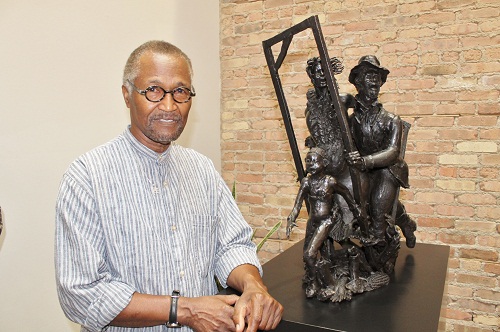
Preston Jackson stands next to his sculpture Passages to Freedom which was unveiled June 16, 2012 at the County of Lake College in Waukegan, IL. BlackArtistNews photo. All rights reserved.
Over the past few days the following news items caught the attention of BlackArtistNews:


.jpg)