Showing posts with label Murals. Show all posts

Sunday, November 9, 2014

WASHINGTON DC: Hale Woodruff

Hale Woodruff, The Repatriation of the Freed Captives, 1939, Oil on canvas. Collection of Savery Library, Talladega College, Talladega, Alabama / National Museum of African American History and Culture. Image via si.edu.
Rising Up: Hale Woodruff’s Murals at Talladega College
November 7, 2014 – March 1, 2015

1400 Constitution Ave, NW
Washington, DC

From Smithsonian Institute press release:

Talladega College in Alabama commissioned prominent African American artist Hale Woodruff to paint a series of murals for its newly built Savery Library in 1938. Woodruff painted six murals portraying significant events in the journey of African Americans from slavery to freedom.

This will be the first time the murals have been exhibited in the Washington metro area. The murals were removed from Talladega College for a five-year collaborative restoration project organized by the High Museum of Art in Atlanta, which also organized a multicity tour of the works.

The murals are six monumental canvases arranged in two cycles of three, portraying heroic efforts of resistance to slavery and moments in the history of Talladega College, which opened in 1867 to serve the educational needs of a new population of freed slaves. The first cycle includes the murals “The Mutiny on the Amistad,” which depicts the uprising on the slave ship La Amistad; “The Trial of the Amistad Captives,” depicting the court proceedings that followed the mutiny; and “The Repatriation of the Freed Captives,” portraying the subsequent freedom and return to Africa of the Amistad captives.

The companion murals “The Underground Railroad,” “The Building of Savery Library” and “Opening Day at Talladega College” show themes of the Underground Railroad, the construction of Savery Library at Talladega College and the early days of the college campus, for which the murals were commissioned, respectively.

“We are pleased to have this once-in-a-lifetime opportunity to present these impressive murals and other works by Hale Woodruff on the National Mall,” said Lonnie Bunch, director of NMAAHC. “Woodruff was an important figure in art history and the paintings depict, in a vibrant and dynamic fashion, events in African American history. We are grateful to the High Museum and Talladega College for making this exhibition possible.”  

Hale Aspacio Woodruff (1900–1980) was born in Cairo, Ill. He studied art at the John Herron Art Institute in Indianapolis and the Fogg Museum of Harvard University. Woodruff contributed to the development of African American art, not only as an artist, but also as a distinguished arts educator.

Woodruff’s first mural project was in collaboration with Wilmer Jennings in 1934. The four-panel mural, titled “The Negro in Modern American Life: Agriculture and Rural Life; Literature, Music, and Art,” was part of a public works project and a teaching project that involved both Woodruff’s students and a local junior high school. In 1935, Woodruff worked on Works Progress Administration murals for the Atlanta School of Social Work.

Between 1931 and 1946, Woodruff served as the first chair of the newly established art department of Atlanta University. During the summer of 1936, he studied mural painting in Mexico under the mentorship of Diego Rivera. In 1946, he became a teacher at New York University, where he taught art for more than 20 years until his retirement in 1968. During the mid-1960s Woodruff and fellow artist Romare Bearden were instrumental in starting the Spiral Group, a collaboration of African American artists working in New York. The Studio Museum in Harlem presented a retrospective of his work titled “Hale Woodruff: 50 Years of His Art” in 1979. The exhibition “Hale Woodruff, Nancy Elizabeth Prophet, and the Academy” was at the Atlanta-based Spelman College Museum of Fine Art in 2007.

“Rising Up: Hale Woodruff’s Murals at Talladega College” is presented by the Smithsonian’s National Museum of African American History and Culture and is organized by the High Museum of Art in collaboration with Talladega College. The exhibition is co-curated by Jacquelyn Serwer, chief curator at NMAAHC, and Rhea Combs, museum curator. A full-color, 155-page catalog, published by the High Museum of Art, will be on sale in the National Museum of American History’s store during the exhibition.

The National Museum of African American History and Culture was established in 2003 by an Act of Congress, making it the 19th Smithsonian Institution museum. Scheduled for completion in 2015, it is under construction on the National Mall in Washington, D.C., on a five-acre tract adjacent to the Washington Monument.



Saturday, March 10, 2012

POST: Murals by 'Picasso of Harlem' are at risk of disappearing


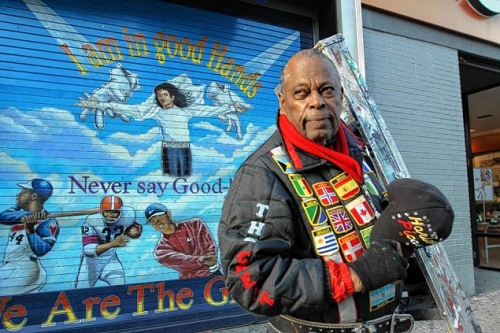
The murals by Franco Gaskin could find a new home at Triboro Plaza. Photo by Marcus Santos for New York Daily News. 

Harlem artist Franco Gaskin spent 35 years creating more than 400 works on roll-down security gates on 125th St.
By Douglas Feiden | New York Daily News
March 5, 2012

Two dozen world-famous murals painted on roll-down security gates on 125th St. by an artist dubbed the “Picasso of Harlem” could find a new home in an outdoor art gallery at the eastern edge of the strip, state officials say.

The iconic artwork of 84-year-old Franco Gaskin — better known as “Franco the Great” to tourists from Japan, Sweden and Brazil — has been rapidly vanishing as spiffy shops and chichi chains transform the neighborhood’s main street.

Enter the state’s Harlem Community Development Corp., which is working with local elected officials and the grassroots group Save the Gates to move the murals to Triboro Plaza, a neglected stretch of 125th St. between First and Second Aves.

“It will expand the cultural corridor all the way to the East River — and create a destination for art, commerce and tourism in a dead zone near the Triboro Bridge where you rarely see any pedestrians,” said HCDC Director of Planning Thomas Lunke.

But the clock is ticking: Gaskin spent 35 years creating more than 400 vibrant works with African-American themes on the corrugated-steel barriers protecting the storefronts — and only 25 of them are now believed to survive as shops are upgraded and gates are junked.

“Harlem’s history is at risk,” said Dana Harper, a retired police officer who has known Gaskin since he walked a beat in the 28th Precinct as a rookie cop in 1982.

“The murals of Franco the Great helped turn 125th St. around and made it a world-famous tourist attraction — but they’ve been thrown into the trash as new merchants without community ties come into the area.”

Born in Panama, Gaskin first came to Harlem in 1958 and watched in horror as dreary-looking metal gates — so-called crime-fighters — sprouted on 125th St. in the decade after the assassination of Martin Luther King in 1968.

“It was like a prison camp,” he said. “The street was a sea of gates — messy and forbidding and covered with gigantic graffiti.”

Starting in the late 1970s, and working on Sundays when the stores were closed, he took up his paintbrush and lifted Harlem’s image with a brand new, globally recognized art form — the storefront gate mural.

Gaskin worked on both side of the street between Broadway and Lexington Ave., portraying black martyrs like King and Malcolm X and lavish scenes from Harlem's jazz clubs, ballrooms and dance halls.

“I did it for love, I did it for beauty, and I did it for 125th St.,” the street artist told the Daily News as he led a four-hour tour of his masterpieces on Tuesday.

He succeeded beyond his wildest dreams, says state Sen. Bill Perkins, who represents central Harlem.

“Those gates were the legacy of crime, and he turned them into works of art and a beautification project,” Perkins said. “He took a desolate, lifeless thoroughfare and showed how the magic of art can revitalize a neighborhood.”

The murals opposite the Apollo Theater — seductive ladies in white mink stoles, gentlemen in tuxedos, dancers gliding in air — became a popular stop for tour buses and, over time, the street roared back to life.

In the past decade, soaring rents and gentrification led to the loss of dozens of the mom-and-pop businesses behind the gates, and when larger corporate retailers took their place, they’d typically chuck out the old murals.

Gaskin became a victim of his own success: “I can’t stop progress,” he says. “But I can sure get heartbroken when I see my gates come down.”

The destruction accelerated when a City Council-approved zoning change in 2008 said roll-down steel gates on 125th St. had to be replaced, over 15 years, with see-through gates made of fiberglass that leave shop interiors visible.

To save the surviving 25 murals — some as wide as 22 feet and as tall as 18 feet — an informal group, the Friends of Franco, is setting up a nonprofit, Save the Gates, which can raise money for framing, perservation and storage.

Meanwhile, state economic development officials — backed by Harlem pols, local merchants and Community Board 10 and 11 — have developed a plan to move the gates to Triboro Plaza, where they'd be displayed in an open-air, 24-hour-a-day art museum.

The block includes city-owned land controlled by the Parks Dept., which must sign off on the HCDC plan. Manhattan Parks Commissioner Bill Castro says he’ll meet with state officials to “further discuss this proposal and weigh the feasibility of this request.”

“It will be a spash of culture in a distressed area,” says state Sen. Jose Serrano (D-East Harlem).

“This is my contribution to Harlem,” says Franco the Great. “It will be wonderful to see it survive.”