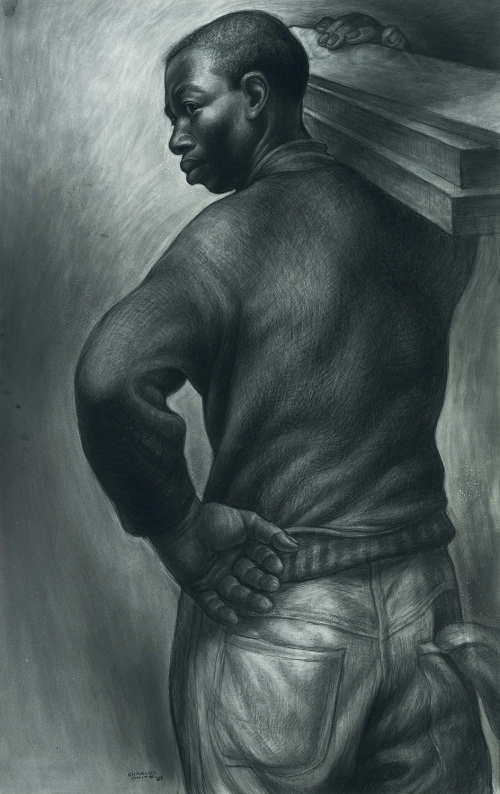
Showing posts with label Charles White. Show all posts

Thursday, March 27, 2014

LECTURE: Charles White - The Last of the Romanticists / College Park, MD / April 3, 2014

Andrea Barnwell Brownlee, Ph.D. Image via museum.spelman.edu. 
Presented by Andrea Barnwell Brownlee, Ph.D., Director of the Spelman College Museum of Art

Thursday, April 3, 2014

Public Reception: 5:30PM – 6:00PM

Lecture: 6:00PM

1207 Cole Student Activities Building
University of Maryland
College Park, MD

Join the David C. Driskell Center as it explores the legacy of Charles White, one of the most important and influential African American artists of the twentieth century.  

Andrea Barnwell Brownlee, Ph.D. is an art historian, curator, writer, the Director of the Spelman College Museum of Fine Art, and the recipient of the 2013 David C. Driskell Prize in African American Art and Art History. Dr. Barnwell Brownlee, an alumna of Spelman College, earned her Ph.D. in Art History from Duke University in 2001. 

The lecture is held in conjunction with the exhibition Heroes: Gone but not Forgotten-The Art of Charles White on display at the David C. Driskell Center January 30 to May 23, 2014.


Thursday, January 30, 2014

COLLEGE PARK: Charles White

Charles White, Jubilee, 1974, Oil on board. Courtesy of Landau Traveling Exhibitions/Heritage Gallery, Los Angeles, CA.

Heroes: Gone But Not Forgotten…
January 30 – May 23, 2014

Opening reception: Thursday, January 30, 2014, 5:00 - 7:00pm

1214 Union Drive
College Park, MD

Charles White – Heroes: Gone But Not Forgotten…, contains 47 works created by artist Charles White, features drawings, prints, and paintings spanning from the 1930s to the 1970s. From early drawings to works that incorporate the experience of a lifetime, the works in this exhibition represent a broad slice of a storied and rich career.

Charles White (1918-1979) flourished in the face of conflict. His work draws much of its strength from the racism he faced during his childhood in Chicago. In the later part of his career, he struggled to maintain a representational style when the mainstream of American art was shifting towards the Pop Art and Abstract Expressionism of artists like Andy Warhol and Jackson Pollock; again, these difficulties served as a catalyst to propel the quality and scope of his work. White envisions steadfast heroes: heroes not born of privilege or power, but rather created by the achievement of the human spirit.

Whether the piece is a drawing, painting, linocut, or lithograph, White uses strong lines to instill in his richly detailed figures a sense of dignity and quiet heroism. In Awaiting His Return (1946, charcoal on paper), White presents a woman, head in hand, eyes sad yet hopeful. The altered perspective lines of the drawing invite the viewer to look beyond what is plainly visible; the soft charcoal shading contained within the harsh, sharply angular confines of her body indicate the distances between pain and resolve—the struggle of the hero.

The majority of the works in this exhibition—the largest collection of White’s work displayed in several decades—have never before been seen. The works come from the Arthur Primas Collection, which includes more than five hundred works of art by African American artists and artists of the Diaspora. The exhibition is curated by Charlotte Sherman of the Heritage Gallery in Los Angeles, CA. It is organized by Landau Traveling Exhibitions and has traveled to the North Carolina Central University Art Museum in Durham, North Carolina in 2012; the exhibition will continue to travel following its closing at the Driskell Center.

In conjunction with the Heroes exhibition, the David C. Driskell Center is proud to feature several works by Charles White from the Center’s permanent art collection, most notably Sammy Davis Jr. (1959, graphite drawing mounted onto acrylic painted board) and Creole Madonna (1934, color crayon on paper), recently donated to the Center from the Sandra and Lloyd Baccus Collection. In addition, the Center will organize a Drawnathon, a day when students and local art enthusiasts will attempt to complete the longest drawing ever created at the University of Maryland, College Park campus. The event will be held on Saturday, April 26, 2014. Additional details will be available on Driskell Center website.


Monday, April 2, 2012

GENESIS: Charles White / April 2, 1918


PORTRAIT BY KENT TWITCHELL
"All of his art is a testimony to the vitality of American culture. And his art is tremendously American."
--Harry Belafonte

Momentous Occasions: Charles White (1977-1982) - Ulysses Jenkins from UCI Studio Art on VimeoA documentary recording the retrospective of the works of Charles White and his students. The exhibition was held at the Municipal Art Gallery at Barnsdall Park in Los Angeles, California. This video covers a visit to the exhibition by Charles White and his seminar class from Otis Art Institute.

Sunday, October 2, 2011

LOS ANGELES: Now Dig This! Art and Black Los Angeles 1960-1980 / Hammer Museum / October 2, 2011 - January 8, 2012


Now Dig This! Art and Black Los Angeles 1960-1980
October 2, 2011 - January 8, 2012
10899 Wilshire Boulevard
Los Angeles, CA

Now Dig This! Art and Black Los Angeles 1960–1980 chronicles the vital legacy of the city’s African American artists. The work of these practitioners was animated to an extent by the civil rights and Black Power movements, reflecting the changing sense of what constituted African American identity and American culture. The power of the black community strengthened nationwide as racial discrimination began to lessen as a result of new legislation and changing social norms. As there were plentiful opportunities for African Americans to make a livelihood in Southern California, Los Angeles soon had a substantial black population, and social, political, and economic changes drew transplants from around the country. Galvanized by these transformations, black artists worked to form a cultural community that became an important part of the city’s thriving arts scene.Now Dig This! examines a pioneering group of African American artists whose work, connections, and friendships with other artists of varied ethnic backgrounds influenced the creative community and artistic practices that developed in Los Angeles during this historic period. The exhibition presents 140 artworks by these artists and the friends who influenced and supported them during this period and explores and celebrates the significant contributions of African Americans to the canon of Los Angeles–based art.

“The artists that have been included in
 Now Dig This! represent a vibrant group whose work is critical to a more complete and dynamic understanding of twentieth century American art. Their influence goes beyond their immediate creative circles and their legacy is something we are only now beginning to fully understand,” says exhibition curator Kellie Jones.

During the 1960s and 1970s, artists in Southern California developed an aesthetic language that reflected their West Coast surroundings and explored various approaches to art making, including assemblage, “finish fetish,” California pop, installation, and performance. Several prominent black artists began their careers in the Los Angeles area, including 
Melvin Edwards, David Hammons, Maren Hassinger, Senga Nengudi, John Outterbridge, Noah Purifoy, and Betye Saar. They were part of a unique support system that involved a confluence of artists, curators, scholars, and gallerists in Southern California. Samella Lewis, Suzanne Jackson, and Dale Brockman Davis and Alonzo Davis opened galleries that became important outlets and gathering places for black artists. Lewis, a noted art historian, also wrote books and articles that established a benchmark for the documentation and analysis of the work of contemporary African American artists.

In the fall of 1966 UCLA’s Dickson Art Center inaugurated its new building with the exhibition The Negro in American Art. Although the exhibition was national in scope, a significant portion of the artists were from Los Angeles and were part of a group working with Noah Purifoy and the Watts Towers Arts Center to reclaim the remains of the Watts uprising, which had taken place just one year earlier, by using them to make art. Seven artists in the current exhibition—Melvin Edwards, Daniel LaRue Johnson, Noah Purifoy, Betye Saar, Raymond Saunders, Ruth G. Waddy, and Charles White—were among the more than forty who participated in the 1966 show. Moreover, three of the works presented in the earlier exhibition—Edwards’s The Lifted X and August the Squared Fire, along with Johnson’s Big Red, all from 1965—are on view here. Now Dig This! expands on this legacy and considers the activities of African American artists in Los Angeles during these pivotal years through a broader lens. —Kellie Jones, Guest Curator
Now Dig This! is presented as part of Pacific Standard Time, a collaboration of more than sixty cultural institutions across Southern California, coming together for six months beginning in October 2011 to tell the story of the birth of the Los Angeles art scene and how it became a new force in the art world. Organized by the Hammer and curated by Columbia University professor Kellie Jones, Now Dig This! will chronicle and celebrate this nuanced and multicultural history of Los Angeles. 

“Pacific Standard Time is a very significant event for the city of Los Angeles. The deep and remarkable history it explores serves as a foundation for the thriving creative community of artists living and working here today,” remarks Hammer director Ann Philbin. “
Now Dig This! reveals a specific moment when a group of African American artists, gallerists, writers, and collectors generated a nexus of creativity and influence that is largely unknown to the general public.” 

NOW DIG THIS! FEATURED ARTISTS
John Altoon
Sister Karen Boccalero/Self Help Graphics
Marie Johnson Calloway
George Clack
Dan Concholar
Houston Conwill
Alonzo Davis
Dale Brockman Davis
Sheila Levrant de Bretteville
Mark di Suvero
Melvin Edwards
Fred Eversley
Charles Gaines
David Hammons
Maren Hassinger
Suzanne Jackson
Virginia Jaramillo
Ulysses Jenkins
Daniel LaRue Johnson
Elizabeth Leigh-Taylor
Samella Lewis
Ron Miyashiro
Senga Nengudi
John Outterbridge
Joe Overstreet
William Pajaud
Noah Purifoy
John T. Riddle Jr.
Betye Saar
Raymond Saunders
Ruth G. Waddy
Gordon Wagner
Charles White
Tyrus Wong
Andrew ZermeƱo/Mechicano Art Center

Hammer Museum Video: Curator Kellie Jones discusses Now Dig This!


About Pacific Standard Time: Art in L.A. 1945 – 1980
Pacific Standard Time is a collaboration of more than sixty cultural institutions across Southern California, coming together for six months beginning in October 2011 to tell the story of the birth of the Los Angeles art scene and how it became a major new force in the art world. Each institution will make its own contribution to this grand-scale story of artistic innovation and social change, told through a multitude of simultaneous exhibitions and programs. Exploring and celebrating the significance of the crucial post-World War II years through the tumultuous period of the 1960s and 70s, Pacific Standard Time encompasses developments from L.A. Pop to post-minimalism; from modernist architecture and design to multi-media installations; from the films of the African American L.A. Rebellion to the feminist activities of the Woman’s Building; from ceramics to Chicano performance art; and from Japanese American design to the pioneering work of artists’ collectives. Initiated through $10 million in grants from the Getty Foundation, Pacific Standard Time involves cultural institutions of every size and character across Southern California, from Greater Los Angeles to San Diego and Santa Barbara to Palm Springs.

Now Dig This! Art and Black Los Angeles 1960-1980 has been made possible by major grants from the Getty Foundation. Generous support has been provided by the Henry Luce Foundation; the National Endowment for the Arts, a federal agency; The Andy Warhol Foundation for the Visual Arts, which funded a Curatorial Research Fellowship; and The Broad Art Foundation. Additional support has been provided by the Eileen Harris Norton Foundation, The Kenneth T. and Eileen L. Norris Foundation, Ina Coleman and Alan Wilson, and V. Joy Simmons, M.D. In-kind support has been provided by InterfaceFLOR.

Friday, November 19, 2010

PROPS: Charles White / Harvest Talk / 1953

Charles White, Harvest Talk, 1953, charcoal, pencil, and graphite, 26 x 39.5 in. The Art Institute of Chicago

In the ‘hood, an artist gets much respect with lead. The kind inside a pencil, that is. Charles White (1918-1979) was an artist from the ‘hood who received international acclaim for the bold, assured way he brandished sticks of graphite. His aim reached well beyond tonal values: “White's visual voice was clearly most articulate in his genius for producing a racially based art that appealed to the cultural sensibilities of people of many races around the world” wrote Andrea D. Barnwell in the monograph Charles White (Pomegranate). As America prepares itself for Thanksgiving, BlackArtistNews bows its head to Charles White for giving the world masterful works such as Harvest Talk.