Showing posts with label Alma Thomas. Show all posts

Tuesday, February 9, 2016

SARATOGA SPRINGS: Alma Thomas

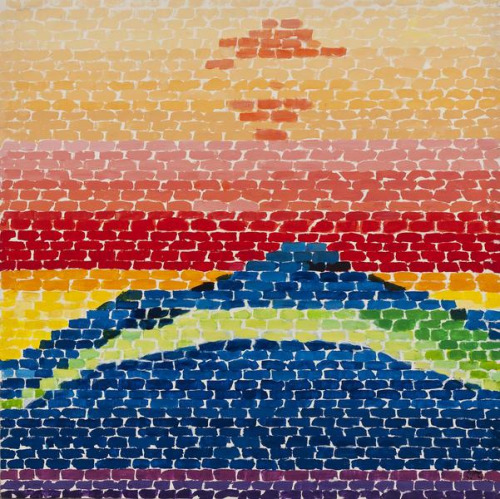
Alma Thomas, Apollo 12 "Splash Down", 1970, acrylic and graphite on canvas, 50.25 x 50.25 inches.
Image via tang.skidmore.edu; courtesy of Michael Rosenfeld Gallery, NY.

February 6 - June 5, 2016

THE FRANCES YOUNG TANG
TEACHING MUSEUM AND ART
GALLERY AT SKIDMORE COLLEGE
815 North Broadway
Saratoga Springs, NY

From tang.skidmore.edu:

Alma Woodsey Thomas (1891 - 1978) is known for her vibrant, colorful paintings. A black woman who grew up under the racial violence of Jim Crow and experienced the Civil Rights Movement firsthand, she did not seriously pursue an artistic career until her retirement at age 69. She resists conventional categorization, whether as an Abstract Expressionist, a Washington Color School painter, or as a female or black artist. Instead, they reveal an artist negotiating her own space amid Washington, D.C.’s, artistic movements, both white and black, of the mid-twentieth century. Frequently included in group exhibitions, she has not been honored with a solo show since 2001.

Born in Columbus, Georgia, Alma Thomas moved with her family to Washington, D.C., in 1907 to escape Atlanta’s erupting racial tensions and so that she and her three younger sisters could receive a better education. She attended Howard University from 1921 to 1924, and then worked until 1960 as an art teacher at a local junior high school. She received her master’s in art education from Columbia University Teachers’ College in 1934. Beginning in 1950, Thomas enrolled in American University, earning her MFA in painting in 1960. In 1972, at age 80, she became the first black woman to have a solo exhibition at New York’s Whitney Museum of American Art.

Thomas actively participated in the art world throughout her life, despite her late entry into professional painting. She remained friends with James V. Herring, the founder of Howard University’s Art Department and one of the founders of Howard’s Barnett Aden Gallery. In the late 1940s she participated in Lois Mailou Jones’s Washington salons for black artists, and was close to Jacob Kainen, with whom she studied at American University. She is frequently cited as a member of the Washington Color School and her work maintains a dialogue with artists and critics such as Morris Louis, Kenneth Noland, Howard Mehring, Gene Davis, Clement Greenberg, and Sam Gilliam.
In her mature style, bright primary colors fill Thomas’s paintings; they are indicative of her study of Johannes Itten, her visit to New York’s Museum of Modern Art’s 1961 exhibition of Henri Matisse’s cut outs, and the work of artists, such as Josef Albers and Wassily Kandinsky. Her visible, regular brushstrokes display the hand of the artist, differentiating her work from the flatness of the Washington Color School. Instead, she paints loosely but constructs her canvases carefully, filling the surface with a dense latticework of color, with subtle patterns emerging from the remaining white spaces. The tensions emerge from the interactions of the bright colors, her brushstrokes, and the negative spaces, creating a continual but controlled sense of movement, an almost musical or dance-like rhythm.

Thomas grounds her paintings, though abstract, in the natural world, evoking leaves, flowers, light, and air. She cites as inspiration "watching the leaves and flowers tossing in the wind as though they were singing and dancing," a reference to a frequent subject of her work, a holly tree outside her window whose leaves created an ever-present play of light.

During the late 1960s and early 1970s, Thomas’s work became increasingly popular, prompting laudatory reviews from critics, including Harold Rosenberg. These reviews described her paintings as “shimmering with color” and admired her for painting “with a verve, an unjaundiced eye, a freedom that is given to few.” Other critical responses have considered the role of her sex and race, investigating her ability to excel at a time and within a style that had been previously dominated by white men.

The exhibition Alma Thomas is organized by The Tang Teaching Museum and Art Gallery at Skidmore College and The Studio Museum in Harlem. The show will open February 2016 at the Tang and be on view at the Studio Museum in Summer 2016. Additional traveling venues to be announced. The exhibition is curated by Ian Berry, Dayton Director of the Tang Museum and Lauren Haynes, Associate Curator, Permanent Collection at the Studio Museum. A major catalogue will accompany the exhibition with extensive images and new essays on Thomas's important work and influential legacy.


Friday, March 20, 2015

NEW YORK: Alma Thomas

Alma Thomas, Rainbow, 1978, Acrylic on canvasboard, 18 x 24 inches. Image via michaelrosenfeldart.com.
Alma Thomas: Moving Heaven & Earth, Paintings and Works on Paper, 1958-1978
March 20 - May 16, 2015

100 Eleventh Avenue (@19th Street)
New York, NY

From michaelrosenfeld.com:

Michael Rosenfeld Gallery is pleased to present Alma Thomas: Moving Heaven & Earth, Paintings and Works on Paper, 1958-1978, an exhibition of over forty exuberant paintings, drawings, and watercolors. This exhibition will be the gallery’s second show dedicated exclusively to Thomas’s work. The first, Alma Thomas: Phantasmagoria, Major Paintings from the 1970s (2001), traveled to the Women’s Museum in Dallas, Texas. The current exhibition will be accompanied by a fully illustrated color catalogue featuring a newly transcribed and previously unpublished oral history interview with the artist.

Michael Rosenfeld Gallery has long been a champion of Alma Thomas’s work. In addition to the 2001 solo exhibition, the gallery has featured her work in several major group exhibitions, including Stroke! Beauford Delaney, Norman Lewis, Alma Thomas (2005), African American Art: 200 Years (2008), Abstract Expressionism: Reloading the Canon (2011), and Beyond the Spectrum, Abstraction in African American Art, 1950-1975 (2014). The gallery has also successfully placed her paintings in the permanent collections of such institutions as the Philadelphia Museum of Art and Crystal Bridges Museum of Art in Bentonville, Arkansas as well as many private collections.

Alma Thomas: Moving Heaven & Earth focuses on the last two decades of Thomas’s life, which were also the first two decades of her career as an artist. Late to commit to producing art full-time, Thomas nevertheless quickly developed an original and dynamic style characterized by large-scale abstractions comprised of rhythmic, repeated marks of vibrant color. The monumental canvases Thomas became celebrated for in the 1960s and 1970s were informed by the Washington Color School, which included Morris Louis, Sam Gilliam, and Kenneth Noland. However, her interest in color experimentation also aligned her closely to Josef Albers, Johannes Itten, and Wassily Kandinsky.

Inspired by nature, recent discoveries in the sciences, and her observations of earthly and celestial phenomena, Thomas’s work was devoid of overt political content. Her dedication to abstraction reflected a belief shared by painter Norman Lewis that modern art at its best could transcend political and historical concerns. But also like Lewis, although Thomas chose to eschew explicitly political content, she remained actively committed to social justice and equality. In addition to her involvement with Artists for CORE (Congress of Racial Equality), Thomas continued to organize art programs and teach art classes to local Washington, DC youth throughout her life. In 1972, Thomas became the first African American woman to be given a solo exhibition at the Whitney Museum of Art, New York. That same year, the Corcoran Gallery (Washington, DC) also mounted Alma W. Thomas: A Retrospective. In 1975, Howard University honored her with its Alumni of Achievement Award in recognition of her importance to the history of art as well as to the local African American communities touched by her considerable talent as an artist and teacher.

Thomas was celebrated for her undeniable talent during her lifetime, and her work has continued to be exhibited throughout the country and met with enthusiastic praise. In her 2001 review of Phantasmagoria, NY Times art critic Grace Glueck wrote, “with each new showing, Thomas's paintings look fresher and livelier, their totally abstract vocabulary of color markings conveying the spirit of a vibrant inner life . . . Laid down in irregular allover patterns on solid grounds that show through in webs and networks, her late works are sophisticated color structures that still reveal a debt to the natural world. Joy may be in short supply elsewhere, but it resonates in these paintings.” The joy that resounds in Thomas’s visual chants of color will continue to reverberate as part of her legacy. A woman whose career as an artist began at age sixty-seven and rose quickly to great heights, Alma Thomas still soars, decades after her death in 1978.

Long after Alma Thomas: Moving Heaven & Earth, the spotlight will remain on Alma Thomas. The Tang Teaching Museum and Art Gallery at Skidmore College and The Studio Museum in Harlem are co-organizing a retrospective of the work of Alma Thomas that will open February 2016 at the Tang and be on view at the Studio Museum in summer 2016.  Additional traveling venues to be announced.  The exhibition is curated by Ian Berry, Dayton Director of the Tang Museum and Lauren Haynes, Associate Curator, Permanent Collection at the Studio Museum.  A major catalogue will accompany the exhibition with extensive images and new essays on Thomas's important work and influential legacy.