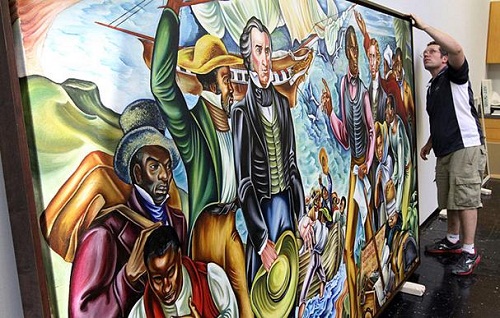
Treasured at Talladega College in the small central Alabama town where they have remained on view for seven decades, Hale Woodruff’s six monumental murals otherwise have resided in a relative twilight zone of obscurity.
But now they are being readied for their national close-up.
Next month, the High Museum of Art will open Rising Up: Hale Woodruff’s Murals at Talladega College for a three-month run before sending the exhibit on a seven-city, three-year tour that will include stops in New York, Washington, Detroit and New Orleans.
“This is their moment,” Stephanie Heydt, the High’s American art curator, said about the works that are appreciated by American art scholars and admirers in the know but otherwise often overlooked in art texts and catalogs. They are considered among the greatest achievements of Woodruff (1900-1980), who ran the art department at Atlanta University (now Clark Atlanta) from 1931 to 1946 and was one of the most influential African-American artists-educators of his generation.
To prepare the large-scale paintings on canvas for all the travel and attention, it took 1,200 hours of careful restoration, spread over a year, at the Atlanta Art Conservation Center, a nonprofit organization close to the Chamblee antiques district.
“The shared desire [of the museum and Talladega College] was to raise their national presence, reintroducing them into the canon,” Heydt said of the two series that explore civil rights themes from Africa to the reconstruction-era South. “I don’t think they were ever dropped from the canon, but [the idea was] to represent them fresh.”
Fresh is an accurate description of the improved condition of the six murals the late Atlanta artist was commissioned to create in the late 1930s and early 1940s. The vibrantly colorful paintings commemorate Talladega’s 1867 founding as one of the country’s first colleges established to serve newly freed slaves.
Historical significance
The first cycle of three murals, installed at the college’s Savery Library on the centennial of the 1839 mutiny on the slave ship La Amistad, depicts the uprising, trial and subsequent return to Africa of those freed men.
In 1942, Woodruff completed a cycle of companion murals that portrayed the Underground Railroad, Talladega College’s founding and Savery Library’s construction.
As complex and detailed as the murals are, Woodruff installed the works with the aid of students in a most simple manner. He nailed the sextet of loose canvases, ranging roughly in size from 6 by 10 feet to 6 by 20 feet, to the walls in the library’s lobby. Frame-like molding was then attached around the edges.
For better (in terms of their survival) and for worse (in terms of their under-the-art-world’s-radar location), they had not moved an inch in 70 years before being carefully removed for conservation.
Conservator Larry Shutts had an unusually positive impression when he first laid eyes on Woodruff’s creations, hung high on the walls of the library’s windowless lobby. Over his 17-year career, Shutts had worked on many sunlight-faded WPA-era murals in post offices, courthouses and federal buildings for the U.S. government. But Talladega’s were notably different.
“My initial impression was, ‘Wow, these are really nice! They’re very beautiful, they’re very colorful, they look very good.’ They looked good there,” he recalled.
That was encouraging because anything on display for that long would be expected to have condition issues, usually from exposure to UV rays.
“That dark vestibule had absolutely no natural light, so we had no ultraviolet-induced fading that typical murals show,” Shutts said. “Those [public] places usually have giant windows that are flooded with light. These had four incandescent chandeliers.”
But even in the relative dimness, Shutts took note of some issues, including flaking paint.
Some of the tacks originally used to attach the canvases to the plaster walls had rusted away or pulled out, so that the murals had started to sag from their own weight, especially in the middle, like “bunting hanging off a balcony,” the conservator recalled.
Not only were there tack holes around the perimeter, a few nails had been hammered around the middle, probably by a maintenance worker trying to address the drooping. Further, there were signs of water damage behind some of the pieces from a steam pipe inside the wall. Also, glue had been applied to the back of one of the canvases, requiring a careful removal using solvents and a spatula.
And the vibrant palette employed by Woodruff perhaps misled Shutts. It wasn’t until he and other workers took the murals down from the library lobby’s walls, rolled them onto long tubes and brought them to Atlanta and more closely examined them that the conservator was able to determine that they were coated in dirt, soot and grime.
A closer look
Woodruff had not varnished the canvases, probably because there had not been enough time to let the paint dry and add a protective sealer coat before installation, Shutts said. Artists typically wait six months to a year to apply varnish, so it’s not unusual for a large commission, typically finished close to a deadline, to be without it.
But that creates problems over time because paint is porous and without a varnish layer to fill in those pores, dirt has no barrier from becoming embedded, the conservator said.
Looking at the loose canvases under a microscope-like device, Shutts and other conservators operated with small hand tools and swabs to accomplish a “graduated” cleaning.
“We worked color by color, shape by shape, form by form, in order to extract as much dirt as that particular pigment would allow,” he explained.
Certain pigments have more bonding ability with the oil and dry better, producing a harder paint, Shutts said, while other pigments have less drying ability, creating a softer paint.
“Therefore certain colors you can’t clean as much, and certain colors you can clean more,” he said. “What worked good on the white shirt doesn’t work so good on the black pants. So you have to modify and adjust your procedures as you go along.”
The more time Shutts spent intensely focused on small details while hovering over the canvases spread flat on large work tables, the more secrets they surrendered.
One of the first things he noticed was that only one of the murals was signed, in pencil on the back, by a studio assistant rather than by Woodruff. He also noticed that while the “La Amistad” series was done almost entirely in Woodruff’s sure hand, the second trio reflected more contributions from variously skilled assistants.
“Once you get to know the paintings ... you can see different hands, different artist touches,” Shutts said. “You’ll see consistency with a whole bunch of faces and then you’ll see another face and go, ‘It just doesn’t look like the rest.’”
 |
| Larry Shutts of the Atlanta Art Conservation Center works on cleaning Hale Woodruff’s Return to Africa mural in preparation for its display at the High Museum, which begins a national tour of the late artist’s works. Photo via ajc.com. |
Restoring original
Other inconsistencies occurred as a result of a phenomenon known as pentimenti, in which a design that had been painted over long ago starts to faintly reappear like a ghost image from underneath paint layers. The reason this happens is that as paint ages, it becomes more translucent.
“When this was first executed in 1939, you would never see this,” Shutts said, pointing out the faint outline of an arm that Woodruff or one of his helpers painted over and repositioned. “It was invisible.”
Other changes became clear once the molding was removed from the edges. The most notable one was to the La Amistad painting The Repatriation of the Freed Captives. In the lower right corner, resting against a trunk at the feet of mutiny leader Cinqué, is an adze, a tool used to shape or smooth rough timbers.
But when the lower molding was removed, conservators could see that the adze had originally been painted as a long gun, with the barrel pointing at Cinqué. There has been much speculation since about the change, made by one of Woodruff’s assistants, conservators believe.
After cleaning, but before flaking paint and holes were addressed, the murals were backed with a fabric liner and attached to custom-made wooden stretchers to ensure long-term stability.
In the process, the experts made the decision to expose as much of the painting that had been covered up by the molding as it could. As a result, each side of the six canvases has grown by 1 to 2 inches.
“So we’re seeing things today that were not seen ever,” Shutts said.
Even long-hidden areas where Woodruff rolled his brushes to check color blends can be spotted, under the edge of wrap-around frames built at and installed by the Atlanta Art Conservation Center.
In one place at the top of the Underground Railroad painting, a strip of canvas had to be added and painted to complete a face in a wanted poster. It, like the nail hole repairs, is invisible to an unknowing eye.
Shutts said the inches that had been covered by molding also provide a “litmus test” of the completed conservation’s accuracy.
“Areas that were not exposed to light, that were behind molding for 75 years, are the exact same color as the rest of the painting,” he said, gratified.
To help maintain the appearance of more than seven decades ago, a thin spray of reversible, non-yellowing synthetic varnish was applied to the canvases as a defense against future dirt and grime.
The elaborate conservation process cost $120,000. As part of its loan agreement with Talladega College, the High Museum raised private and public funds to cover the cost. The Atlanta museum and each institution on the tour additionally will pay an undisclosed participation fee to the school.
“Overall the murals were in good condition [before conservation], but certainly not set up to remain in good condition for the next century,” High curator Heydt said. “And now they are. They’re pretty much good to go for a long time.
“Now they’re just gorgeous.”
--------------------
Exhibit preview
June 9-Sept. 2. 10 a.m.-5 p.m. Tuesdays-Saturdays; until 8 p.m. Thursdays; noon-5 p.m. Sundays. $18; $15, students, seniors; $11, ages 6-17; free, 5 and younger. High Museum of Art, 1280 Peachtree St. N.E., Atlanta. 404-733-4200, www.high.org.
--------------------
Hale Woodruff At A Glance
Hale Aspacio Woodruff (1900-1980) may not be as well known as some of the artists whose careers he helped advance, but he was a seminal figure on the Atlanta and American art scene of the 20th century.
Illinois-born and Paris-trained, Woodruff launched Atlanta University’s (now Clark Atlanta) art department in 1931 and ran it until 1946, when he moved to New York to teach at New York University.
In addition to teaching, he made a major contribution to American art in 1942 by creating AU’s annual national competition for African-American artists denied the opportunity to show at white-only museums. The competitions were held until 1970, providing an important showcase for artists such as Jacob Lawrence, Elizabeth Catlett, Charles White, John Biggers and Lois Mailou Jones.
The 291 pieces by 155 artists that the school collected through purchase prizes are today at the center of Clark Atlanta University’s permanent collection, considered among the finest holdings of African-American art. An important part of that collection is Woodruff’s own “Art of the Negro” six-panel mural series — “a kind of token of my esteem for African art,” he once called it.
Rising Up: Hale Woodruff’s Murals at Talladega College, the High Museum of Art exhibit opening June 9, will include other Woodruff murals as well as smaller paintings he made in Mexico, where he traveled in 1936 to study mural painting for a brief stretch under Diego Rivera.
--------------------
In the Conservator's Own Words
In the catalog that accompanies Rising Up: Hale Woodruff’s Murals at Talladega College”(High Museum of Art, $45), Larry Shutts, Atlanta Art Conservation Center associate conservator of paintings, writes about the responsibility of taking on the restoration of Hale Woodruff’s murals:
“Early in my research to prepare for the conservation treatment, I gained an appreciation for the importance of Woodruff’s murals, their beauty, and their place in art history. It was not until their removal, however, that it became clear how important these works are to the Talladega community. Woodruff’s murals are much more than just decoration, more than superb examples of the art form: They are intimately tied to the heritage and legacy of the school.
“At one point, before the removal of the first mural, a student — one of many who had convened in the lobby of Savery Library that day — pulled me aside and asked me a favor. He made me promise that the murals would receive the best of care, that nothing bad would happen to them, and that they would be returned in better condition, ready to be seen and enjoyed by future generations of students.
“Promise kept.”