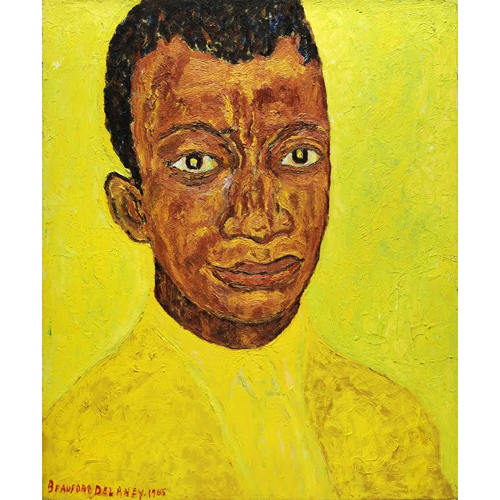
Beauford Delaney, Portrait of James Baldwin, oil on canvas. Image via pilotonline.com, courtesy of The Chrysler Museum of Art.
Chrysler Museum acquires painting that celebrates 2 African American icons
Text | Denise M. Watson for The Virginian-Pilot
Published | Wednesday, February 3, 2016
Beauford Delaney has often been described as an elusive artist, but he is present in his paintings: intense and explosive, his images crazy with rich colors, layers and shadow.
The artist, who died in a mental hospital in 1979, never saw financial success in a career that emerged in the late Harlem Renaissance era of the 1930s. But his talent attracted the friendships of artists like Georgia O’Keeffe and writer James Baldwin, who saw Delaney as a mentor.
Delaney wouldn’t be recognized as an important artist until years after his death. Alex Mann, the Brock Curator of American Art at the Chrysler Museum of Art, recently acquired one of Delaney’s most iconic paintings for the Chrysler.
Delaney’s 1965 portrait of Baldwin is now on display and will be featured as the Chrysler kicks off its African American art programming for Black History month with a gallery talk this Sunday.
“We are always looking for great pictures to add to the Chrysler collection, and I’ve been studying African American artists who were overlooked during their lifetime but now we see their work and say, “ ‘Wow, this is fantastic,’ ” Mann said.
“Anything that has a good story within it is important to me, and this picture is amazing and it’s perfect for the museum.”
The Smithsonian National Museum of African American History and Culture (NMAAHC) in Washington, D.C., has acquired Leah Red Coat Stirring (Sketch), an
original oil painting by artist Gustave Blache III. It is the second
painting from the Leah Chase: Paintings
by Gustave Blache III series to be acquired by the Smithsonian Institution,
the world’s largest museum and research complex.
In 2011,
the National Portrait Gallery
acquired Cutting Squash, an iconic
oil painting depicting legendary New Orleans chef Leah Chase working in her
kitchen. Cutting Squash is currently
installed and part of the permanent collection exhibition “Recent Acquisitions” on view at the National
Portrait Gallery from November 7, 2014, through November 11, 2015. In 2013, the
NMAAHC acquired for their permanent collection Self Portrait with Checkered Scarf, an original oil painting by
Blache. The NMAAHC is presently scheduled to open on the Mall in 2015 and will
become the repository of one of the most comprehensive collections of the
African American experience anywhere.
Raised in
New Orleans, Blache graduated from the New Orleans Center for Creative Arts. He
received his B.F.A. from the School of Visual Arts in Savannah, Ga., and his
M.F.A. from the School of Visual Arts in New York. Blache has been included in
fine art exhibitions with artists as diverse as Edgar Degas, Pierre Auguste
Renoir, Mary Cassatt, Robert Rauschenberg, Jasper Johns, Andy Warhol and
Jean-Michel Basquiat. Blache is featured in “Colored Frames”, a documentary
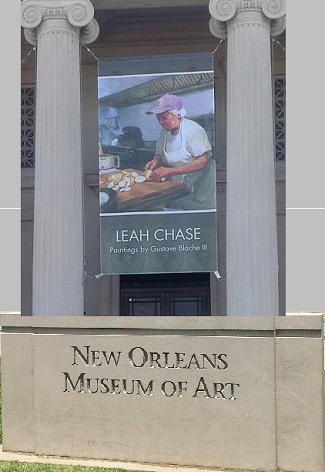
that PBS broadcasted nationally. In 2012, the New Orleans Museum of Art
presented the one-man exhibition, Leah
Chase: Paintings by Gustave Blache III which depicted the behind the scenes
of Chef Leah Chase in the kitchen of world renowned Dooky Chase’s Restaurant.
Regarding
the latest Smithsonian acquisition, Blache says “I was initially contacted by
internist Alexandria Van Haute from the Smithsonian on behalf of research
specialist Nicole Green and museum curator Dr. Joanne Hyppolite with interest
in acquiring a painting from the series for their permanent collection. The
Smithsonian specifically wanted a painting of Mrs. Chase in a red coat. The
painting would accompany a permanent installation of artifacts from Dooky Chase’s
Restaurant that centered on community. What will be on display is Chase’s
signature red coat along with other objects from the restaurant. I originally
kept the painting Leah Stirring Red Coat
for myself as a memento from the series but when the museum came calling I had
to make it available to them. All the other paintings from the series had
previously sold but this one because I never made it available to the public
even though it exhibited with the others in 2012 at the New Orleans Museum of
Art. Dr. Hyppolite and (Nicole) Green visited Brooklyn to see the Leah sketch
in person at the end of the summer and seemed eager to have it as a part of the
Smithsonian’s permanent collection. I got the wonderful news in November that
the painting passed committee; and I was very excited and thrilled. It was
great news for Mrs. Chase, the Chase Family and the city of New Orleans—her
second image in the Smithsonian Institution, Cutting Squash and now this one.”
Blache
says he has had no recent exhibitions since the show at the New Orleans Museum
of Art in 2012 but is currently working on a new series that he is really
excited about.
“I’m not
allowed to share what it is just yet but I can say it is a New York inspired
subject,” he says.
Asked
about plans for the future he says that in addition to the series he is working
with The Artist Book Foundation to produce his first
monograph, Gustave Blache III: A Work in Process. It’s scheduled for release in
the fall of 2016.
Blache
states, “The monograph will chronicle my career to this point, particularly
highlighting my early career and studies in Savannah and in New York, but
ultimately it will focus on my past series that document important and
overlooked processes of individuals whose labors go unrecognized. Series like
the Curtain Cleaners, Mop Makers, and Leah Chase will now be reviewed along with the new series I’m
working on now. The Self Portraits
that I’ve painted from 2000-2008 will also be detailed in the monograph. We
have a great group of scholars from various museums contributing to the
catalogue, and I’m interested to see what the final product will look like when
it’s all completed.”
Jean-Michel Basquiat, Mecca, 1982, acrylic and oilstick on canvas mounted on wood supports, 70 x 68 7/8 inches. Image via sothebys.com.
Auction hammer slammed on music giant's $4.5M bid for Jean-Michel Basquiat painting at Sotheby’s
From
the nypost.com November 20, 2013:
He raps, “I just want a Picasso in my casa” — but Jay Z has
settled for another of his art-world obsessions, plunking down a cool $4.5
million for a Jean-Michel Basquiat piece.
The Brooklyn-born rap impresario was the anonymous buyer of a
quirky 1982 Basquiat painting titled “Mecca’’ on November 13, 2013 at Sotheby’s in Manhattan, a source told The Post.
His hefty purchase — an orange, white and black acrylic and
oil-stick work — features the Empire State Building under a trademark Basquiat
crown.
Its estimated sale price was between $4 million and $6 million,
so the rapper got something of a steal.
But it doesn’t look as if money would have been an object anyway
— Jay Z has had a love affair with the late graffiti artist and fellow Brooklyn
native for several years.
Jay Z, whose real name is Shawn Carter, has repeatedly included
in his songs references to Basquiat — who OD’d on heroin in 1988 at age 27.
He said one of Basquiat’s paintings even inspired an entire
track — and has lovingly talked about a print of that work that he owns.
The painting, “Charles the First,’’ was the basis for his 2010
song “Most Kingz,’’ the rapper has said. It opens with the lyrics “Inspired by
Basquiat, my chariot’s on fire.”
In his 12th, and most recent, studio album, “Magna Carta Holy
Grail,” Jay Z references some $493 million worth of art, according to Forbes.
In one track, “Picasso Baby,’’ Jay Z gives a nod to Basquiat by
rapping, “It ain’t hard to tell, I’m the new Jean-Michel.”
A Jay Z rep did not respond to requests for comment.
Self Portrait is the second work of art by Blache to
be acquired by the Smithsonian Institution, the world's largest museum and
research complex, which was established in 1846. In 2011, the National Portrait
Gallery acquired Cutting Squash, an
iconic oil painting depicting legendary New Orleans "Queen of Creole
Cuisine" and American Civil Rights figure, Mrs. Leah Chase, working in her
kitchen.
The NMAAHC
is presently scheduled to open on the Mall in 2015 and will become the
repository of one of the most comprehensive collections of the African American
experience anywhere.
Wadsworth Jarrell, Revolutionary, 1972, Screenprint on paper, 36 x 26 1/2 inches.
Curators of the
Smithsonian’s new African-American history museum reveal art they’ve acquired
so far
By Julia Halperin for Museums, Issue 249, September 2013
Published online: September 2013
In the past ten years, the National Museum of African
American History and Culture has built a collection of 18,000 objects—including
a little-known but substantial collection of visual art. When the $500m
institution opens on the National Mall in Washington, DC, in 2015, works by
Jacob Lawrence, Elizabeth Catlett and Lorna Simpson will accompany historical
objects such as an antebellum slave cabin from the 1850s and a segregated Jim
Crow train carriage from 1922.
The museum will include a series of
galleries dedicated to visual art, ranging from the late 18th century to the
present. It has been steadily acquiring works from auction houses, private
collections and galleries, such as DC Moore and Howard Greenberg in New York.
Among the museum’s purchases is Sam Gilliam’sApril
4, 1972, an abstract painting dedicated to Martin Luther King, bought from
New York’s Swann Galleries in 2011 for $31,200. The museum does not disclose
its acquisition budget.
“We believe you cannot tell the story of African-American history and
achievement without art,” says Kinshasha Conwill, the museum’s deputy director.
Deborah Willis, the chair of photography and imaging at the Tisch School of the
Arts, is helping to advise the museum on its collection. “When my students walk
through the exhibition, they will see a history not only of struggle but also
of achievement,” Willis says.
The visual art collection makes up only around 1% of the museum’s holdings. The
cost of art—generally higher than that of historical documents and
artefacts—has limited what the museum can buy, says Jacquelyn Serwer, the
museum’s chief curator. “It’s not easy to pull together large amounts of money
to buy art when there are so many things we have to buy that are much less
expensive,” she says.
Like most museums, the institution relies on private collectors to donate works
that are too costly to buy. Some artists, such as Eldzier Cortor, a 96-year-old
Modernist painter who worked in New York after the Harlem Renaissance, have
donated their own works to the museum. Those still on the institution’s wish
list include Kerry James Marshall, Leonardo Drew, Rashid Johnson, David Hammons
and Sanford Biggers.
Some of the museum’s most significant gifts came unexpectedly. In 2008,
Margaret Asch, an academic at the University of Victoria in Canada, travelled
to Washington, DC, to deliver the drawingDixie
Café, 1948, by Jacob Lawrence. The artist created the work after visiting
the South and experiencing segregation for the first time. Asch inherited it
from her father; most scholars had assumed it was lost. “She and her husband
showed up at our office unannounced and took out the drawing, and everybody in
the room burst into tears,” Serwer says.
The museum, co-designed by the British architect David Adjaye and the US
architectural firm Freelon Group, is also looking to buy several works of
outdoor sculpture to install in its garden.
The inaugural display will include paintings from the Harlem Renaissance and
the Spiral Group, an African-American art collective associated with Abstract
Expressionism. A handful of paintings will also be hung in the historical
galleries. These includeHunted
Slaves, 1862, by Richard Ansdell, which depicts two runaway slaves being
chased by fierce mastiff dogs.
The curators want to encourage visitors to consider the contribution of
African-American artists as part of a broader art-historical narrative. “We’re
very game to convince people that there have been accomplished, interesting,
innovative African-American artists at every stage of American art,” Serwer
says. She says the museum is not afraid to confront hot topics, despite the
fact that it is part of the Smithsonian Institution, which is sensitive to
criticism from Capitol Hill. In 2010, the Smithsonian’s Secretary, G. Wayne
Clough, censored the National Portrait Gallery’s exhibition “Hide/Seek” by
controversially ordering the removal of a video by David Wojnarowicz. “If
you’re going to talk about race in this country, you’re going to have to be
prepared to create some controversy,” Serwer says.
You're at Art Basel. You're a
megamillionaire rap mogul. Your manager spots a glorious painting that he's
sure will appeal to your refined yet edgy taste. It's certainly no stretch that
Jay-Z forked over $20,000 for a Hebru Brantley—though it's a nice touch that Hova asked the
Chicago-south-side-born artist, whose aesthetic is part Wildstyle, part
Japanimation, to deliver the painting to his hotel room. If you find the price
a little steep, keep in mind that Rick Ross dropped a reported $20,000 at Art
Basel on a mere photograph. Diddy dished out more than triple that on a
sculpture at the Miami art fair. And Usher's Art Basel buy? Obviously, it was a
Louis Vuitton waffle maker. (I spent so much time, in vain, googling its price
that I'm pretty sure I'm about to be under attack by targeted ads for Gucci
blenders.) But if you, like pretty much everyone else who's not Jay-Z, don't
have that kind of cash lying around, there's a cheaper option: the October 11,
2012, issue of the Reader featured an equally cool Brantley, My
Secrets Keep Secrets, on its cover. It would look spectacular framed.
Robert Seldon Duncanson, The Caves, 1869, Oil on canvas, Amon Carter Museum of American Art
Amon Carter Museum of American Art in Fort Worth, TX Announces Acquisition of its First Painting by 19th-Century Artist
The Amon Carter Museum of American Art has announced their acquisition of a major
painting by 19th-century landscape artist Robert Seldon Duncanson (1821–1872),
the first African-American artist to achieve international acclaim. The work,
titled The Caves, painted in 1869,
was originally owned by Cincinnati Abolitionist Richard Sutton Rust
(1815–1906), and it remained in his family until the Amon Carter purchased it
in late 2012. Because it has been in a private collection for nearly 150 years,
the painting will be accessible to the public for the first time beginning May 4,
when it is displayed in the Amon Carter’s galleries.
“Duncanson
is an immensely important figure in American art,” says Andrew J. Walker,
director of the Amon Carter. “He was a self-taught, black artist from
Cincinnati and a leading landscape painter of his time, which was a monumental
accomplishment during the Civil War and Reconstruction periods. Owning a work
by this esteemed artist greatly enriches our collection.”
Impressive
in scale, the painting is approximately 3 feet tall and is in magnificent condition.
The Caves is painted in the Hudson
River School tradition, which was an inspiration to Duncanson after he viewed
works by Thomas Cole and other Hudson River School artists at Cincinnati’s
Western Art Union in the late 1840s. The scene depicts an intimate view of the
wilderness, with unusual geographic features of steep ravines and sandstone
cliffs perforated by a canopy of evergreens and a trio of caverns.
“At first
glance, the scene suggests a documented view of untouched nature,” says Rebecca
Lawton, curator of paintings and sculpture. “But then we notice three figures
making their way up a steep incline toward the mouths of the caves.
“This
painting is a fine example of Duncanson’s mature style,” Lawton continues. “His
extraordinary powers of transcription are evident; and although the exact
location of the painting is not confirmed, we believe it’s the area known today
as Hocking Hills State Park in Ohio. The work beautifully synthesizes
mid-19th-century concerns for nature as an expression of cultural and national
identity.”
Duncanson’s
paintings seldom overtly depict the political and cultural issues of the years
surrounding the Civil War, such as slavery and discrimination, according to
Margi Conrads, deputy director of art and research. Instead, the artist may
have included subtle cues in his landscapes that conveyed his anti-slavery
position.
“His
depiction of caves poses intriguing questions about whether the painting
includes references to the abolitionist movement or the role of African-Americans
in everyday society,” says Conrads. “Caves were among the safe havens for
runaway slaves through the Civil War. Additionally, both before and after the
War, African-Americans guided tourists through caves, and it’s possible
Duncanson is referencing this in his painting through the figure at the
cavern’s mouth. Regardless, the painting is a beautiful testimony of an artist
dedicated to depicting the essential natural world.”
About
Robert Seldon Duncanson
Robert
Seldon Duncanson was born in Seneca County, New York, in 1821 to an
African-American mother and a Scottish-Canadian father. Duncanson spent his
early childhood in Canada and later moved outside Cincinnati to live with his
mother.
Duncanson
was self-taught and principally influenced by Thomas Cole and the Hudson River
School. By 1842, he had exhibited his paintings and received many commissions
as a result. The artist thrived in Cincinnati as a landscape painter with his
views of the Ohio River Valley and scenes throughout North Carolina,
Pennsylvania, Canada, England and Scotland. He went on to gain international
recognition, the first African-American artist to achieve such success.
In 1851,
winemaker Nicholas Longworth (1783–1863) commissioned eight enormous murals
from the artist to decorate the foyer of his Palladian-style villa, Belmont, in
Cincinnati. Today Longworth’s home is the Taft Museum of Art. In 1853,
Duncanson was asked to illustrate Harriet Beecher Stowe’s Uncle Tom’s Cabin and then, financed by the Freeman’s Aid Society
and the Anti-Slave League, Duncanson departed for a tour of Europe where he
discovered French landscapist Claude Lorrain (1600–1682) and the attraction to
Orientalism.
Back in
Cincinnati in 1854, Duncanson spent the next four years painting and
collaborating with the African-American photographer and abolitionist James
Presley Ball (1825–1904) by retouching and painting over Ball’s photographs.
Together they created the 600-foot-long antislavery panorama titled Ball’s Splendid Mammoth Pictorial Tour of
the United States(1855). During this time, he also painted portraits of
prominent white abolitionists from Detroit and Cincinnati, including James G.
Birney, editor of the Philanthropist, an abolitionist newspaper; Lewis Cass, a
senator from Michigan; and Richard Sutton Rust, an author, Methodist minister
and owner of The Caves.
When the
Civil War broke out in 1861, Duncanson moved to Montreal and, in 1865, to the
United Kingdom, spending most of his time in England and Scotland. He returned
to Cincinnati during the winter of 1866–67. He died in Detroit in 1872 at the
age of 51 while preparing an exhibition.
The Brooklyn Museum has been collecting African art since 1900. It was also the
first American museum to present African objects as art rather than
ethnographic data, and in 1923 it organized one of the largest exhibitions of
African art anywhere. Right now its special exhibition isGravity and Grace: Monumental Works by El Anatsui, devoted to Mr.
Anatsui, the contemporary African artist known for his magical wall hangings
fashioned from everyday materials.
This week
the museum announced that it has acquired “Black Block,” its first work by Mr.
Anatsui. The two-panel wall hanging from 2010 is part of the show. “It’s one of
his signature pieces,” said Eugenie Tsai, the museum’s curator of contemporary
art.
Unlike
the colorful, shimmering wall hangings that Mr. Anatsui has become known for,
“Black Block” is monochromatic. When the exhibition closes in August, “Black
Block” will travel with the show to the Des Moines Art Center, the Bass Museum
of Art in Miami Beach and the Museum of Contemporary Art in San Diego.
Gravity and Grace: Monumental Works by El Anatsui
on view at Brooklyn Museum February 8 through August 4, 2013
John Outterbridge. Case in Point, from the Rag Man Series, c. 1970. Mixed media, 12 x 12 x 24 in. (30.5 x 30.5 x 61 cm). Image via hammer.ucla.edu.
The
Hammer Museum has acquired a major work by John Outterbridge. Case in Point (c. 1970) is featured
in the Hammer’s travelling exhibition Now Dig This! Art & Black Los Angeles, 1960-1980.
Assembled from leather and other materials and closely resembling a bag of
grenades, this work communicates intense feelings about Outterbridge’s
experience of being ushered to the back of a bus in 1955 despite his being in
full army uniform. With Case in Point,
Outterbridge confronts the all-too-common reality of racism that African
Americans experienced at home after serving the country abroad in the Korean
War.
Mark Bradford, Kingdom Day, 2010, mixed media collage on canvas. Image via themodern.org.
Kingdom comes in time for museum's tenth anniversary
A monumental painting by artist Mark Bradford (b. 1961), Los Angeles, will be unveiled as part of the Modern Art Museum of Fort Worth's tenth anniversary celebration, the first in the Modern’s collection. Crafting semi-abstract paintings from fragments of the urban environment—billboard paper, posters, newsprint, and street debris—Bradford’s works are layered with multiple materials and meanings. An African American who grew up in south-central Los Angeles, the artist’s richly textured collages merge his fascination of the personal space of painting with the sprawling, continually changing street facades of the city and the particular political and racial tensions that still exist there.
The Modern’s newly acquired painting is titled Kingdom Day, 2010, and is one of Bradford’s most ambitious works to date, consisting of four 10-by-10-foot canvases. An homage to the Kingdom Day Parade in Los Angeles, which takes place every January on Martin Luther King Jr. Day, the work specifically refers to the 1992 parade, the same year four policemen were tried and acquitted for beating Rodney King, inciting riots throughout Los Angeles. The painting, which on first take appears almost abstract, presents an ambiguous and turbulent image. Various colored banners and words are obscured by a field of gestures that resemble sparks from an explosion. At the same time, the painting suggests a topographical read: a satellite view of the Southern California coast covered by violent atmospheric static.
Beauford Delaney (American, 1901-1979), Marian Anderson, 1965, oil on canvas, 63 x 51½ in., J. Harwood and Louise B. Cochrane Fund for American Art. Image via VirginiaMuseum.blogspot.com.
Modernist's portrait one of several works by black artists added to collection of Richmond, VA museum
On December 16, 2012, The Board of Trustees of the Virginia Museum of Fine Arts met to approve the acquisition of a focused group of 12th to 20th-century objects by African and African American artists, among other works. The acquisitions underscore VMFA’s ongoing commitment to building, interpreting, and programming a diverse, global permanent collection. Each quarter, after VMFA’s trustees approve proposed acquisitions, the art becomes the property of the Commonwealth of Virginia, exemplifying the museum’s “It’s Your Art” motto.
Important paintings by two leading 20th-century American modernists—Beauford Delaney’s Marian Anderson (1965) and Aaron Douglas’s The Prodigal Son (ca. 1927)—were purchased with the J. Harwood and Louise B. Cochrane Fund for American Art. In addition, Elizabeth Catlett’s bronze Standing Mother and Child (1978) was donated by the Richmond chapter of The Links, Inc.
Two photographs by Gordon Parks are the first by this major 20th-century photographer to enter VMFA’s collection. Both of these images enable the museum to tell a more expansive story of photography at mid-century, while emphasizing Parks’ commitment to documenting the Civil Rights movement over more than a decade.
Beauford Delaney is critically acclaimed for his modern portraits, of which Marian Anderson is his most ambitious and accomplished. Characterized by a chromatic brilliance and technical complexity, the painting of the iconic contralto and cultural figure epitomizes the artist’s exploration of abstractions that featured the color yellow as a symbol of perfection and transcendence. The second work by Delaney to enter VMFA’s collection (the 1946 New York cityscape, Greene Street, was acquired in 2010), Marian Anderson becomes the museum’s first painted portrait of a celebrated historical black figure.
Called the Dean of African American art, Aaron Douglas is regarded as the leading visual artist of the Harlem Renaissance as well as the first black artist to create a distinctive modernist style that connected contemporary African Americans with their African heritage. The Prodigal Son has all the hallmarks of Douglas’s signature approach, while evoking one of his most important collaborations – eight gouache accompaniments to James Weldon Johnson’s God’s Trombones: Seven Negro Sermons in Verse, a collection of free-verse poems inspired by folk sermons of Southern black preachers. The Prodigal Son oil acquired by VMFA directly relates to this award-winning 1927 publication for which Douglas produced various drawings and paintings, including versions of the same subject in different media.
Standing Mother and Child is among the best-known later sculptures by the seminal African American artist and social activist Elizabeth Catlett. The iconic theme of mother and child, so expressively rendered in this 1978 bronze, is one most associated with the artist (who had three sons with her second husband, Francisco Mora). Characterized by Catlett’s distinctive figural realism with abstract elements drawn from African and Pre-Columbian art, Standing Mother and Child emphasizes the loving intimacy between the all-but fused figures.
Gordon Parks’ position as the first African American photographer on the staff of Life magazine put him at the center of the period’s complex racial struggles—from segregation in the South to the rise of the Black Power movement. Stokely Carmichael, Watts, Los Angeles was the lead image in the May 17, 1967 Life article on this important, if controversial, African American leader who coined the term “Black Power.” Gordon Parks wrote the essay in the feature, offering an important opportunity to pair his written voice with his photographic vision.
Untitled, Mobile, Alabama comes from a series of 70 original transparencies taken for a September, 1956 Life photo-essay on segregation entitled “The Restraints: Open and Hidden.” The “colored entrance” neon sign reveals the degree to which segregation was indelibly designed and integrated into 1950s American culture. Yet the dignity and repose of the woman and small child stand in contrast to the more violent Civil Rights images of protests usually associated with the genre.
In addition to this resonant array of African and African American objects, additional works of art were acquired by purchase and gift at the December meeting.
An intimate, candid painting of chefLeah Chaseabsorbed in slicing yellow squash in the kitchen as she prepares
for the lunch rush at Dooky Chase
restaurant has been added to the collection of iconic American images in theNational Portrait Gallery, part of
the Smithsonian Institution in Washington, D.C. The tiny painting, smaller than
a leaf of notebook paper, is the work of artistGustave Blache III, who grew up in Gentilly and eastern New Orleans and now
lives in Brooklyn.
Blache’s portrait of Chase began in the restaurant kitchen and now
will be displayed in the nation’s premier museum complex, under the same roof
as universally known presidential portraits ranging from George Washington by
Gilbert Stuart to Barack Obama’s street-art-style portrait by Shepard Fairey.
In the museum, the New Orleans chef will stand shoulder to shoulder with the
great explorers, inventors, and industrialists who shaped the country.
It’s not Chase’s only appearance in there: Photos of President
Obama’s visit to Dooky Chase hang in the foyer, bespeaking the cultural
significance of the landmark eatery named for Leah’s husband and partner, Edgar
“Dooky” Chase II.
The portrait of Chase is part of a suite of 20 small-scale paintings
that Blache created depicting back-of-house activities at the renowned
71-year-old Orleans Avenue restaurant, which is known for its authentic Creole
cuisine, its historic role as a meeting place during the civil rights era and
Chase’s extensive collection of African-American art.
“I wanted to do the behind-the-scenes part of the restaurant,”
Blache said. “What’s the story people don’t see? What happens when a delivery
comes? Doing prep work?”
It’s a humble depiction. Chase is wearing her characteristic
baseball cap. A colander of cabbage awaits chopping. Steam rises from boiling
pots in the background.
Blache’s cool, spare style hovers somewhere between Edgar Degas
and Wayne Thiebaud. Asked whether she thought the rendering was accurate,
Chase, 89, said the young artist had gotten it right.
“I told him, ‘You could have made me look like Halle Berry or Lena
Horne, but you made it look like me,’ ” she said.
In one scene, Chase rinses cherry tomatoes at a sink. In another
she consults an inventory list. In yet another, she pours oysters from a
container.
The painting’s unlikely journey to Washington began in 2009, when
New Orleans-born art dealer Eugene C. Daymude stopped for lunch at Dooky Chase,
only to find the restaurant closed for a private party. Chase graciously seated
him anyway, and sometime during his meal it struck him that the sight of Chase
preparing classic Creole dishes was the perfect subject matter for his friend
and client, Blache.
Like a latter-day Jean-François Millet, Blache seeks to depict the
dignity and grace of everyday labor. He calls his concept “visual journalism.”
In past painting series, he has captured blind craftsmen manufacturing mops and
curtain cleaners at work on drapery. He agreed that the celebrated but
little-seen kitchen of Dooky Chase, overseen by the dynamic Mrs. Chase, was an
ideal subject.
Chase agreed to the project, though she wasn’t sure how things
would turn out. “I didn’t know what he could do,” she said. “I didn’t know how
good he really was.”
Over the next two years, Blache made several trips to Chase’s
domain, sketching, snapping photos for reference and immersing himself in the
atmosphere.
“The kitchen is a bit cramped,” Blache recalls. “I was very aware
of not trying to impede her. You do not want to be the person in her way.”
Chase said that there was little chance the artist would distract
her from her culinary duties.
“When he got in my way, I told him get out of the way,” Chase
said.
Blache studied at the New Orleans Center for Creative Arts, then
went on to The School of Visual Arts in Savannah, Ga., and, finally, the School
of Visual Arts in New York, where he received a master of fine arts degree.
Early in his college career, he painted life-sized figures on huge
canvases, but to save money and time he began doing oil sketches on small
Masonite panels. The immediacy and small scale seemed to match the intimate
tone he sought in his paintings, so he stuck with the format.
“It forces you to get up close and really investigate and examine
the painting,” he said.
Blache’s brand of realism earned him spots in several gallery
exhibits in New York and New Orleans. In 2004 he moved back to the Crescent
City with his wife, but Hurricane Katrina forced
him to evacuate. While away, he was offered a job with a prestigious painting
restorer in New York. So it was off to Brooklyn.
His Dooky Chase series, in part, reconnects him with his New
Orleans roots. His mother, Monica Blache, pointed out that her son can trace
his personal history directly to Dooky Chase restaurant. His maternal
grandparents’ first date was there.
Success swiftly followed the completion of the series in October
2011. Several of the paintings were exhibited at a one-night showing at Le
Musée de f.p.c. (free people of color) house museum on Esplanade Avenue, which
led to an offer from the New Orleans Museum of Art to exhibit the entire suite
from April 24 to Sept. 9, 2012. Edgar Chase is a current NOMA board member and
Leah is a lifetime member. Meanwhile, Daymude contacted a curator at the
National Gallery, who agreed to consider one of Blache’s portraits of Chase for
the national collection.
“We are always looking for portraits of nationally prominent
figures,” National Portrait Gallery chief curator Brandon Fortune said.
But that doesn’t mean it’s easy to have a painting accepted by the
prestigious institution. A panel of 15 curators, historians and the museum
director reviewed Blache’s “Cutting Squash” before giving it the nod in
December.
But there was one more hurdle. The painting had been purchased by
a New Orleans collector, who kindly agreed to swap for another painting from
the series, allowing Blache to donate “Cutting Squash” to the country’s
collection.
“It is a very interesting image of a woman at work, doing a very
simple task, cutting squash,” Fortune said. “But in some ways it transcends the
everyday and becomes something of national significance.”
Fortune said that the painting will not go on display immediately
in the National Portrait Gallery; it will be shipped back to the Crescent City
in April to be included in the NOMA exhibit. After that, “I’m confident that we
will work to put the Leah Chase portrait up within a reasonable time period
after the painting returns from New Orleans,” she said.
Considering the honor of entering the National Portrait Gallery,
Chase said it goes to prove “you don’t have to be a general or the greatest
person in the world to be put on canvas.”
Blache sees the National Gallery acquisition as an honor for him
and his hometown as well.
“You know it’s a huge accomplishment, for New Orleans,” he said.
“It hits home for all of us to have one of our representatives there. The
richest to the poorest person who has eaten at Dooky Chase can share in the
honor.”



.jpg)