Showing posts with label Travelling Exhibit. Show all posts

Tuesday, August 5, 2025

NEW YORK: JOHN WILSON

Witnessing Humanity: The Art of John Wilson

September 20, 2025 - February 8, 2026

THE METROPOLITAN MUSEUM OF ART
1000 Fifth Avenue
New York, NY

From metmuseum.org:

For over six decades, the American artist John Wilson (1922–2015) made powerful and poignant works that reflected his life as a Black American artist and his ongoing quest for racial, social, and economic justice. While still a teenager, Wilson was struck by the absence of positive representations of Black Americans and their experiences in both museums and popular culture. Working in a figurative style, he sought to correct this omission and create art in a variety of mediums and techniques that centered the humanity and experiences of Black Americans. Wilson’s subjects were diverse and include depictions of racial prejudice, economic inequality, fascism, the physical toll of labor, the writings of Richard Wright, and intimate images of family, friends, and community, with a particular focus on fatherhood. In both finely rendered portraits and more abstracted images of anonymous people, Wilson portrayed the emotion, dignity, and inner life of his subjects. Despite the range and importance of his art and the continuing relevance of themes he explored, Wilson’s work has not received the recognition it deserves.

Featuring approximately 100 works in a variety of mediums as well as previously unavailable archival material, this exhibition will show the humanity, scope, and power of Wilson’s art over the course of his career. The exhibition begins with work he made while in art school in Boston in which he depicted the horrors of Nazi Germany and American racial violence as well as tender images of his family life. It continues through his time in Paris, Mexico City, and New York City, highlighting his goal to create a more democratic art, and concludes with his sculptures and celebrated depictions of Dr. Martin Luther King Jr., such as the maquette for the sculpture at the U.S. Capitol. The exhibition will include paintings, prints, drawings, and sculpture, as well as examples of Wilson’s work as an illustrator for children’s books.

Witnessing Humanity will be the largest exhibition of Wilson's work and the artist's first solo museum show in New York.

The exhibition was organized by the Museum of Fine Arts, Boston and The Metropolitan Museum of Art.

For more information, click here.

Monday, February 10, 2025

WTF: MIA'S GIANT CONTRADICTION

Portraits of music icons Swizz Beatz and Alicia Keys, by artist Kehinde Wiley, flanked the entrance of the Giants exhibit at the High Museum of Art in Atlanta, GA.
(Photo: blackartistnews.) 

Is the Minneapolis Institute of Art Missing in Action on Its Own Standards?

The Minneapolis Institute of Art (Mia) recently announced it will host Giants: Art from the Dean Collection of Swizz Beatz and Alicia Keys, an exhibition celebrating contemporary Black artists. Given the prestige of the collection and the influence of its collectors, this should be an exciting moment for the museum. However, Mia’s decision feels oddly contradictory—especially in light of its recent cancellation of a Kehinde Wiley exhibition due to harassment allegations against him.

This contradiction becomes even more glaring when considering that Giants prominently features Wiley’s work. His portraits of Swizz Beatz and Alicia Keys were a major part of the exhibit’s previous presentations at the Brooklyn Museum in New York and the High Museum of Art in Atlanta, where they were displayed at the entrance like guardian figures overseeing and protecting the space. Additionally, his painting Femme Piquée par un Serpent (2008) was included in both venues. Femme reinterprets the classical European motif of a woman in distress, based on Auguste Clésinger’s 19th-century sculpture of the same name, by replacing the woman with a young Black man dressed in contemporary urban fashion. This creates a striking contrast to the original work, with the figure's confident pose and vibrant, intricate background challenging traditional notions of victimhood and offering a modern reinterpretation of power, race, and identity.

In various interviews and conversations, Beatz has discussed how he acquired the painting, its significance to the Dean Collection and that he and Keys consider Wiley a "close friend." Wiley even appeared in a national news feature to promote Giants at the Brooklyn Museum. Unless Mia plans to edit these pieces out—an alteration that would fundamentally change the collection’s presentation—Wiley’s work will now be on view at a museum that, just months ago, deemed his solo exhibition unacceptable.

So, what changed? If the allegations were reason enough to cancel one show, why is it acceptable to display his work in another context? If the museum is taking a principled stand, this move weakens its position. If the decision was about optics, this only makes the inconsistency more apparent. Either way, the message is unclear.

Museums shape cultural narratives through the choices they make, and those choices should be consistent. By canceling Wiley’s solo show while still displaying his work in Giants, Mia leaves us with more questions than answers.

Visitors study Kehinde Wiley's portraits of Swizz Beatz and Alicia Keys in Giants at the Brooklyn Museum, where the powerful imagery of the artists takes center stage in the exhibition.
(Photo: blackartistnews) 


Installation  view of Kehinde Wiley's Femme Piuée par un Serpent in Giants at High Museum of Art, Atlanta, GA. 
(Photo: blackartistnews) 


Thursday, January 23, 2025

LONDON: NOAH DAVIS

Noah Davis

February 6 - May 11, 2025

BARBICAN CENTRE
Silk Street
London

From barbican.org.uk: 

Celebrating the late artist’s expansive creativity, this debut retrospective showcases Noah Davis as one of the most original and uncanny painters emerging in recent years. 

Primarily based in Los Angeles, Noah Davis created a body of figurative paintings that explores a range of Black life.

Motivated by the desire to ‘represent the people around me’, Davis painted figures diving into pools, sleeping, dancing, and looking at art in scenes that can be both realistic and dreamlike, joyful and melancholic. Davis drew from anonymous photography, personal archives, film, art history and his imagination to create a ravishing body of work. Often enigmatic, his paintings reveal a deep feeling for humanity and the emotional textures of the everyday.

In 2012, Davis co-founded The Underground Museum to give free access to world-class art for the people of Arlington Heights, LA. This exhibition presents over 50 of Davis’ works in painting, sculpture, curating and community-building from 2007 to his untimely death in 2015.

For more information, click here. 

NEW YORK: AMY SHERALD

 Amy Sherald: American Sublime 

April 9–August 3, 2025

THE WHITNEY MUSEUM OF AMERICAN ART
99 Gansevoort Street
New York, NY

From whitney.org:

Amy Sherald: American Sublime features fifty paintings spanning the artist’s career, from early portraits to her renowned depictions of figures like Michelle Obama and Breonna Taylor. This exhibition, her first major museum survey, highlights Sherald’s intentional focus on Black Americans, extending the tradition of American realism to amplify historically underrepresented voices. Her work offers a profound exploration of identity and selfhood, embodying her belief that “imagination is image in action.”

For more information, click here.

Wednesday, January 15, 2025

BOSTON: JOHN WILSON

Witnessing Humanity: The Art of John Wilson

February 8 - June 25, 2025

MUSEUM OF FINE ARTS BOSTON
465 Huntington Avenue
Boston, MA

From mfa.org:

Witnessing Humanity: The Art of John Wilson is the largest-ever exhibition of Wilson’s work, co-organized by the MFA and the Metropolitan Museum of Art, New York. Featuring approximately 110 works by the artist in a wide range of media—prints, drawings, paintings, sculpture, and illustrated books—the exhibition explores the many ways Wilson called attention to racial, social, and economic injustices through his art. Challenging both biases and omissions, Wilson explored subjects that include anti-Black violence, the civil rights movement, labor, and family life—with a particular focus on fatherhood.

The exhibition was organized by the Museum of Fine Arts, Boston and The Metropolitan Museum of Art.


For more info, click here.

Wednesday, March 1, 2017

LOUISVILLE: SOUTHERN ACCENT (GROUP SHOW)

Southern Accent: Seeking the American South in Contemporary Art
April 30 - August 20, 2017

Co-organized by the Nasher Museum of Art at Duke University and the Speed Museum of Art

Featuring works by

Terry Adkins
Benny Andrews
Radcliffe Bailey
Romare Bearden
Sanford Biggers
Willie Birch
Sonya Clark
Robert Colescott
Thornton Dial
Minnie Jones Evans
Theaster Gates
Barkley L. Hendricks
Kerry James Marshall
Tameka Norris
Gordon Parks
Ebony G. Patterson
Fahamu Pecou
Amy Sherald
Xaviera Simmons
Jimmy Lee Sudduth
Hank Willis Thomas
Kara Walker
Carrie Mae Weems

SPEED MUSEUM OF ART
2035 South Third Street
Louisville, KY

Friday, February 5, 2016

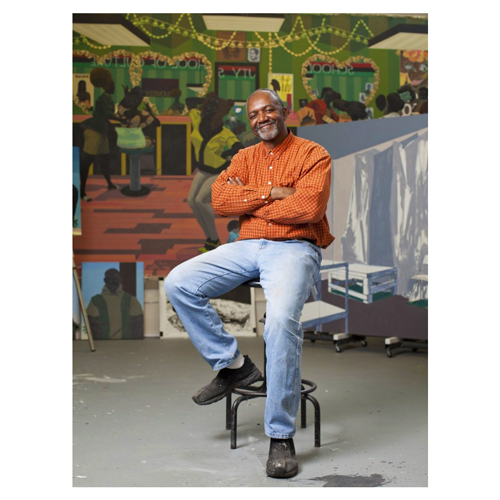
PAINTING THE TOWNS: Kerry James Marshall Set For Major Three-City Retrospective


Text | Hedy Weiss for The Chicago Sun-Times
Published | January 24, 2016


In many ways, Chicago-based artist Kerry James Marshall has depicted the African American experience on canvas much as playwright August Wilson chronicled it for the theater. And beginning this spring, Marshall’s work will be seen in its first retrospective exhibition, “KJM: Mastry,” which will open at the Museum of Contemporary Art in Chicago (April 23 – Sept. 25, 2016), move on to New York’s Metropolitan Museum of Art (Oct. 25, 2016 – Jan. 29, 2017), and finally be on display at the Museum of Contemporary Art Los Angeles (March 21 – July 2, 2017).

Considered one of America’s greatest living painters, Marshall (who lives in Bronzeville with his wife, actress Cheryl Lynn Bruce) has worked at capturing the African-American experience for more than three decades, creating large-scale interiors, landscapes, and portraits that suggest narratives of African-American history from slave ships to contemporary culture. In the process, he has drawn on his deep knowledge of art history – from the Renaissance to 20th-century abstraction, making such additional sources as the comic book and the muralist tradition part of the mix. The result is a wide range of intimate scenes of black middle-class life, painted in vibrant color and with detailed patterning.

The exhibition, which will include about 70 works, will focus on Marshall’s paintings – from his seminal statement in “Portrait of the Artist as a Shadow of His Former Self” (1980), to his most recent explorations of African-American history. Organized in broadly chronological order, the exhibition will consider the dominant themes in his work: History painting, landscape, portraiture, the nude, religion, and abstraction. A selection of drawings, and works of related media such as photography, video, and sculpture, also will be on view.

Read complete article here


Friday, March 20, 2015

NEW YORK: Alma Thomas

Alma Thomas, Rainbow, 1978, Acrylic on canvasboard, 18 x 24 inches. Image via michaelrosenfeldart.com.
Alma Thomas: Moving Heaven & Earth, Paintings and Works on Paper, 1958-1978
March 20 - May 16, 2015

100 Eleventh Avenue (@19th Street)
New York, NY

From michaelrosenfeld.com:

Michael Rosenfeld Gallery is pleased to present Alma Thomas: Moving Heaven & Earth, Paintings and Works on Paper, 1958-1978, an exhibition of over forty exuberant paintings, drawings, and watercolors. This exhibition will be the gallery’s second show dedicated exclusively to Thomas’s work. The first, Alma Thomas: Phantasmagoria, Major Paintings from the 1970s (2001), traveled to the Women’s Museum in Dallas, Texas. The current exhibition will be accompanied by a fully illustrated color catalogue featuring a newly transcribed and previously unpublished oral history interview with the artist.

Michael Rosenfeld Gallery has long been a champion of Alma Thomas’s work. In addition to the 2001 solo exhibition, the gallery has featured her work in several major group exhibitions, including Stroke! Beauford Delaney, Norman Lewis, Alma Thomas (2005), African American Art: 200 Years (2008), Abstract Expressionism: Reloading the Canon (2011), and Beyond the Spectrum, Abstraction in African American Art, 1950-1975 (2014). The gallery has also successfully placed her paintings in the permanent collections of such institutions as the Philadelphia Museum of Art and Crystal Bridges Museum of Art in Bentonville, Arkansas as well as many private collections.

Alma Thomas: Moving Heaven & Earth focuses on the last two decades of Thomas’s life, which were also the first two decades of her career as an artist. Late to commit to producing art full-time, Thomas nevertheless quickly developed an original and dynamic style characterized by large-scale abstractions comprised of rhythmic, repeated marks of vibrant color. The monumental canvases Thomas became celebrated for in the 1960s and 1970s were informed by the Washington Color School, which included Morris Louis, Sam Gilliam, and Kenneth Noland. However, her interest in color experimentation also aligned her closely to Josef Albers, Johannes Itten, and Wassily Kandinsky.

Inspired by nature, recent discoveries in the sciences, and her observations of earthly and celestial phenomena, Thomas’s work was devoid of overt political content. Her dedication to abstraction reflected a belief shared by painter Norman Lewis that modern art at its best could transcend political and historical concerns. But also like Lewis, although Thomas chose to eschew explicitly political content, she remained actively committed to social justice and equality. In addition to her involvement with Artists for CORE (Congress of Racial Equality), Thomas continued to organize art programs and teach art classes to local Washington, DC youth throughout her life. In 1972, Thomas became the first African American woman to be given a solo exhibition at the Whitney Museum of Art, New York. That same year, the Corcoran Gallery (Washington, DC) also mounted Alma W. Thomas: A Retrospective. In 1975, Howard University honored her with its Alumni of Achievement Award in recognition of her importance to the history of art as well as to the local African American communities touched by her considerable talent as an artist and teacher.

Thomas was celebrated for her undeniable talent during her lifetime, and her work has continued to be exhibited throughout the country and met with enthusiastic praise. In her 2001 review of Phantasmagoria, NY Times art critic Grace Glueck wrote, “with each new showing, Thomas's paintings look fresher and livelier, their totally abstract vocabulary of color markings conveying the spirit of a vibrant inner life . . . Laid down in irregular allover patterns on solid grounds that show through in webs and networks, her late works are sophisticated color structures that still reveal a debt to the natural world. Joy may be in short supply elsewhere, but it resonates in these paintings.” The joy that resounds in Thomas’s visual chants of color will continue to reverberate as part of her legacy. A woman whose career as an artist began at age sixty-seven and rose quickly to great heights, Alma Thomas still soars, decades after her death in 1978.

Long after Alma Thomas: Moving Heaven & Earth, the spotlight will remain on Alma Thomas. The Tang Teaching Museum and Art Gallery at Skidmore College and The Studio Museum in Harlem are co-organizing a retrospective of the work of Alma Thomas that will open February 2016 at the Tang and be on view at the Studio Museum in summer 2016.  Additional traveling venues to be announced.  The exhibition is curated by Ian Berry, Dayton Director of the Tang Museum and Lauren Haynes, Associate Curator, Permanent Collection at the Studio Museum.  A major catalogue will accompany the exhibition with extensive images and new essays on Thomas's important work and influential legacy.


Sunday, November 9, 2014

WASHINGTON DC: Hale Woodruff

Hale Woodruff, The Repatriation of the Freed Captives, 1939, Oil on canvas. Collection of Savery Library, Talladega College, Talladega, Alabama / National Museum of African American History and Culture. Image via si.edu.
Rising Up: Hale Woodruff’s Murals at Talladega College
November 7, 2014 – March 1, 2015

1400 Constitution Ave, NW
Washington, DC

From Smithsonian Institute press release:

Talladega College in Alabama commissioned prominent African American artist Hale Woodruff to paint a series of murals for its newly built Savery Library in 1938. Woodruff painted six murals portraying significant events in the journey of African Americans from slavery to freedom.

This will be the first time the murals have been exhibited in the Washington metro area. The murals were removed from Talladega College for a five-year collaborative restoration project organized by the High Museum of Art in Atlanta, which also organized a multicity tour of the works.

The murals are six monumental canvases arranged in two cycles of three, portraying heroic efforts of resistance to slavery and moments in the history of Talladega College, which opened in 1867 to serve the educational needs of a new population of freed slaves. The first cycle includes the murals “The Mutiny on the Amistad,” which depicts the uprising on the slave ship La Amistad; “The Trial of the Amistad Captives,” depicting the court proceedings that followed the mutiny; and “The Repatriation of the Freed Captives,” portraying the subsequent freedom and return to Africa of the Amistad captives.

The companion murals “The Underground Railroad,” “The Building of Savery Library” and “Opening Day at Talladega College” show themes of the Underground Railroad, the construction of Savery Library at Talladega College and the early days of the college campus, for which the murals were commissioned, respectively.

“We are pleased to have this once-in-a-lifetime opportunity to present these impressive murals and other works by Hale Woodruff on the National Mall,” said Lonnie Bunch, director of NMAAHC. “Woodruff was an important figure in art history and the paintings depict, in a vibrant and dynamic fashion, events in African American history. We are grateful to the High Museum and Talladega College for making this exhibition possible.”  

Hale Aspacio Woodruff (1900–1980) was born in Cairo, Ill. He studied art at the John Herron Art Institute in Indianapolis and the Fogg Museum of Harvard University. Woodruff contributed to the development of African American art, not only as an artist, but also as a distinguished arts educator.

Woodruff’s first mural project was in collaboration with Wilmer Jennings in 1934. The four-panel mural, titled “The Negro in Modern American Life: Agriculture and Rural Life; Literature, Music, and Art,” was part of a public works project and a teaching project that involved both Woodruff’s students and a local junior high school. In 1935, Woodruff worked on Works Progress Administration murals for the Atlanta School of Social Work.

Between 1931 and 1946, Woodruff served as the first chair of the newly established art department of Atlanta University. During the summer of 1936, he studied mural painting in Mexico under the mentorship of Diego Rivera. In 1946, he became a teacher at New York University, where he taught art for more than 20 years until his retirement in 1968. During the mid-1960s Woodruff and fellow artist Romare Bearden were instrumental in starting the Spiral Group, a collaboration of African American artists working in New York. The Studio Museum in Harlem presented a retrospective of his work titled “Hale Woodruff: 50 Years of His Art” in 1979. The exhibition “Hale Woodruff, Nancy Elizabeth Prophet, and the Academy” was at the Atlanta-based Spelman College Museum of Fine Art in 2007.

“Rising Up: Hale Woodruff’s Murals at Talladega College” is presented by the Smithsonian’s National Museum of African American History and Culture and is organized by the High Museum of Art in collaboration with Talladega College. The exhibition is co-curated by Jacquelyn Serwer, chief curator at NMAAHC, and Rhea Combs, museum curator. A full-color, 155-page catalog, published by the High Museum of Art, will be on sale in the National Museum of American History’s store during the exhibition.

The National Museum of African American History and Culture was established in 2003 by an Act of Congress, making it the 19th Smithsonian Institution museum. Scheduled for completion in 2015, it is under construction on the National Mall in Washington, D.C., on a five-acre tract adjacent to the Washington Monument.


Thursday, November 6, 2014

LA JOLLA: Jack Whitten

Jack Whitten Garden In Bessemer , 1980, Acrylic on Canvas, 58 x 52 inches.
Image via mcasd.org, courtesy the artist, Alexander Gray Associates, New York; Zeno X Gallery, Antwerp.
Jack Whitten: Five Decades of Painting
September 20, 2014 – January 4, 2015

700 Prospect Street
La Jolla, CA

From mcasd.org:

For five decades, Jack Whitten (b. 1939, Bessemer, AL) has kept time through his innovative studio process. In his canvases, he explores the possibilities of paint, the role of the artist, and the allure of material essence. As a child of the segregated south, he bears witness to expressions of evil and the resilience of the human spirit. As a diligent formalist, Whitten explores and exploits the newest acrylic and dry pigment media, the register of the image, and the edge of the canvas. As the New York artist, schooled in the sixties and maturing in the seventies, he balances on the fulcrum of the century that was and the century to come. He is an artist of his moment due precisely to his respect for the past and commitment to the present. Whitten creates in the moment in order to harness the essence of matter. From his first spectral canvases, as a graphic trace of a haunted soul, to his recent "Apps for Obama," a key for complex, contemporary life, Whitten’s poetic and physically compelling compositions capture what is needed, what is left, what is remembered, and what is next. Jack Whitten: Five Decades of Painting surveys this enduring artist’s career with approximately 60 canvasses from the mid-1960s to the present.

Jack Whitten: Five Decades of Painting is organized by the Museum of Contemporary Art San Diego and made possible by generous lead underwriting support from Dr. Paul Jacobs, and presenting corporate sponsorship from RBC Wealth Management. Additional funding has been provided by The Andy Warhol Foundation for the Visual Arts, the National Endowment for the Arts, and proceeds from the 2014 Biennial Art Auction. Institutional support of MCASD is provided by the City of San Diego Commission for Arts and Culture and the County of San Diego Community Enhancement Fund.


Friday, October 24, 2014

NEW YORK: Chris Ofili

Image via newmuseum.org.
Chris Ofili: Night and Day
October 29, 2014 – February 1, 2015

Also on view:

A look at Chris Ofili’s engagement with dance
October 22, 2014 – February 1, 2015

235 Bowery
New York, NY

From newmuseum.org:

The New Museum presents the first major solo museum exhibition in the United States of the work of artist Chris Ofili. The exhibition is curated by Massimiliano Gioni, Artistic Director, Gary Carrion-Murayari, Kraus Family Curator, and Margot Norton, Assistant Curator. Occupying the Museum’s three main galleries, “Chris Ofili: Night and Day” will span the artist’s influential career, encompassing his paintings, drawings, and sculptures. Over the past two decades, Ofili has become identified with vibrant, meticulously executed, elaborate artworks that meld figuration, abstraction, and decoration. In his extremely diverse oeuvre, Ofili has taken imagery and inspiration from such disparate, history-spanning sources as the Bible, hip-hop music, Zimbabwean cave paintings, Blaxploitation films, and William Blake’s poems. As the title of the exhibition suggests, Ofili’s practice has undergone constant changes, moving from boldly expressive to deeply introspective across an experimental and prodigious body of work. The exhibition will feature over thirty of Ofili’s major paintings, a vast quantity of drawings, and a selection of sculptures from over the course of his twenty-year career.

Ofili’s early paintings from the ’90s were created using his signature layering of materials, including paint, resin, glitter, and elephant dung, and a diverse combination of iconography. The exhibition will bring together more than twelve of his canvases from this period, which combine spectacularly rendered psychedelic surfaces with provocative imagery from a staggering array of cultural sources, from religious icons to Blaxploitation films. From this early period, Ofili established an approach to painting that is both seductive and rigorously historical. After moving to Trinidad from London in 2005, Ofili’s work took a new direction and prompted “The Blue Rider” series, which takes its name from the early twentieth-century artist group that sought spirituality by connecting visual art with music. Since then, Ofili has gone on to create a number of large blue paintings. For this exhibition, nine of these works will be brought together for the first time in an architectural environment designed by the artist. Composed in dark hues of blue, this series of paintings evokes the blue light of twilight and the soulfulness of blues music. Although rooted in the landscape and culture of Trinidad, Ofili’s blue paintings extend beyond to offer a contemplative approach to history, identity, and ways of seeing.

His most recent canvases have been animated by exotic characters, outlandish landscapes, and folkloric myths that resonate with references to the paintings of Henri Matisse and Paul Gauguin. This exhibition will also include a selection of paintings from Ofili’s “Metamorphoses” series. These brightly colored canvases were inspired by the poem of the same name by Ovid and illustrate the ancient Roman author’s stories of gods and humans, including the tale of the goddess Diana and the hunter Actaeon. They were initially created at the invitation of the National Gallery of London in response to their own series of paintings of Diana and Actaeon by Titian from the mid-sixteenth century. Ofili’s paintings offer a unique interpretation of both the original text and its painted interpretations, opening up the ancient myths to new, contemporary readings. These works will be displayed in a dreamlike, painted environment inspired by British filmmakers Michael Powell and Emeric Pressburger’s 1947 film Black Narcissus.

Ofili’s hybrid juxtapositions of high and low, and of the sacred and the profane, simultaneously celebrate and call into question the power of images and their ability to address fundamental questions of representation. Through a series of unexpected connections between his most important bodies of work, Ofili’s exhibition at the New Museum will reflect the vast breadth of his practice.

“Chris Ofili: Night and Day” will be accompanied by a fully illustrated catalogue featuring contributions from the exhibition’s curator, Massimiliano Gioni, as well as art historian Robert Storr, lawyer and journalist Matthew Ryder, National Gallery of London curator Minna Moore Ede, and fellow artists Glenn Ligon and Lynette Yiadom-Boakye.

Chris Ofili was born in Manchester, England, in 1968, and currently lives and works in Port of Spain, Trinidad. He received his BFA from the Chelsea School of Art in 1991 and his MFA from the Royal College of Art in 1993. Solo exhibitions of his work have been presented internationally, including recent shows at the Arts Club of Chicago (2010); Tate Britain, London (2010 and 2005); kestnergesellschaft, Hannover (2006); and the Studio Museum in Harlem, New York (2005). He represented Britain in the 50th Venice Biennale in 2003 and won the Turner Prize in 1998. His works are held in the permanent collections of a number of museums, including the British Museum, London; the Carnegie Museum of Art, Pittsburgh; the Museum of Contemporary Art, Los Angeles; the Museum of Modern Art, New York; Tate, London; the Victoria and Albert Museum, London; and the Walker Art Center, Minneapolis.


Friday, October 3, 2014

NEW YORK: Ernest Cole


Ernest Cole Photographer
September 3 – December 6, 2014

Goundbreaking work by one of South Africa’s earliest and most important anti-apartheid photographers

New York University
100 Washington Square East
New York, NY

From Grey Art Gallery press release:

New York University’s Grey Art Gallery presents Ernest Cole Photographer, comprising 125 gelatin silver prints—at once wrenching, subtle, and poetic—by one of South Africa’s first and greatest black photojournalists. Ernest Cole Photographer is the first solo museum exhibition of Cole’s photography. The rare black-and-white prints in the exhibition have been drawn from Cole’s stunning archive—now in the care of Gothenburg’s Hasselblad Foundation, which organized the show. 

Through multiple series of incendiary photographs, Cole (1940–1990) created a cogent, harrowing portrait of black life during apartheid. Yet despite their power and historic importance, the works have received little attention since 1967, when Cole’s groundbreaking book, House of Bondage, was published, with an introduction by Joseph Lelyveld. Ernest Cole Photographer presents the images along with astute captions, bearing stark witness to the wide spectrum of human experience as black people were forced to negotiate every aspect of their lives during the apartheid era.

Grey Art Gallery Director Lynn Gumpert notes, “Ernest Cole not only documented life in South Africa but also pushed for radical change. Through his trenchant critiques of institutionalized segregation and his celebrations of human resilience, Cole challenged the status quo, and his work continues to speak incisively to contemporary issues of inequity and poverty, in the United States and the world over. By exposing the evils of apartheid in images captured at the front lines, the exhibition constitutes both a body of evidence and a moral reckoning.”

Exhibition catalogue:
Ernest Cole Photographer is accompanied by a fully illustrated 264-page catalogue with tritone images and three essays exploring Cole’s life and work. In “Ernest Cole in the House of Bondage,” Cole’s friend, fellow photographer, and studio mate Struan Robertson locates Cole’s life in the context of apartheid, detailing his artistic drive and intelligence amid extremely difficult life circumstances; in “A Slight Small Youngster with an Enormous Rosary: Ernest Cole’s Documentation of Apartheid,” South African journalist and art critic Ivor Powell explores Cole’s biography and artistic achievements; and in “Notes on the Life of Ernest Cole (1940–1990),” Gunilla Knape traces Cole’s trajectory from his boyhood through his professional triumphs and struggles. Published by Steidl and the Hasselblad Foundation, the catalogue also includes technical notes on Cole’s archive and a selected bibliography. The catalogue is available through the Grey Art Gallery for $55.00.


Read full press release here.


Monday, September 15, 2014

COLLEGE PARK: Robert Blackburn


Passages
September 18 – December 19, 2014

FIRST RETROSPECTIVE OF ARTIST AND MASTER PRINTMAKER

Opening reception with special guests Faith Ringgold and Mel Edwards: Thursday, September 18, 2014, 5-7pm

1207 Cole Student Activities Building
University of Maryland,
College Park, MD

Driskell Center press release:

The David C. Driskell Center at the University of Maryland is pleased to organize the first comprehensive retrospective exhibition of influential artist and master printmaker Robert Hamilton Blackburn (1920-2003): Robert Blackburn: Passages. The exhibition is curated by Dr. Deborah Cullen, Director & Chief Curator, The Miriam & Ira D. Wallach Art Gallery, Columbia University in the City of New York; with contributions by Prof. Curlee R. Holton, Executive Director, David C. Driskell Center.

Robert Blackburn: Passages features about 90 works by Blackburn and 10 by his contemporaries such as Charles Alston, Will Barnet, Grace Hartigan, Robin Holder, and Norman Lewis. Passages will include works on loan from the Library of Congress, the Elizabeth Foundation for the Arts’ Robert Blackburn Printmaking Workshop, The Cochran Collection, The Nelson/Dunks Collection, and Metropolitan Transit Authority Arts for Transit and Urban Design, and others, and will be on display at the Driskell Center from September 18th through December 19th 2014. The exhibition will start its national tour on January 2015 and will travel thereafter.

A retrospective of Blackburn is long overdue. A “printmaker’s printmaker,” Blackburn affected the course of twentieth-century graphic through his own work, as well as through the institution which he founded in New York City in 1948, The Printmaking Workshop—the oldest and largest print workshop in the United States until 2001. Blackburn’s “passages” through the modern and contemporary print world are complex and unique, and he is a bridge between the Works Project Administration (WPA) and the “print explosion” of the 1960s.

In conjunction with the exhibition, the Driskell Center will also publish an exhibition catalogue which will be the first significant monograph of Robert Blackburn’s work. The catalogue will include color reproductions of each work in the exhibition, as well as essays by Prof. Curlee R. Holton and curator Dr. Deborah Cullen, whose monographic text is an excerpt from her dissertation, “Robert Blackburn: American Printmaker,” 2002 (The Graduate Center of the City University of New York). The catalogue will be available for purchase at the Driskell Center and on the Center’s website for $35.

In addition, the Driskell C. Center and the Arts Program at the University of Maryland University College will host a symposium, “Robert Blackburn and the Modernist Movement in Prints,” on Friday and Saturday, October 24th and 25th. The symposium will be held at the University of Maryland University College, College Park Marriott Hotel & Conference Center, Adelphi, MD. Both the symposium and exhibition Robert Blackburn: Passages look at Blackburn’s work within the context of American modernism. The symposium will open with a reception at the David C. Driskell Center on Friday, October 24th, from 5:30p.m. - 7p.m. The Symposium’s sessions on Saturday, October 25th, include: “Is it a Good Print, or Not?”; “Blackburn as an Artist/Printmaker and his Contemporaries”; and “Blackburn and Modernism.” Presenters at the symposium include Judith Brodie, curator and head, department of modern prints and drawings, National Gallery of Art; Prof. Curlee R. Holton, Executive Director, David C. Driskell Center; Dr. Deborah Cullen, Director and Chief Curator, Miriam & Ira D. Wallach Art Gallery, Columbia University; Katherine Blood, Curator of Fine Prints & Poster, Prints & Photographs Division, Library of Congress; Phil Sanders, Director, Robert Blackburn Printmaking Workshop; Prof. Joshua Shannon, Associate Professor, Contemporary Art History & Theory at the Department of Art History and Archaeology at the University of Maryland; and Prof. David C. Driskell, artist and Distinguished University Professor Emeritus of Art at University of Maryland, College Park. The symposium will conclude with a reception for the exhibition Maryland Printmakers: Printmaking in a Modern Society at the University of Maryland University College’s Arts Program (at the same location as the symposium). Additional information about the symposium and registration will be made available at driskellcenter.umd.edu.

ABOUT ROBERT BLACKBURN
Trained through the nexus of arts organizations in Harlem during the 1930s, Blackburn learned lithography at the WPA’s Harlem Community Art Center. He attended The Art Students’ League in the early 1940s, where he met Will Barnet, who would become his teacher and longtime friend. He moved downtown, and by 1948, bought his own press to initiate a collaborative atelier in his loft. Blackburn traveled to Paris and throughout Europe in 1953-1954 on a John Hay Whitney Traveling Fellowship, while his workshop was run by friends. Upon his return, Blackburn was hired as the first master printer of Universal Limited Art Editions (ULAE) in West Islip, Long Island, where he printed its first seventy-nine editions for Helen Frankenthaler, Grace Hartigan, Jasper Johns, Robert Motherwell, Robert Rauschenberg, Larry Rivers, and others. His fluency and technical mastery of complex, abstract, color lithography contributed to forging the well-known ULAE expression that instigated the “graphics boom” of the 1960s. Blackburn returned full-time to his own shop, and in 1971 incorporated it as a not-for-profit organization. He continued to work on a series of experimental woodcuts as well as investigative intaglio and monotype, traveled, and did residencies and commissions including designing mosaics for a New York subway station in the year before his death. Blackburn received a John D. and Catherine T. MacArthur Foundation Fellowship in 1992 and a Lee Krasner Award from the Pollock-Krasner Foundation in 2000.

Blackburn produced an experimental and intimate body of work, primarily in lithography and woodcut that reveled in rich color, explored ideas of edition and variation, and experimented with abstraction at a time when black artists were expected to use figuration. The artist’s graphics have been exhibited internationally and are represented in numerous public and private collections.