Showing posts with label Jack Whitten. Show all posts

Thursday, November 6, 2014

LA JOLLA: Jack Whitten

Jack Whitten Garden In Bessemer , 1980, Acrylic on Canvas, 58 x 52 inches.
Image via mcasd.org, courtesy the artist, Alexander Gray Associates, New York; Zeno X Gallery, Antwerp.
Jack Whitten: Five Decades of Painting
September 20, 2014 – January 4, 2015

700 Prospect Street
La Jolla, CA

From mcasd.org:

For five decades, Jack Whitten (b. 1939, Bessemer, AL) has kept time through his innovative studio process. In his canvases, he explores the possibilities of paint, the role of the artist, and the allure of material essence. As a child of the segregated south, he bears witness to expressions of evil and the resilience of the human spirit. As a diligent formalist, Whitten explores and exploits the newest acrylic and dry pigment media, the register of the image, and the edge of the canvas. As the New York artist, schooled in the sixties and maturing in the seventies, he balances on the fulcrum of the century that was and the century to come. He is an artist of his moment due precisely to his respect for the past and commitment to the present. Whitten creates in the moment in order to harness the essence of matter. From his first spectral canvases, as a graphic trace of a haunted soul, to his recent "Apps for Obama," a key for complex, contemporary life, Whitten’s poetic and physically compelling compositions capture what is needed, what is left, what is remembered, and what is next. Jack Whitten: Five Decades of Painting surveys this enduring artist’s career with approximately 60 canvasses from the mid-1960s to the present.

Jack Whitten: Five Decades of Painting is organized by the Museum of Contemporary Art San Diego and made possible by generous lead underwriting support from Dr. Paul Jacobs, and presenting corporate sponsorship from RBC Wealth Management. Additional funding has been provided by The Andy Warhol Foundation for the Visual Arts, the National Endowment for the Arts, and proceeds from the 2014 Biennial Art Auction. Institutional support of MCASD is provided by the City of San Diego Commission for Arts and Culture and the County of San Diego Community Enhancement Fund.


Friday, October 4, 2013

IN PRINT: Jack Whitten / Modern Painters / September 2013

INTERVIEW BY SCOTT INDRISEK
PHOTO BY KRISTINE LARSEN

Though he’s been making work since the 1960s, Jack Whitten is in the midst of a well-deserved renaissance. His pivotal experiments in process-driven abstraction were revisited in a major show on view through March at the SCAD Museum of Art, in Savannah, and also included in “NYC:1993” at the New Museum this past spring. This month new paintings go on view at New York’s Alexander Gray Associates, and pieces from 1971 to 1973 will be shown at Brandeis University’s Rose Art Museum from September 17. In 2014, the Museum of Contemporary Art in San Diego will give Whitten his first major retrospective. Scott Indrisek met with the artist at his studio in Sunnyside, Queens, to talk about his experimentations with paint.

Excerpt:

How do you work with paint as collage, exactly?
 
Collage has been sort of the keystone of modernist thought. With Picasso, with Matisse. What I have done is remove the paint from the canvas, which makes it physical. I can pick it up and hold it in my hand, I can cut it and I can reapply it. This is the essence of the notion of making a painting as opposed to painting a painting.
 
Can we talk a bit about your rather unique technical process?
 
I make these strips of acrylic beforehand, all in different shapes. And then when I put the strips into the wet field of paint, they relax. It’s very conceptual. Everything comes together with the last step. This is not an overlay, that’s an inlay; it’s inlaid into a field of wet acrylic, and when that happens, you get a strange spatial juxtaposition. For painting, that’s a new space. I first saw a glimpse of that space in the ‘70s, and I’ve been chasing it ever since. But now I’ve chased it up to point where I can force it into a corner.

To read complete interview pick up a copy of the September 2013 issue of Modern Painters on newsstands now or read online here.


Wednesday, August 28, 2013

NEW YORK: Jack Whitten

Image via alexandergray.com. 
September 11 - October 12, 2013

Opening reception: Wednesday, September 11, 2013, 6-8pm

508 West 26th Street #215
New York, NY

From the Alexander Gray Associates web site:

Alexander Gray Associates is pleased to present an exhibition featuring new paintings by Jack Whitten, accompanied by a fully-illustrated catalog. The presentation highlights the most recent evolution of process in Whitten’s nearly 50-year career dedicated to abstraction, manipulation, and subversion of traditional painting practices.

Scale, context, and history play equally integral roles in the group of paintings on view. With its alluring, slick black surface, the sprawling Remote Control (2013) is both seductive and intimidating, alluding to the appeal and threat of technology. In the massive Crushed Grid (2013), Whitten reinvents the modernist grid by immersing a distorted net of acrylic ribbons in thick layers of undulating paint. The varied effects of his material experimentation add a sense of tension, depth, and motion; the result is an array of illusory surface textures that seem solid and aerated, dense and viscous yet fluid.

The memorial and homage paintings in the exhibition further exemplify Whitten’s innovative consideration of painting as object. Elements of three-dimensionality are applied to the canvas, such as the acrylic molds in Nine Cosmic CDs: For The Firespitter (Jayne Cortez) (2013). The radiant energy captured by Whitten’s vivid palette provides insight into the fierce personality and artistic achievements of the late poet who inspired the painting.

About his recent work Whitten states, “I like the idea that people are suspended while asking questions about process. I like the idea that the viewer might be frozen by wonder. I have developed many conceptual and technical approaches over the past 50 years, and now, all I’m doing is going back into my toolbox and using them. I am dealing with the evolution of painting, Western abstract painting in particular. In this way, evolution is the symbol I am trying to capture. That’s why each work is so different, it is still in the act of evolving.”

Concurrent with the exhibition at Alexander Gray Associates, Jack Whitten: Light Years 1971–1973 is on view at the Rose Art Museum at Brandeis University September 17–December 22, 2013. Whitten’s painting, 9-11-01, is featured in The Encyclopedic Palace at the 55th Venice Biennale through November 24, 2013. Whitten will also be featured in the renowned traveling exhibition Blues for Smoke at the Wexner Center for the Arts September 21, 2013–January 5, 2014, as well as the Gallery’s Art Basel Miami Beach 2013 presentation. Whitten’s work will be the subject of an upcoming retrospective at the Museum of Contemporary Art, San Diego in 2014.


Wednesday, February 22, 2012

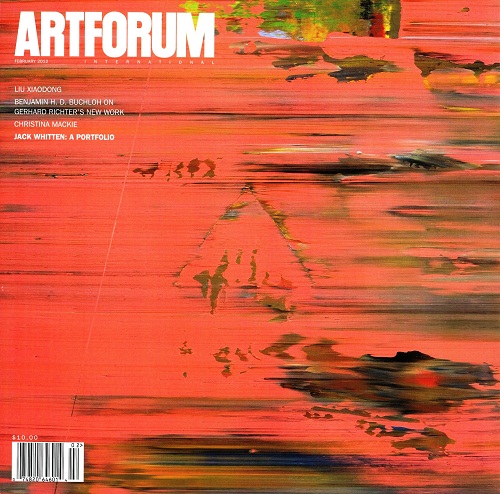
COVER: Jack Whitten / Artforum / February 2012

Jack Whitten, Pink Psyche Queen (detail), 1973, acrylic on canvas, 71 x 60".

ARTIST'S PORTFOLIO: JACK WHITTEN
Michelle Kuo, introduction

Excerpt:

When does an image end? At the edge of the screen, we might say, or of the stretcher or the page. But none of these answers has ever seemed to satisfy Jack Whitten. His work eludes the perimeters we know. It conjures something else: infinite extension, scanning, even searching.
The modernist grid, of course, implied such extension: its vertical and horizontal lines always iterable, potentially continuing beyond the limits of a given picture, as if that picture had merely zoomed in on a larger array. Beginning in the 1960s, though, Whitten came to understand that other kinds of movement were possible too -- ones the grid could not map -- and he began to introduce techniques of imaging that were often the first of their kind.

Pick up a copy of Artforum's February 2012 issue to read complete text and view more of Jack Whitten's work.