“FIVE” is a special feature at BlackArtistNews where five questions are posed to an individual artist, curator, gallerist, collector or art lover. Why five questions? Well, there are five fingers on each hand and artists create with their hands hence one, two, three, four, FIVE.
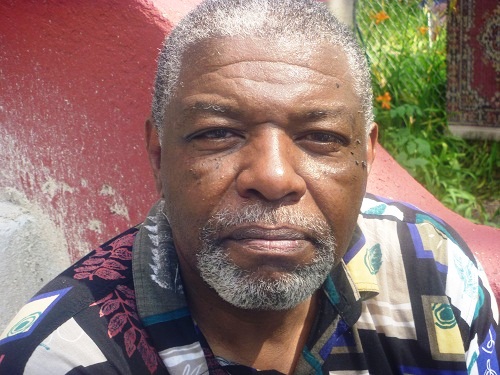 |
| James V. Allen. BlackArtistNews photo. All rights reserved. |
In July 2011 the BlackArtistNews RECAP Fear No Art Location chronicled personal events experienced on the way to an opening reception for James V. Allen at a Chicago-based organization called the Urban Art Retreat. The artist kindly agreed to an interview and spoke candidly about his life and practice: he confessed to being emotionally challenged and added that art is a stablizing component that enables him to lead a balanced and productive life. Currently, Allen’s work is included in Chicago Black Artists Art Networks a group exhibit showing Saturdays October 1 – November 12, 2011 at the Urban Art Retreat. If you ever doubted the transformational power of art, you will change your mind after reading this edition of “FIVE”:
Are you from Chicago?
I originally came from Los Angeles, California. Came here ten, almost eleven years ago. I used to come annually to visit my sister. And then she got cancer, breast cancer and ten years ago she passed on. And instead of going home, I stuck around; I wanted to be close to my nephew. I also… I’ve always appreciated that Chicago is very much an art town. And then of course after she died I went into depression. I suffer from bi-polar, manic depression and all that stuff. And I went to a center to get therapy and medicine.
Here in Chicago?
Here in Chicago. It’s over in Lawndale. (Note: Lawndale is a west side neighborhood in Chicago.) That’s where I started painting again. You know along with the therapy and medication I started to come out of the depression. And after about five years I was not only going to the place I was teaching a few art classes.
Where?
At this place called Lawndale Mental Health Center it’s on Campbell and Roosevelt. Recently I’ve been filling in for Dianna [C. Long, Director of Urban Art Retreat] over at this place called the Sacred Heart. I go there on Thursdays and I teach an art class over there. For mentally disturbed people an art class is really just allowing them to come in and do what they want to do. So since I’ve been here at the Urban Art Retreat I’ve been working with Dianna. Last year we did After School Matters [where] we taught [teenagers] how to paint. That was good. Last year she helped me get my first show going.
Where was that?
This was at a restaurant which ceases to exist right now. She’s also helped me with some of the technical aspects of art; teaching me things but of course I’m still like a lot of people in the Art Retreat still suffering from depression. And [being] bi-polar [means] you are either up and/or frustrated or you are down and you just disappear.
When looking at the faces in your work I could tell that they were coming out of some sort of melancholic state.
There you go. I did dark, depressing work while I was in the institution until the director began to object [Laughs] and now I’m feeling a lot better. I’m trying to put more light into it. Of course my subject matter is always going to stay a little serious – it’s all about prison and slavery and a lot of other things.
Did you draw as a kid?
As a kid I was pretty much struggling with Attention Deficit Disorder during a time when they didn’t even know what it was. So I only got good grades in Art and History [Laughs] everything else I completely failed but I always drew. I used to spent hours on the table – my father was a building contractor and he had these tables where he used to put his plans and I would start I say about three o’clock in the afternoon and the sun would be coming out and I’d still be drawing.
In hindsight, do you think that intense concentration was part of the disorder or do you think it was just because you were passionate?
Part of art for any individual with emotional problems is therapeutic, okay. Just like if you don’t know how to meditate, but you know how to sit down and draw something, you can get the same satisfaction [just like] from meditation. Being able to express yourself that way. So yeah, I was pretty much a lonely kid [and] right about when I was maybe three, four I was molested in Los Angeles so that changed my life completely. I never told anybody what happened but I knew something was wrong with me and it just compounded with everything else. So when I was very young my father, who was sort of a progressive black man, recognized that maybe I needed some help. And I can recall lying to the therapist about everything. I didn’t want him to know what was really wrong with me.
But you eventually told the truth or it came out…
It came out after I was grown, fifty years old and over at the Lawndale place – I tried to kill myself. And I began to go to classes and take medication and I began to see that you can manage – you can’t cure these diseases – but you can manage it. So when I was very young my father took me to [art] exhibits and [I] can recall thinking that this would be a good job for a person to grow old doing. [Laughs] Because physicality always leaves but you can still – even though I have heart problems – I’m pretty much not limited with the art I can create. Next thing I’m going to do is get me some glasses. [Laughs] Who knows what’s going to happen once I can see!
So you create the faces in your work out of your imagination.
That’s all it is. When I came here, I was still working with some photographs. But Dianna she said, you should just work from [your imagination.]
Sounds like she really pushed you. In a good way.
Oh, yeah. It always happens that people like me with those kind of problems need to [be pushed.] That’s why we’re trying to build a retreat. That’s because we want a place… over the years teaching a lot of classes I’ve experienced that people who are extremely disturbed they still are capable of expressing themselves. And many of them… I’ve told many of them that this work… that you can sell this work. If they can teach an elephant to paint then I know that you guys can be out there making money. So we’re trying to make the retreat a place where everybody can come. We’d like to have a gallery for the work, you know what I’m sayin’? And I’d have mine in there too! [Laughs] Because I [really] feel a kinship to these people. So that’s pretty much where we are now. We’re trying to expand the work, expand the place. I’m hoping next year to have a much larger place.
Do you play some sort of administrative role with the Urban Art Retreat?
In the process of coming here and having exhibits here they elected me to the board of directors. That sounds good but that means I have a lot more things to do. [Laughs]
That’s a lot of work! That’s a lot of work! [Laughs]
But it's all good. It’s something good, you know. I think that one of the problems I used to have was the guilt of spending all [my] time being an artist while the world goes to hell. Here’s a place where you can actually make the world a better place.
Does art matter?
Oh, absolutely, man. If we don’t have something in this world that is totally positive then man is left with being a soldier, a killer of children, an exploiter, okay? And [for] civilization really that’s the most positive thing we have going. Outside of the humanitarian things that do exist unfortunately though this system is so committed to exploitation until the humanitarians cannot solve these problems.
But as a commodity artworks do get exploited too.
Yes, they get exploited too, but I’m just sayin’ from the standpoint of what art is, what it really means to people that enjoy it, and what it could mean to people that don’t understand it.
I understand.
I think that everybody should understand that this is one of the best things that human beings have created. From the beginning of time they were in there with a purpose: imagine a cave person with a torch at night trying to get this image down you know what I’m sayin’?
 |
| James V. Allen with his work at the Urban Art Retreat. Photo via UrbanArtRetreat.com |

