Showing posts with label Review. Show all posts

Wednesday, October 15, 2014

CHEERS: Kerry James Marshall Delivers A Stunner at Zwirner Gallery in London

Kerry James Marshall, Untitled (Rapunzel), 2014, Acrylic on PVC panel, 24 x 30 inches. Image via davidzwirner.com 
Text | Andrew Russeth for ARTNews.com
Published | October 13, 2014


Just how good is Kerry James Marshall’s show at David Zwirner in London’s Mayfair district? So good that the second I left today I began plotting the next time that I could sneak out of the Frieze Art Fair this week to give it another view. Plenty of shows open here in the coming days, and there are plenty more that I have yet to see, but so far Marshall’s seems like the most exciting one in town. People are talking about it.
Titled “Look See,” this is his first solo appearance in London since 2005, and his first show with Zwirner. He has delivered a knockout. Fifty-nine on Friday, he has hung 14 new paintings, most of solitary people, who are posing for a screen, or for themselves, or even for you. The mood is intimate, erotic, and occasionally voyeuristic. They may make you uncomfortable—like you are peering in on a private moment—but you will not want to look away.
These are formidable, alluring objects, painted on thick PVC panels. Their surfaces are flat, but the brushstrokes, patterning, and color they contain are luscious. The subject of Untitled (Sofa Girl) (all works 2014), for instance, reclines alone on Daniel Buren-striped fabric, cloaked in a deep-blue-purple-black darkness, remote in hand, watching a television set that is just out of view, but which casts a slight glow over room. She has short hair, a facial expression that is a rare mixture of exhausted, amazed, and dazed—the face of insomnia-induced TV binges (a rare sight in art, but one you have felt)—and an adorable, very sleepy cat. It is an incredible painting, complex but immediate.
Read complete story here.

Tuesday, April 2, 2013

MIAMI: Robert Pruitt

Robert Pruitt, Fear of Black Planets, image via GeneralAudiencePresents.com.
Houston Artist’s Sci-Fi Take on Black Culture Comes to North Miami
Published: Thursday, April 4, 2013
Robert Pruitt grew up surrounded by the dead. His bedroom was in the same building as his family's business — Jimmie Pruitt & Sons Funeral Home — but instead of focusing on the morbid, Pruitt became obsessed with comic books.
"We lived in the funeral home until I was about 9," Pruitt says. "I was pretty much into the arts early on and loved Marvel Comics. My favorite characters to draw were Spider-Man, the X-Men, and the Fantastic Four."
Given that history, perhaps it's no surprise that the Houston-based artist's work now walks a fine line between the dark and the comic, from an M-16 rifle made of rainbow bubblegum to a man with a face-obscuring hoodie and a halo of pistols.
Pruitt, whose work references African and African-American traditions while exploring the contradictions of modern black culture, makes his South Florida solo debut this month at North Miami's General Audience Presents, a new alternative space located across the street from the Museum of Contemporary Art.
"His work is very fresh and has not received that much exposure in Miami," says Lissette Garcia, the show's curator. "Robert's work deals with concepts of Afro-futurism, Afro-centricity, architectural tropes, and black popular culture in a very intelligent and powerful way."
Pruitt grew up in Houston's Fourth Ward, where his family's mortuary served mostly the area's large black community. Although Pruitt's elementary school friends were afraid to play at his house, his unusual upbringing didn't faze him. "I got what my family was doing, so I wasn't disturbed."
Instead, he concentrated on his drawing. After high school, he went to Texas Southern University, where he met artists Dawolu Jabari Anderson, Jamal Cyrus, and Kenya F. Evans. In 2002 they founded a conceptual collaborative called Otabenga Jones & Associates. The group — which takes its name from Ota Benga, an African Pygmy brought to the United States in 1904 and exhibited in zoos — has drawn acclaim and headlines.
They earned a spot in the Whitney Biennial in 2006 and have agitated for social justice in Houston, presenting an overturned police car recalling the riots and resistance movements of the 1960s, and protesting an African-art show at the Museum of Fine Arts in Houston with signs reading "My Blacknuss Is Bigger Than Your White Box" to decry the white collector's choice of works.
"You can say we explore alternative histories in African and black culture to investigate solutions that might have existed then but even now can effect change," the 37-year-old artist says.
If all of that sounds heavy, Pruitt's work on display in North Miami is anything but. His solo show, Fun With Your New Head, takes its title from a sci-fi tome by Thomas M. Disch and depicts many of the artist's Houston friends in stunning portraits surrounded by symbols from ancient history and pop culture.

His Conté-crayon-and-charcoal drawings on hand-dyed paper convey the complexity of black identity through imagery of elements as disparate as sci-fi, hip-hop, comics, and past African-American political struggles.
"I'm influenced by Sun Ra, fashion imagery from contemporary culture, historical and old colonial portraits and photos, ethnographic imagery, and scientific and anthropological studies," Pruitt says.
In Fear of Black Planets, for example, Pruitt portrays his colleague, Houston-based artist Nathaniel Donnett, with what appears to be a spherical cage encasing his clean-shaven pate. Donnett gazes directly at the viewer through the bizarre metal enclosure while wearing jeans and the type of T-shirt students at historically black colleges might sport at a football game. But instead of the word Morehouse or Spellman across the front, it reads, "Sankore." 

"Sankore is an ancient university in Africa," Pruitt explains. "It was founded by an Islamic woman centuries ago, and they taught the higher sciences including geometry and mathematics." The cage-looking helmet, meanwhile, references Buckminster Fuller's geodesic dome.

In another work, singer Natasha Turner appears bored or lost in deep thought as she rests her cheek in the palm of her hand. Pruitt depicts his musician friend with a soaring Afro shaped like an Egyptian pyramid, suggesting that the woman clad in a sleeveless orange blouse is groaning under the burden of ancient history.
At General Audience's show, Pruitt's unusual process for preparing the surfaces of paper is also on display. "Before creating the drawings, I submerge the paper in a wooden tank I made and lined with plastic," he explains. "To get the background effect, I hand-dye the paper in a fabric dye or tea wash for a few hours before removing them from the liquid and plastering them directly on a wall in my studio to dry."
Pruitt has a talent for producing visual puns freighted with historical and psychological heft. Take that bubblegum assault rifle, which he says evokes "the violence in American society and its childlike obsession with guns," or his sculpture of a Molotov cocktail made from a Mrs. Butterworth's pancake syrup bottle to convey how pop-cultural depictions of aggression feed violent cycles.
Pruitt's show gives the impression the ancestral spirits that haunted the halls of his family's funeral home walk hand in hand with his coterie of friends and loved ones lining the gallery walls. "It's often a bit about African history and the community I live in and the paths crossing between them that inspire me," he says.
Robert Pruitt: Fun With Your New Head
March 21, 2013 – April 27, 2013
GENERAL AUDIENCE PRESENTS
769 NE 125th Street, North Miami, FL


Friday, June 3, 2011

EXHIBIT REVIEW: Gary Simmons - Shine / Aesthetica Magazine Blog / April 13, 2011

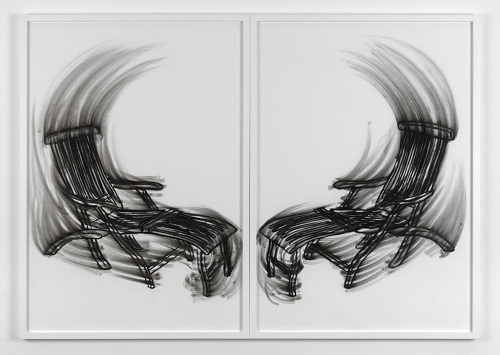
Gary Simmons, Twins, 2011, Pastel on paper. 2 parts
Each: 106.68 x 76.20 cm. / 42 x 30 in.
Overall: 152.40 x 106.68 cm. / 60 x 42 in.

Concepts of Memory and Time: Gary Simmons, Simon Lee Gallery, London

Review by Sarah Richter for Aesthetica Magazine Blog

Haven’t we all wondered if antiques, places and objects from the past contain stories, memories of what has occurred and been seen. American artist Gary Simmons examines these same issues, confronting them in a most unconventional way. His second solo show, Shine, currently on exhibit at the Simon Lee Gallery draws its inspiration from Stanley Kubrick’s unforgettable 1980 horror film The Shining.

The over sized images take their cue from memorable motifs and moments from the film, such as tricycle in Big Wheel Spiral and the infamous quote, “All work and no play makes Jack a dull boy” in The Diamond and Full Page. In addition to drawing inspiration from this American film classic, Simmons takes inspiration from the structure of the Bryce Hospital in Alabama. This hospital served as an institution for African Americans who were considered insane and unfit for a place in contemporary society in the early... [read the full article at Aesthetica Magazine].

Sarah Richter is a candidate for the MA in Art History at Richmond the American International University in London.

Tuesday, May 24, 2011

EXHIBIT REVIEW: "Embodied: Black Identities" / NY Times / May 20, 2011

Show for Black Artists (Even Those Disliking Label)

  Note: Press release and catalogue purchase links were added to this blog on 05/25/11.
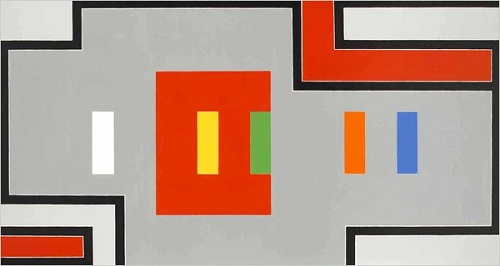
DEFINING HUE An exhibition of black artists' works includes “Piano-Forte,” top left, oil on linen by Felrath Hines from 1988.

By MARTHA SCHWENDENER

Some of the knottiest issues in “Embodied: Black Identities in American Art From the Yale University Art Gallery” don’t reveal themselves at the entrance to the show. Instead, they appear later, like in the “Viewer’s Note” on the wall next to Adrian Piper’s photographs from the 1971 series “Food for the Spirit.”

Mounted next to three black-and-white photographs of the artist standing before a mirror, the short statement says that Ms. Piper’s “critique of identity politics and desire to distance herself from being categorized as a ‘black artist’ ” led her to refuse reproduction rights for the work to appear in the exhibition catalog. However, the work has been included in the exhibition anyway to “highlight the urgency” of issues around art and racial identity.

Artists are regularly included in exhibitions dedicated to aesthetic movements or curatorial conceits they don’t agree with. It’s just that “Embodied: Black Identities” deals with a category — race — that historically defined one’s status, not just as an artist, but as a human being in this country.

As it is, the exhibition is a small statement rather than a big one. Drawn from Yale’s collection and organized by graduate and undergraduate students from Yale and the University of Maryland, where the show appeared last fall, it comprises mostly modest works: lots of prints and a few photographs, bolstered by the paintings of Kerry James Marshall, Barkley L. Hendricks and others. It feels like a testing ground for young scholars trying on some ideas central to recent art, as well as the critical jargon. Works are grouped into three categories that look at the “performance of race through art and artifice”; the “absent or dematerialized body”; and “displacement” and its effect on “shared histories, cultural geography and national identity.”

Embodied: Black Identities in American Art from the Yale University Art Gallery
February 18–June 26, 2011

A collaboration among a team of students from Yale and the University of Maryland, College Park, Embodied: Black Identities in American Art from the Yale University Art Gallery features works that address, question, and complicate the paradigms that have mapped meanings onto African American bodies throughout history. The 54 works selected for the exhibition, representing the Gallery’s commitment during the past decade to growing this area of the collection, include paintings, sculpture, decorative arts, prints, drawings, and photographs. The exhibition is accompanied by a fully illustrated catalogue.

Exhibition and publication organized by Yale University and University of Maryland students, under the direction of Pamela Franks, Deputy Director for Collections and Education, Yale University Art Gallery, and Robert E. Steele, M.P.H. 1971, M.S. 1974, Ph.D. 1975, Executive Director, David C. Driskell Center, University of Maryland, College Park. Made possible by by Lois Chazen; Laura M. and James A. Duncan, B.A 1975; Mr. and Mrs. Elliott L. Schlang, B.A. 1956; Francis H. Williams; the Jane and Gerald Katcher Fund for Education; the Nolen-Bradley Family Fund; the Florence B. Selden Fund; and the John F. Wieland, Jr., B.A. 1988, Fund for Student Exhibitions.

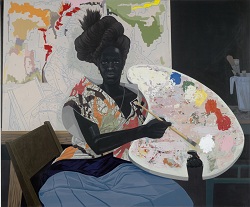
Image: Kerry James Marshall, Untitled, 2009. Acrylic on PVC. Yale University Art Gallery, Purchased with the Janet and Simeon Braguin Fund and a gift from Jacqueline L. Bradley, B.A. 1979. © Courtesy of the artist and Jack Shainman Gallery, New York